Full House Reading Challenge – So You’ve Been Publicly Shamed – Jon Ronson

full-house-challenge-2017-final

Genre: Non-Fiction, Psychology, Culture

Narrative Style; First person, journalistic

Rating: 4/5

Format: Paperbackunknown

Published: 2015

Synopsis: The story starts with Ronson discovering a Spambot posting as himself on twitter. He uses the righteous indignation of the Internet to get it taken down. He then begins to look at the phenomenon of online shaming. This leads him to talk to some of the people who have suffered badly at the hands of the Internet – Justine Sacco, Adria Richards and Lindsey Stone, for example – and discusses the best ways to survive shame. 

Reading Challenge – Full House Reading Challenge – Genre Non-Fiction

I was interested in this book for two reasons – the first was Ronson himself, an always enjoyable writer who tackles interesting subjects, the second was the subject matter. It has been with increasing distaste and disappointment I have watched such shaming unfold online. Unlike Ronson, I have never taken part. It is particularly disgusting to see the way the comments go when women are the object in question. No one deserves to be told they should be raped and abused. It is horrific.

Ronson first gets involved in the subject of online shaming when he uses the power of the Internet to get some researchers to take down the spambot they had made in his name. The comments turned nasty and Ronson won. They took down the spambot. Ronson cites early examples of the shaming of corporations into treating their customers better or newspapers being slapped on the wrist for printing homophobic or sexist stories. This was a new phenomenon and Ronson decided to investigate.

There is a difference between shaming corporations and shaming individuals although the basic impulse may be the same. (Ronson suggests that people think they are doing good in both situations.) This is what unfolds in the rest of the book as Ronson speaks to Justine Sacco (she of the I can’t get AIDS, I’m white tweet), Jonah Lehrer (who made up quotes in his books), Lindsey Stone (who mocked the sign for silence and respect at Arlington National Cemetry, to name but a few. Most of them were guilty of stupidity at most. Lehrer was more difficult to sympathise with but even then, you couldn’t help feeling that no one should have to read what people posted on the live twitter feed while he was trying to apologise. It is certainly true that a stupid tweet or photo should not still be impacting your life a year later.

Ronson also looks for solutions and ways to survive. He discusses the role of shame in a prison environment, visits a workshop for Radical Honesty and discusses the historical origins of shaming. All of which is very interesting and told in Ronson’s trademark style. However, what he can’t offer is any sort of solution or ways to avoid being shamed. And it certainly seems like this is something that is here to stay. In the Afterword, Ronson describes being accused of being racist for supporting Justine Sacco and of being a misogynist because of a misjudged comment about rape. His final advice is to the reader is to make sure that they don’t stay silent if they think that someone is being shamed, get involved and stand up for them. Empathy is the solution to shame. And it is true that we can’t leave the Internet to the trolls and lowlifes who would say that they would see someone raped or murdered because they made an ill-judged decision.

Full House Reading Challenge Sign Up Post

full-house-challenge-2017-final

I wasn’t sure whether I was going to do any reading challenges this year. I certainly felt like I wanted a change from the ones I have done for the last few years. With this in mind, I have decided to do the Full House Challenge which is hosted by The Book Date. There are twenty-five categories and I have an idea what I’m going to read for about half of them.

Instructions are as follows:

Challenge will run from Jan 1st to December 31st 2017
Write and publish a post stating your intention to participate. In the post please include the Challenge graphic and a link back to this post. Then link your intention post at the bottom of this post. Make sure it is the actual post and not just a generic link to your blog.
Add your reviews back here on the link in this post. At the end of every three months, there will be a U.S. $12 prize with a book of your choice from the Book Depository or U.S. Amazon voucher, for the entries. There will be a new linky then for the next quarter and so on to the end of December.

Here is the grid with the categories….

full-house-challenge-2017-grid

Here are the ideas I have so far:

Non-Fiction – So You’ve Been Publically Shamed – Jon Ronson

On TBR for more than 2 years – The Heart is a Lonely Hunter – Carson McCuthers

More than 500 pages – War and Peace – Tolstoy

Page Turner – The Falls – Ian Rankin

Published Pre-2000 – Catch 22 – Joseph Heller

European Author – The Immoralist – Andre Gide

Award Winner – Troubles – J. G. Farrell (Lost Booker Prize Winner)

Size word in the title – Big Brother – Lionel Shriver

Two worded title – American Gods – Neil Gaiman

Book from childhood – Little Women – Louisa May Alcott

USA / Canadian – Gilead – Marilynne Robinson

Not For Me – Gateway to Fourline – Pam Brondos

Debut Book – The Short Drop – Matthew Fitzsimmons

Aussie / NZ author Breath -Tim Winton

Food on cover or in title – Love, Lies and Lemon Cake – Sue Watson

Diversity – The Vegetarian – Han Kang

Book from a list – Room – Emma Donahue

Cozy Mystery – The Mysterious Affair at Styles – Agatha Christie

Published 2017 – All the Little Children – Jo Furniss 

Middle-Grade Book – Swallows and Amazons – Arthur Ransome

Borrowed – Life Class – Pat Barker

Book About Books – The Sadeian Woman – Angela Carter

Attractive Cover – The Bone Clocks – David Mitchell

Western – No Country for Old Men – Cormac McCarthy


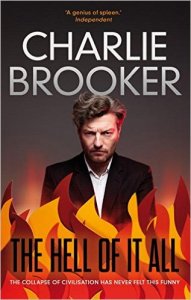
Non-Fiction Challenge – The Hell Of It All – Charlie Brooker

2016 Nonfiction Challenge

Genre: Cultural Comment, Journalism, Humour

Narrative Style: First person opinion pieces

Rating: 5/5

Format: Kindle51i2ihfnmml-_sx315_bo1204203200_

Published: 2009

Synopsis: A collection of Brooker’s columns for The Guardian. Subject matter ranges from Celebrity Big Brother to The State of Gordon Brown to Holidays to The Apprentice. Filled with Brooker’s trademark snarky ire. 

Reading Challenges: Non-fiction Challenge

I probably ought to admit that I bought this book because it was cheap for Kindle and I didn’t investigate any further than that. I’m rather fond of Brooker’s grumpy brand of pessimism so I was quite excited by its cheap price. However, it transpires that it was from 2008-9 so it was a little weird to be reading about things from that long ago. Still, it didn’t stop it from being enjoyable although I did sometimes wonder if I’d been asleep throughout that time as I couldn’t remember everything that he was talking about.

It also felt a little surreal. There are columns here on the vacuity of celebrity culture, on the horribleness of politicians, on the racism of the BNP, the global financial meltdown, and the way people over-react to everything. Reading it from the vantage point of 2016, it felt like these were our halcyon days. If Brooker was this angry then, his head must explode every time he switches on the news these days.

There are many laugh out loud moments such as when he suggests that breathing is the only hobby he is likely to be able to cope with or when he describes the woeful attempts of crisp manufacturers to delight us with new flavours or his opinion on nightclubs (he doesn’t like them much, in case you wondered).Or when he describes his lazy attitude to household tasks which leads him to have to live by the light of his fridge when he fails to buy lightbulbs. As my husband and I are currently down to two out of four lights in the kitchen and are involved in a protracted game of lightbulb chicken, this definitely resonated.

Like reading Owen Jones’ Chavs, it is always good to remember that there are journalists who I can agree with and who give voice to the things that trouble me. Especially at times like these.


Eclectic Reader Challenge 2016 – Behind Closed Doors – B. A. Paris

2016eclecticreader_bookdout

Genre: Thriller, Debut Author 2016

Narrative Style: First person, chapters divided between past and present.

Rating: 2/5

Published: 2016unknown-2

Format: Paperback

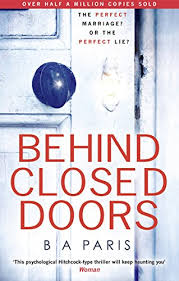
Synopsis: Grace and Jack Angel seem to have a perfect life. They are newly-weds who can barely stand to be apart from each other. Jack is a renowned lawyer who works with battered women and is chivalrous almost to a fault. However, behind closed doors, the story is completely different. 

Reading Challenges: Eclectic Reader Challenge 2016 – Debut author in 2016

I don’t tend to read books as soon as they come out unless they are by an author I already like and even then, there are only a few I would dash out and buy straight away (Margaret Atwood and Julian Barnes are two that spring to mind). As a result, I didn’t have much of an idea who to read for this genre. I decided to look at the Goodreads awards for debut authors. Behind Closed Doors looked interesting and it had quite a lot of four and five star reviews so I decided to give it a go.

I have to say I was disappointed. Although if I’d realised that it was published by an offshoot of Harlequin, I’d have known that I wouldn’t like it. I’d also have realised that it wasn’t going to be very challenging. All of the ‘twists’ were signposted so clearly that there was very little suspense and the characters were so flat it was impossible to care whether they lived or not.

What is most troubling about this novel is the archaic sexual politics. It reminded me of an essay Iread when I was at university by Joanna Russ called ‘Someone’s trying to kill me and I think it’s my Husband‘ which is about the modern gothic, books she describes as being in the tradition of Rebecca. There is a heroine in peril with a husband who appears charming but may, in fact, be a killer. This seemed an old-fashioned trope to me and one I could not get to grips with.

Part of the problem is that there is no ambiguity. We know that Jack is evil before we even start to read. It says on the back cover that Grace is a prisoner. There is no ‘is he isn’t he’ about this. The only tension exists in wondering exactly how much of a psycho Jack is. Quite a big one, it turns out.

Still, it was hard to care. Grace has no personality of her own but is merely a foil to Jack’s great evil. I found it difficult to cope with a novel that so squarely placed man as aggressor and woman as victim. There was a little interest in seeing exactly how she would escape – because escape she would, that was equally apparent – and that was the only thing that kept me reading.


Chavs: The Demonisation of the Working Classes by Owen Jones

2016eclecticreader_bookdout2016 Nonfiction Challenge

Genre: Journalism, politics

Narrative Style: Academic

Rating: 5/5unknown-1

Format:paperback

Published: 2011

Synopsis: Jones investigates where our current image of the working classes as layabout, trouble making chavs has come from. He analyses political decisions made by Thatcher, New Labour and the current Tories as well as analysing newspaper headlines and shows such as Little Britain.

Reading Challenges: Non-Fiction Challenge, Eclectic Reader Challenge – Genre Investigative Journalism

When it comes up in conversation, I tend to say that I come from a working class background rather than I am working class. There are two reasons for this. First of all, I now have a lot of the trappings of a middle class life. I’m a teacher, I live in suburbia, I read the Guardian and have a veg box delivered and people are keen to point that out. I don’t really believe that class is something that you shrug off the minute that you start to earn more money. Just like if you are upper class and you lose all your money, you are still upper class, you just have no money. It makes more sense when you think about it that way round but it is just as true of working class people who have climbed up the ladder a little bit.

The other reason is less pleasant. I want to disassociate myself from the popular image of the working class chav. I want to say I’m working class like it was perceived 30 years ago when I was growing up rather than working class as it is perceived now. Having read Owen Jones’ book, I feel more than a little ashamed of myself.

It’s not that the things that Jones discusses were news  to me and it’s not like I’m supportive of measures to cut benefits but it is easy to forget that there are genuine reasons and real people behind the stereotypes.

Jones outlines the systematic destruction of working class culture by first, Thatcherism, then New Labour and finally, the Tories again. It is easy to see how this program of cultural demolition has pushed many of the working classes into the open arms of the far right. The role that Labour used to play in many working class communities has left the ideal space for the BNP and UKIP. Cleverly, the BNP have started to play a community role in some of these areas, organising events and dealing with problems.

As Jones points out, the demonisation of the working classes has allowed this Government the most almighty get out clause. It has allowed them to avoid dealing with tax evasion, instead focusing the public’s eye on the much smaller problem of benefit fraud. It paints working class people as lazy and shiftless rather than deal with the fact that there aren’t enough jobs and a lot of the jobs there are are insecure. Focusing working class minds on the problem of immigration has allowed them to avoid putting in place legislation which would stop businesses being able to pay lower wages to immigrants. The list goes on, each item more deplorable than the last.

It is very easy to see why immigration is seen as such a big problem in working class communities. Of course, it would be easy to dismiss this as racism but as Jones points out, this is a far more complex problem than that. Immigrants who are willing to work for a low wage – but probably higher than they were earning at home – drag the entire job market down. Similarly, immigrants are less concerned about having permanent contracts so jobs become more insecure. It is in this atmosphere that parties such as the BNP and UKIP thrive, playing ruthlessly as they do on these insecurities.

Jones describes an experience he had while knocking on doors during the run up to the 2010 election. He describes what seems like a normal working class conversation about immigration except that the woman was Asian. I had a similar experience more recently in the run up to the Brexit referendum. Pupils were very keen to share their opinions (or their parents’ opinions, I suppose.) One Asian pupil was particularly vocal about how we should leave so we could get rid of all the immigrants. There was no point in saying that at some point, somewhere in his family history, they must have emigrated to this country. At the time, I was annoyed with him, I must admit. It seemed unfair that he should wish to stop the very process that had at some stage brought his family to this country. Having read, Jones’ book, I feel like I understand a little more. It is to do with feeling threatened and insecure and that is the motivating factor for the working classes and the issue of immigration, not racism.

After reading this, it is easy to see why so many working class people voted for Brexit. At the mercy of right wing politicians who made promises they could not keep and abandoned by mainstream politics, it is little wonder so many voted to leave. It is the logical result of the systematic ruin of working class communities.

Jones is rightly angry and after reading this book, you will be too. It is frustrating to think that things are only going to get worse when we eventually leave Europe. Brexit will compound problems in working class communities without actually doing any of the things that it promised to do about immigration.

One thing is for sure, this idea that we are all middle class now or that class no longer exists is a big lie. It is unlikely to be challenged any time soon, as it is so helpful to the Government. I’m not sure what the answer to all this is. A stronger Labour party who were genuinely concerned about working class issues would be a start but until they can stop all the in-fighting, that doesn’t seem all that likely.

Eclectic Reader Challenge 2016: Queenbreaker: Perseverance – Catherine McCarran

2016eclecticreader_bookdout

Genre: Young Adult, Historical Fiction

Narrative Style: First person, chronological29117059

Published: 2016

Format: Kindle

Rating: 3/5

Synopsis: At the beginning of Anne Boleyn’s reign as queen, Mary Shelton is sent to court. She must learn to survive in a world of secrets, lies, and ambition. Will she get what she most desires – a good marriage – or will she fall victim to those around her who are fighting only for their own interests.

Challenges: Eclectic Reader Challenge – YA Historical Fiction

I have always had a bit of an interest in the Tudors since doing it for my A-Levels so a book about life at court under Anne Boleyn seemed like a good choice for this genre.

The novel is written from the point of view of Mary Shelton as she learns to navigate  her way through life at court. She is a country girl and is treated as such. She is unable to see through the lies of others and as such finds herself – more than once – in a situation that will bring shame on her family. This element of the novel is convincing as it captures what I imagine the intrigue at court would be like.

Mary herself was difficult to like and I found I watched dispassionately when she found herself on the wrong end of John De Vere’s lies. It was hard to feel sympathy for any of the characters or to care about their reasons for revenge. Maybe reading this as a younger person, I would have had more sympathy for Mary who was trying so hard to be one of the grown-ups. At least she had the excuse of actually being a teenager. The rest of them just behaved like spoiled children.

It was a little hard to keep on top of exactly who was double crossing who. A lot of the women had two names and I found it difficult to remember who was who and who was one whose side. Mary ends up with a finger in every major intrigue which seemed unlikely. Would a teenage girl, not aristocratic or from London really have become such a lynchpin?

Towards the end, it becomes clear that someone must rescue Mary from her plight (as there are two more books in the series) and I felt that removed some of the tension that there might have been. By that point, I just wanted the story to be over as it had become a little repetitive. I can’t imagine that I will read the next one.


The Non-Fiction Challenge – The God Delusion by Richard Dawkins

2016 Nonfiction Challenge

Genre: Non-Fiction, Philosophy, Science

Narrative Style: First person, scientific and philosophical discussion

Rating 4/5

Format: Paperback9781846570377

Published: 2006

Synopsis: Dawkins endeavours to explain where our need for religion comes from evolutionally and why he is so passionately against religion. He explores the morality of the bible in close detail as well as looking at the psychology of religion. 

It’s hard to know whether Richard Dawkins is better known as a biologist or as a religion hating atheist. As such, I was keen to read this work. I am familiar with Dawkins writing having read The Selfish Gene and The Greatest Show on Earth previously.

At the beginning of the book, Dawkins explained some of the reasons he is so against religion and his tone was almost preacherly as he called for atheists to band together in order to challenge religion’s privileged position in modern society. This tone, accompanied by Dawkins superior attitude towards anyone who believes, is what most people find difficult about Dawkins when he talks about religion. Indeed, I was a bit troubled by it myself. I don’t think it helps that religious people feel Dawkins looks down on them. Dawkins calls himself passionate and that is fine but it doesn’t mean that everyone has to agree with you. It seemed ironic that he should be asking atheists to band together – to form a religion as it were. There is a further reason why I think this will never happen. For me, and I am sure other atheists, part of the reason for not belonging to a religion has to do with not wanting to be a member of an organised group.

Thankfully, this polemic does not carry on throughout the whole book otherwise I think I would have stopped reading. Instead, Dawkins moved on to what he is good at – talking about science. He discusses how he feels that religion has developed in an evolutionary sense and what it might mean about humans psychologically that we seem to need a God figure. He also assesses whether we really do use the Bible as a guide to morality and finally what he feels to be the worse problems with religion. This is really interesting and as  I already consider myself an atheist so I could consider Dawkins evidence quite dispassionately.

Towards the end, Dawkins advocates stopping adults passing their religion on to their children an act he considers a form of child abuse. I have to admit that this made me a little uncomfortable. While I understand that children can suffer because of their parents’ beliefs, I feel that this would be a huge infringement of personal freedom and would probably be unenforceable anyway.

Ultimately Dawkins misunderstands the nature and strength of belief. After all, the whole point of having faith is that you have faith. All the reasoned arguments in the world are not going to change that. This would seem to be borne out by the reviews of this book on Goodreads which seem to be split along religious lines. If you believe, this book makes no difference. Personally, I don’t have an issue with religion in most of the ways I come across it. Most of the people I know who are religious are kind, loving and don’t feel the need to foist their religion on to others. Perhaps it is naive of me to separate this from the problems – war, homophobia, abortion doctor killing extremists – but that is how I feel. I don’tthink Dawkins would approve.

Eclectic Reader Challenge: Treasure Island – Robert Louis Stevenson

2016eclecticreader_bookdout

Genre: Adventure, Classics

Narrative Style: First person

Rating: 4/5

Published: 1883Treasure-Island

Format: Paperback

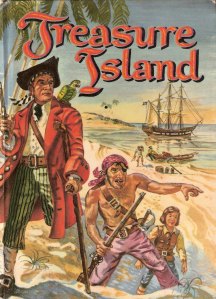
Synopsis: Jim Hawkins is tasked with telling the story of how he came into possession of a treasure map and then how he took to sea to get the treasure. He comes into contact with a host of exciting characters along the way – Long John Silver, Ben Gunn and Captain Flint to name but a few.

Reading Challenges: Eclectic Reader Challenge – Set on an Island. (I know that it isn’t entirely island set but the island is such a crucial part of the story, I decided to stick with it.)

When I mentioned that I was going to read this book, my husband was astonished that I hadn’t read it, as he had, as a child. I pointed out that Treasure Island wasn’t the sort of book that was bought for female children. I got Little Women, Anne of Green Gables and Black Beauty (a list confirmed when speaking to female friends who are my age). And then once I was buying books for myself, it retained some of its boyishness and I assumed for a long time that I wouldn’t like it.

This was not the case. This is a very enjoyable adventure story. I’m not sure, however, that I would have liked it aged 12 when I was reading Little Women. The single female character is Jim’s mother and she is barely in it. I’m not so in need of female companionship in a book now though.

The story itself is straightforward. Jim comes into possession of a treasure map and with the aid of Doctor Livesey, Squire Trelawney and Captain Smollet sets out to find the island and then the treasure. There are many bumps along the way but as this story is being told in hindsight, it is apparent Jim will survive. Not that this means there is no tension, there are plenty of moments when you wonder how Jim will escape but escape he does.

The best – and probably most famous – character is Long John Silver. He is superbly amoral, shifting allegiance so frequently, it is impossible to get a handle on him. He seems genuinely affectionate towards Jim but this may just be part of his ploy to avoid the rope. I like the fact that this is read by children and it isn’t just a straightforward morality tale.

I did find the ending a little bit disappointing but possibly only because I didn’t want it to be over. This is really good fun with an exciting plot and larger than life characters. Well worth anybody’s time.

The Non Fiction Challenge – Just Kids – Patti Smith

2016 Nonfiction Challenge

Genre: Autobiography / Memoir

Narrative Style: First personUnknown

Rating: 4/5

Published: 2010

Format: Paperback

Reading Challenges: The Non Fiction Challenge

Synopsis: Patti tells of her relationship with the artist Robert Mapplethorpe and their time in New York in the late sixties and early seventies, just before both of them became famous. 

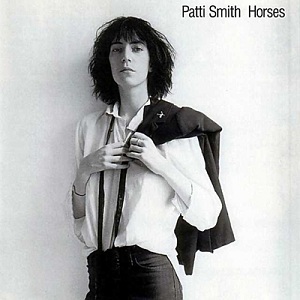
It is apt that I discovered Patti Smith and Robert Mapplethorpe together and to me they have always come as a pair. In 1992, my then boyfriend bought a copy of Horses (On vinyl, of course. That’s the sort of students we were.) and we rushed home to listen to it. The music blew me away. I had never heard anything like it. But I was also really taken with the photo of Patti on the front (taken by Mapplethorpe) which seemed to encapsulate something of the music. Patti was all PattiSmithHorsesmasculine elegance, a look I was trying – with less success – to pull of myself. (This was a time when I thought I was Jim Morrison and wandered around in outsize men’s shirts and leather trousers.) I quickly discovered it was by Robert and was soon as fascinated by his photography as I was by Patti’s music.

I knew a little of their relationship already, having read a biography of Patti Smith some years ago but it was interesting to hear it from the horse’s mouth, as it were. It isn’t just the relationship between Patti and Robert that is so interesting but also her description of the times which saw them mixing with Warhol and the members of The Factory and staying at the Chelsea Hotel to name but two things.

Of course, the whole thing is tinged with sadness. At the end, Patti says that Robert asked her to write the story of them and it had taken her until then to be strong enough to do it. (He died in 1989 and this was published in 2010) Her longing for Robert to still be alive is in every word of this and it seems apparent that she misses him still. When I was approaching the end, I found myself preparing for the horror of his death. My relationship with his work has always been tinged with sadness as by the time I discovered him, he was already dead and I was sad to think there would never be any new work from this amazing artist. It was an emotional end and not at all easy to read. You get a real sense of how difficult it must have been for Patti to carry on afterwards.


Eclectic Reader Challenge 2016: The Night Circus – Erin Morgenstern

2016eclecticreader_bookdout

Genre: Paranormal Romance, Magic Realism

Narrative Style: Third person from a variety of view points. Non-chronological

Rating: 5/5

Published: 2011Unknown-1

Format: Kindle

Reading Challenges: Eclectic Reader Challenge 2016 – Genre paranormal romance

Synopsis: Celia is trained by her father to take part in a mysterious magical competition. She is bound by the scar on her finger. She has no idea what the rules are or who her opponent will be. Marco is rescued from an orphanage by a strange man who trains him in the art of magic. He too has a scar. 

The Cirque de Reves appears in towns with no warning. It is the most amazing thing that people have ever seen. They go back night after night as there is always more to explore. Then the circus disappears just as suddenly. Could this be the playing field for two extraordinary young illusionists?

I was dreading this genre, conjuring up as it did images of vampires and ridiculously twee films. I’m not really a romance fan and the addition of some supernatural creature didn’t make it any more appealing. When I started to read The Night Circus, I didn’t realise that it would fit but it soon became apparent that this was a romance.

From the start, there is a magical atmosphere. Celia’s father is an entertainer, a magician who has to make his illusions less good so that the public think it is not real. His training of Celia is ruthless. He is determined to win the game and Celia is his pawn. Marco is trained in a different way but his trainer – the mysterious man in grey – is equally determined. The stage is set straightaway for a magical battle.

Admittedly, the pace is slow but I liked that. There was so much illusion, so much beautiful description that it would have been a shame to miss out on it. The circus is almost like another character in the book as it quickly takes on a life of its own. We learn of the different personalities and are given hints of future events. The act of reading this book was not unlike a visit to the circus. You want to take it slow so you can take in every detail.

The romance is equally slow burning. It takes a while for Marco and Celia to realise they are adversaries and then when they do, they are frightened by the intensity of feeling when they are together. Finally, they discover that the only way to end the game is for one of them to die. They realise they have to find a way to escape.

I did find the changing chronological sections a little confusing. I spent a lot of time looking back at chapters to see when they were set. However, I think that it worked. The importance of the character of Bailey becomes apparent and I realised why Morgenstern had structured it the way she had.

This was one of those books that I didn’t want to finish. It was so beautiful, I felt really sad leaving it behind. Still, it is good to think of the circus carrying on, appearing suddenly to charm people before disappearing into mystery again.