Full House Reading Challenge – All the Little Children – Jo Furniss (Contains spoilers)

Genre: Post-Apocalyptic, Published in 2017

Narrative Style: First person, chronological

Rating: 3/5

Format: Kindle

Published: 2017

Reading Challenge: Full House Reading Challenge – Genre – Published in 2017

Synopsis: Marlene and her sister in law take their children camping. However, they soon realise that something strange has happened to the rest of England. Dead bodies are piling up and there are no news broadcasts or electricity. It transpires that there has been a terrorist attack which has released a deadly virus. However, this will not be the only problem that they face when trying to get to safety.

This book is about motherhood. The post-apocalyptic, virus ridden setting is almost irrelevant. This is about Marlene learning to become a ‘good’ mother. It reminded me of films such as Jack & Sarah where the mother is sacrificed by the writer so that dad can learn to be a good father. Only this time the entire population of England was sacrificed for Marlene to learn her lesson.

Marlene was previously a workaholic who had little time to spend with her children. She has little fellow-feeling for her sister in law, Joni and her teenage daughter. Nor does she feel anything for a lost boy they pick up. A contrast is drawn between Joni, who is hippyish and maternal to the nth degree and Marlene who is cool and practical. These positions shift as Joni becomes withdrawn and unable to cope and Marlene has to take over.

This isn’t a bad book. The plot trots along at a nice pace. It does take a little bit of swallowing. The virus does its virulent job of killing everyone off but somehow they survive despite being near a number of dead bodies. The virus then disappears completely. This seemed unlikely to me although the author does try and explain that the virus used chemicals somehow and obviously once everyone was dead, there were very few of those left. Still, it didn’t quite hang right for me

Marlene and Joni were both annoying and both stereotypical. Neither really escaped from the character trap they were placed in. Marlene is supposed to have transformed at the end when she leaves her family in order to find Joni’s daughter but it just seemed like one more abandonment of them to me.

The ending of this novel is ripe for a sequel and I found that a bit annoying as it ends in the middle of the action and I wouldn’t really be tempted to read on. I would have preferred a bit more closure but I guess the point is that Marlene has learned her lesson about motherhood and so the novel can end. As I said at the beginning, this isn’t reallly a survival novel, more a story of how to become a better mother.


Full House Reading Challenge – Gilead – Marilynne Robinson

Genre: Family, Religion

Narrative Style: First person

Rating: 4/5

Published: 2004

Format: Paperback

Synopsis: John Ames is trying to write a memoir for his young son. Aware of the fact that he will die soon and will not have much time with his son, he tries to write down what he feels is important – about his family and about history. Ames is a preacher and there is a lot of ruminating about the nature of heaven and what happens when you die. 

Full House Reading Challenge: Genre – American / Canadian Writer

I inherited this book a few years ago from my husband’s aunt and it has sat on the shelf since then. I was aware of Robinson as an important female American writer but when I read the blurb on the back of Gilead, I wasn’t sure I would enjoy it. I’m not a particularly religious person and I wondered if it would be too spiritual for my tastes.

It turned out that this was true to a certain extent – it was the reason I didn’t give it five stars. However, there is much to love about this book. Robinson’s prose captures Ames’ voice exactly and I could almost hear him talking in my ear. It was like having an intimate conversation with an older relative.

The historical details – the story dates back to the civil war – were interesting and vividly painted. I was particularly touched by the description of son and father setting out to find the grave of Ames’ grandfather who walks away from Gilead. Father and grandfather did not see eye to eye as the older man was a radical abolitionist and often preached in a blood soaked shirt.

Ames is particularly affected by the arrival of his namesake, the son of his neighbour and friend. John Ames Boughton had left town in disgrace many years ago and Ames finds he is worried by his reappearance and struggles to respond when the younger man reaches out to him. He has a number of theological struggles but the main one is to try to forgive Boughton his sins which he finds increasingly difficult.

It would be impossible not to feel for Ames who has been lonely for most of his life after losing his first wife in childbirth and his baby daughter not long after. He is now married to a much younger woman and has a child but is dying and cannot bear the thought that soon he will be nothing but a memory.

There isn’t a lot in the way of action in this story. It is mostly about the struggles of an old man who is about to die. The slow reveal of Boughton’s true situation offers some suspense but really the novel is about spiritual matters and how best to live your life according to your beliefs. In the end, Ames is able to respond kindly to Boughton, giving an example to his young son of how to live and be thankful for what you have.

Full House Reading Challenge _ War and Peace – Leo Tolstoy

Genre: Classic, Russian Fiction, War

Narrative Style: Third person

Rating: 3/5

Published: 1869,

Format: Paperback

Synopsis: An epic tale of politics and private lives set during the Napoleonic Wars, War and Peace attempts to tell the history of Russia through looking at the progress of a group of citizens. The different perspectives and fortunes of the many characters are closely affected by the war. Balls and soirees are described in detail as well as councils of war and battles. 

Reading Challenges: Full House Reading Challenge – more than 500 pages.

Well, that was a long haul. I can’t remember the last time it took me quite so long to read a book. I always knew that it was going to take some time but five months is a lot of reading time. It wasn’t just the length either. There were times when I felt that I didn’t want to carry on reading and I would leave it lying for days before I made myself pick it up again.

There were a number of reasons for this. I always struggle a bit with classics. It is not my favourite genre and it is a question of making myself read them because I feel I should. At times, I felt bogged down in Tolstoy’s philisophical ideas about history and free will. Not to mention the incredibly detailed battles.

I enjoyed the drawing room and ball room scenes much more and was interested in the fates of the main characters – particularly Pierre and Natasha, both of whom were very well drawn and convincing. But there were far too many small characters that were absolutely impossible to keep track of. I felt as though I ought to be taking a note of everybody just in case I should meet them again.

It was a relief to be finished it. Especially as the second epilogue is purely Tolstoy’s thoughts on man’s free will which seemed to go round in circles and I’m sure could have been considerably shorter. Overall, I’m glad to have read it though I’m not sure I’d wholeheartedly reccommend it to anyone else.

Full House Challenge – Room by Emma Donaghue (Contains spoilers)

Genre: Psychological thriller

Narrative Style: First Person from the point of view of a child.

Rating: 4/5

Published: 2010

Format: Kindle

Synopsis: To Jack, Room is his whole world. He has never known anything else. The only human he knows is his ‘ma’ who also lives in Room. Ma tells Jack that nothing else exists apart from Room. Everything else is just TV and doesn’t really exist. The reader gathers that Ma has been kidnapped and Jack has been born in captivity. When Ma decides they need to escape from their prison, Jack has to learn all about the outside world really quickly.

Reading Challenges: Full House Challenge – Book on a list – Bestselling books of 2010. 

I didn’t read this at the time because I really didn’t want to read a book written from the point of view of a child. Some of my reservations were well founded. Although I did enjoy this book, it was hard going at times. If you can imagine a five-year-old constantly talking in your ear for hours at a time, then you can imagine what it is like to read this book. It was unrelenting.

The book is split into two parts. In the first half, we learn of Jack’s world and how his mother has tried to protect him from the truth of their captivity. Everything in Jack’s world is imbued with personality – from Rug to Wardrobe to Floor – and he doesn’t seem to ever feel bored or lonely.

There are a couple of problems with this. First of all, Jack is incredibly intelligent. He is precocious and his vocabulary is truly amazing. He knows things and songs that it seems unlikely he could have picked up even from all his hours of TV. Second of all, it seems unlikely that his mother could have managed to so successfully keep him away from their captor ‘Old Nick’. She makes demands of Old Nick that I feel stretch the reader’s disbelief. If she really had so much power, why was she still a captive?

This section also gives the reader a chance to get used to Jack’s narrative voice. Much has been made of how well Donaghue has captured a five-year-old’s voice. I’m not sure I agree. It certainly seems to fit with an adult’s idea of what it might be like inside a five-year-old’s head and that is probably why he seems so precocious and has such a good vocabulary. Also, it is too exact. Jack says the same things, the same way every time. I’m not sure that anyone’s thoughts are quite as exact as that.

I must admit that one of the things I found irritating about Jack’s voice was the lack of the definite article. I understand completely what Donaghue was trying to do and it was very clever but it made me cringe everytime it was missing.

The second half of the book documents the escape. This is another moment that does not ring true. Jack’s world is suddenly turned upside down when his mother explains her lies and persuades him to play dead. Old Nick happily drives off with him wrapped in a carpet – not even checking if the boy is dead or not.

However, once he has escaped and his mother is rescued, the book becomes interesting again as Jack and Ma adjust to life outside. Jack learns that there are more people in the world than he could have imagined He discovers stairs. Everything is too loud and too bright. His mother also has difficulty re-adjusting. This is definitely the most interesting part of the book.

While I did enjoy this book, I would probably recommend the film more. The main reason for this is we are able to see things from different perspectives and Jack’s voice wasn’t constantly in your ear. It would have been good to hear Ma’s voice for some of the book as I am sure her story would have been just as interesting as Jack’s.

Full House Reading Challenge – Love, Lies and Lemon Cake – Sue Watson

Genre: Romantic comedy

Narrative Style: First person chronological

Rating: 2/5

Published: 2014

Format: Kindle

Synopsis: Faye Dobson’s marriage has grown stale. She no longer has anything in common with her husband and she is bored with her life. She had had dreams once but now they all seem dead. When a new deli opens with a hunky Australian behind the counter, she realises something has to change.

Reading Challenges: Full House Reading Challenge – Genre – Food in title.

Okay, so I knew this might not be for me from the start. I was struggling to find a book with food in the title. All the obvious ones like Chocolat, for example, I’ve already read. There are a lot of rom-com sounding books with food in the title so I thought I’d give one a go. It’s good to read outside of your norm once in a while anyway.

So, the narrator of Watson’s novel is Faye Dobson. She is a bored housewife whose husband is a stereotypical pig who only cares about his plumbing. Her daughter is away at university and no longer needs her. She works in a hairdresser with an assortment of stereotypes and this is not fulfilling her. So far so typical. Everything in Faye’s life is a cliché. Which would be okay if she broke out of the mould and did something exciting.

Unfortunately, the trope of Antipodean hunk rescuing middle-aged frump is just a different sort of cliché. Dan is everything you’d hope he would be. Perfect on the eye, understanding, just longing for an older woman to be his mother substitute.

As you may be able to tell, I found this book rather irritating. It isn’t particularly badly written. In fact, it was one of the more enjoyable of this genre that I have read. It just wasn’t for me. I’m not going to deny my intellectual snobbiness. The main character was a hairdresser and her husband was a plumber. I really don’t think I was the target audience.

I think the thing that I found the most irritating was the fact that this was pure escapism. Faye leaves her husband in the most easy way possible and then we barely hear from him again. She is allowed unlimited time away from work to have her Mediterranean adventure with Dan. And when history repeats itself with her daughter, everything turns out rosy in the way that it didn’t for Faye. Real life has no place here.

It made me think about why I read. I wouldn’t say that escapism is very high on my list. I like to read about other people’s lives to find out about different times and places. This told me nothing that I didn’t already know.

Full House Reading Challenge – The Mysterious Affair at Styles – Agatha Christie

Genre: Cosy Mystery

Narrative Style: First Person

Rating: 3/5

Published: 1920

Format: Kindle

Synopsis: Just before her death by strychnine poisoning, Emily Inglethorp is heard arguing with someone.  It is assumed to be her husband. In fact, the case seems cut and dried at first. However, Hercule Poirot soon proves that this is not the case.

Reading Challenges: Full House Reading Challenge – Genre Cosy Mystery.

I have read some Agatha Christie before but it was a long time ago and the only thing I was sure of was that it wasn’t a Poirot book. I seem to remember enjoying it but I was certainly still at school, it was that long ago.

It wasn’t that I didn’t enjoy this book. There was some interest and intrigue. It was fun working out the mystery. But that was as far as it went.

The main problem was that it felt like all the mechanisms were on show. Maybe I am just too used to reading detective fiction but this one was definitely lacking in subtlety. It was just too pat. Poirot just happened to be in the area. Hastings was just a little too stupid. (And as he was presumably supposed to represent the reader, it was a little insulting.) The double bluff was a step too far with Poirot the only one clever enough to have figured it out.

As ever, I found it difficult to cope with people who are so incredibly posh. I did not feel particularly bothered about their fates. The main thing here was the mystery. The characters were almost incidental.

Finally, I suppose it was a little tame. I’m not suggesting that I need gore and horror, necessarily but I do prefer stories with a bit of meat to them. There was not a lot here to sink your teeth into.

Full House Reading Challenge: The Short Drop – Matthew Fitzsimmons (Contains Spoilers)

Genre: Thriller

Narrative Style: Third Person from various viewpoints.

Rating: 2/5

Published: 2015

Format: Kindle

Synopsis: Ten Years ago, senator’s daughter Suzanne Lombard disappeared. She has never been found. Gibson Vaughn, childhood friend of Suzanne is still finding her disappearance difficult to deal with so when he is approached by old nemesis, George Abe, who has a new lead, he is torn between wanting to find the truth and his dislike of Abe. When he agrees, he has no idea of the tangled web into which he will be pulled.

Reading Challenges: Full House Reading Challenge – Genre – Debut Novel. 

People really seem to like this book. There are barely any reviews on Goodreads that are less than 4 stars. I really don’t understand this as I found this book to be ordinary at best.

It started well. Gibson Vaughn was painted as a loner, a man haunted by his past and by Suzanne’s disappearance and that sounded interesting. The fact that he was being observed by a mysterious group that might be FBI added to the tension straightaway. Quickly Vaughn is pulled into an attempt at finding Suzanne’s abductor. So far so good: pacy, interesting characters, plenty of clues and insinuations.

However, for me it quickly went down hill. Various events stretched my willingness to suspend my disbelief to breaking point. It started when Jenn Charles and her ex-cop partner, following Abe’s orders, despatch some Guantanamo Bay style torture on the suspect they have captured. Then there is the psychopath Fred Tinsley, who is following the gang, waiting for the instruction to start bumping them off. And the security heavies Cold Harbour, who are controlled by Lombard’s father who is determined that nothing will spoil his presidential candidacy.

This just didn’t ring true for me. I must admit that I’m not overly familiar with the genre of political thriller but it just seemed a little too much. What had seemed fast paced and interesting at the beginning, began to feel like a rollercoaster gone off the rails.

On top of that, I saw all of the twists coming and that was annoying. The ending was unsatisfying. While Lombard resigns his candidacy, it seems like more should happen to him, that the terrible truth of what he has done should be revealed. Vaughn takes possession of Suzanne’s daughter without anyone so much as blinking and the girl herself is remarkably calm and unconcerned about what is going on.

Still, it seems I am in the minority. Most people love this book. Maybe it is just another genre that doesn’t really suit me.

Full House Reading Challenge – The Immoralist – Andre Gide

Genre: Classics, Translated Literature, Philosophical

Narrative Style: First person narrative 

Rating: 4/5

Format: Kindle

Published: 1902

Synopsis: Gide presents us with the confession of Michel, a man who seeks to live by his own desires. Having married to please his aged father, Michel soon discovers beauty in the shape of an Arab boy and is changed irrevocably. He starts to live by his own desires. He becomes restless and despite his wives ill health, travels constantly until at the end he arrives back at the place where he first discovered beauty. 

Reading Challenges: Full House Reading Challenge: European author.

This is not an easy read. Not because Michel abandons his wife and social convention to follow his own desires. In fact, it is still possible to like Michel even though he behaves badly towards Marceline. His questioning of moral constraints and his longing for a freedom that is meaningful mean that the reader is able to understand his behaviour.

The unease comes from Michel’s fascination with the male children that he meets. He sees the beauty in them and begins to spend all of his waking hours with them, leaving his wife to her own devices to be with them. The oldest of these children is 15. It is important to note that everything is innocent but still it makes for uncomfortable reading. Michel is fascinted by them and longs to follow his desires. So begins his journey towards becoming an immoralist.

Michel’s striving for freedom makes him restless and he cannot settle to anything, He becomes fascinated by the farm workers on his estate, with criminal lowlife and allows himself to become involved with poaching his own estate. Towards the end, he needs to keep moving, despite the fact that his wife is dying. This restlessness relates to his homosexuality which, in the end, he acknowledges with the last line of the novel when he says that he prefers the brother of the girl who has been looking after him. Earlier, he has the opportunity to take his freedom, through his friendship with Menalque but instead stays with his wife, who is representative of all  that society expects from Michel.

Whilst feeling uncomfortable with the object of Michel’s desire, it is still possible to empathise with his struggle. In fact, it is this aspect that is so difficult. Michel is not evil. He is conflicted and selfish and longs to be free of society’s constraints but in the end, he is recognisably human.

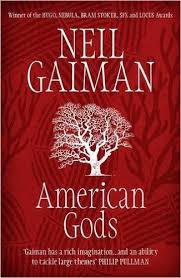
Full House Reading Challenge – American Gods by Neil Gaiman

Genre: Urban Fantasy

Narrative Style: Third Person

Rating: 5/5

Published: 2001

Format: Kindle

Synopsis: Shadow is looking forward to getting out of prison and seeing his wife again. However, on the day of his release he receives the news that his wife has been killed in a car crash. Then on the plane home, a strange man asks him to work for him. He knows things about Shadow he can’t possibly know and when he tries to escape him, he finds he can’t. This is only the beginning of the oddness that will now occupy Shadow’s life. The Gods are going to war and who knows what will be left afterwards.

Reading challenges: Full House Reading Challenge: Genre Two word title. 

I was hooked from the very beginning of this book. Shadow was intriguing from the very start. On the plane on the way to his wife’s funeral, he meets Wednesday who knows an awful lot about Shadow for a stranger. He wants Shadow to work for him. Shadow wants no such thing but finds it is impossible to escape his fate.

Shadow meets a lot of Gods along the way. Some were more obvious than others, perhaps due to my familiarity with certain legends over others – I’m much more familiar with Norse and Egyptian legends than I am with Native American for example. All of them are well drawn and recognisable even in their human form.

The old Gods are all dying out, due to lack of belief. Having been dragged to America from their native lands, they are finding survival in the modern world difficult. New Gods such as media and technology are trying to take over. Wednesday wants to take on this new world. He takes Shadow on a journey, trying to persaude other Gods to join forces and fight.

Of course, all is not what it seems and Gaiman carefully plants clues to the truth of Wednesday’s plan and Shadow’s place in it from the very start. There is a lot of talk of cons and sleight of hand so it should be no surprise that as an author, that is exactly what Gaiman does to the the reader. Not that it feels like a cheat. It certainly doesn’t. More like the satisfaction of watching a master pull of an impressive trick. Why didn’t I see that coming?

Gaiman is also a master at melding fantasy and reality. This tale of gods and myths takes place very firmly in modern America. The myth and the truth are not two separate things. It is easy to accept the magic because it feels like an everyday thing.

Full House Reading Challenge – Big Brother by Lionel Shriver – Contains spoilers

Genre: Literary Fiction, Family

Narrative Style: First person narrative

Rating: 4/5

Published: 2013

Format: Paperback

Synopsis: When Pandora goes to pick up her big brother, Edison, from the airport, she doesn’t recognise him. He has become a literal big brother, that is he is extremely fat. Pandora’s husband is a health nut and when Edison starts to cook extremely unhealthy meals for everybody, things become tense. Then Pandora decides that something drastic needs to be done and moves in with Edison to help him shed the pounds. 

Reading Challenges – Full House Reading Challenge – Size word in title.

There is a lot that is good about this book. I always enjoy Shriver’s novels and the way she tackles big themes. Here, the thoughts on obesity and the way society eats its problems are dealt with in an interesting and emotional way. The characters of Pandora and Edison are complicated and realistically drawn. I did get fed up with Edison’s constant jazz talk but it was consistent with his character. It would annoy me in real life so it was nothing to do with Shriver’s writing.

The story starts when Pandora goes to pick Edison up from the airport to stay with them as he has nowhere else to go. There is already tension between Pandora and her health nut husband, Fletcher, about the visit. So when Edison arrives and he is 200 pounds heavier, you know there are going to be sparks flying.

The first section of the novel details this stay in all its gory detail. As Edison pours his heart into making massive, unhealthy meals, Fletcher becomes more and more controlling of his own intake.  No one discusses Edison’s obesity but ignore the problem so he becomes a literal elephant in the room. Fairly soon, things reach a breaking point.

When it becomes apparent that Edison has no prospects at all, Pandora decides to help him lose weight and they move in together, much to the annoyance of Fletcher. (If truth be told, it was hard to understand what Pandora saw in Fletcher. He could have done with a little rounding out, character wise.) They then embark on a miraculous diet which eventually sees Edison losing the required amount of weight. This section was interesting as it started to explore the reasons behind Edison’s weight gain. Edison becomes livelier and more like the brother that Pandora remembered from her youth as he loses weight. He becomes a metaphor for the way that society views fat people as not quite human. His humanity returns with his slimmed down body.

At the end of this section, they throw a huge party to celebrate Edison’s weight loss. All is going well until Edison realises that Pandora will return to Fletcher and he will be on his own. He begins to overeat again and quickly regains the weight. All through the novel, the nature of the sibling relationship is examined and compared with that of a married couple. In the end, Pandora realises that her relationship with Edison is unhealthy and returns to Fletcher.

This is where it all goes a bit wrong. Suddenly, Pandora begins offering different possibilities for Edison. Maybe he did this, maybe he did that and then we are into the final section of the book. Pandora then confesses that she didn’t move in with Edison and that none of that section was true. I know on some level it is stupid to complain about a writer selling you a lie but I find this particular narrative trick incredibly annoying. It’s a cheap trick. I can see the point Shriver was trying to make – Pandora feels guilty that she did nothing to help Edison so she concocts the fantasy to make herself feel better after his death. Also, it is a more realistic ending than the miraculous weight loss. Still, it had the feeling of being led up the garden path.

It’s a shame because I had been really enjoying this book. I couldn’t put it down but now all I am left with is the feeling of having been cheated.