
This is possibly my favourite of the witches books. It is a joy to read and never puts a foot wrong. It is laugh out loud funny but also has a strong moral message to get across. It also makes clever use of fairy tales and the idea that stories have a life of their own. I couldn’t put it down even though I have read it before – more than once.
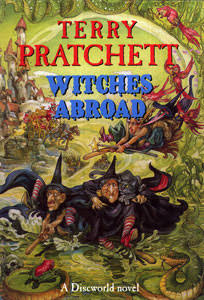
It begins with the death of a fairy godmother. I guess we all have an image of a fairy godmother – good, kind and grandmotherly – Disney, I’m looking at you. In Pratchett’s world, everyone had two fairy godmothers. One good and one bad. When Desiderata Hollow dies, she leaves her godmother’s wand to Magrat with strict instructions about visiting Genua and to definitely not allowing Naggy Ogg and Granny Weatherwax to accompany her – which of course results in their immediate attendance on the trip.
There is much hilarity on their journey what with Granny’s reluctant broomstick, Nanny’s attempts at speaking ‘foreign’ and Magrat’s journey of self discovery. Not to mention the adventures of Greebo (Nanny’s cat) which involve killing a vampire bat and taking on the bulls at a running of the bulls type event. As they get closer to Genua, they start to see odd things. Dwarves singing mining songs, a talking wolf and a girl in a red cape on the way to her grandmother’s house and a house that falls on Nanny (but thankfully doesn’t kill her due to her reinforced hat).
The other fairy godmother – the bad one (although she believes herself to be good) – is Lady Lilith de Tempscire. She is trying to make Emberella, a servant girl, marry the Duc. Desiderata has promised Emberella that this will not happen and it is Magrat’s job to ensure this although she cannot master using the wand and can only make it produce pumpkins. Lilith, it transpires is keen on stories and making reality fit them. She is also very good at magic that makes animals think they are humans so the Duc is literally a frog made human and waiting for the kiss to seal the deal. Granny Weatherwax recognises her straightaway and we quickly realise that we are in for a fearsome battle between two formidable magic users.
As always with Pratchett, this is not merely a comedy nor is it just a tale about good and evil. The themes are fairly typical of Pratchett – the use of power, the nature of what being good means and just because something is different doesn’t mean it is wrong. As well as this, the idea of knowing yourself is very important. This is dealt with in an amusing way in Magrat’s search for some sort of self in the Discworld equivalent of Asian philosophy but also given a more serious aspect in the final battle between Granny Weatherwax and Lilith where they are in a hall of mirrors and they can only escape if they are able to spot their true self. Granny, unsurprisingly, has no problem with this. Lilith, on the other hand, has made so many versions of herself, in order to keep power and control, she is unable to do it.
Overall, this is a great read. It’s funny, it’s clever and it makes you think. I don’t know what else you could ask for in a book.

