Pratchett Reread 11 – Witches Abroad

This is possibly my favourite of the witches books. It is a joy to read and never puts a foot wrong. It is laugh out loud funny but also has a strong moral message to get across. It also makes clever use of fairy tales and the idea that stories have a life of their own. I couldn’t put it down even though I have read it before – more than once.
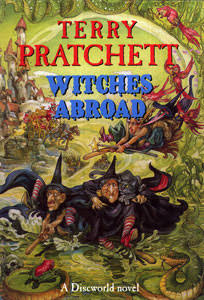
It begins with the death of a fairy godmother. I guess we all have an image of a fairy godmother – good, kind and grandmotherly – Disney, I’m looking at you. In Pratchett’s world, everyone had two fairy godmothers. One good and one bad. When Desiderata Hollow dies, she leaves her godmother’s wand to Magrat with strict instructions about visiting Genua and to definitely not allowing Naggy Ogg and Granny Weatherwax to accompany her – which of course results in their immediate attendance on the trip.

There is much hilarity on their journey what with Granny’s reluctant broomstick, Nanny’s attempts at speaking ‘foreign’ and Magrat’s journey of self discovery. Not to mention the adventures of Greebo (Nanny’s cat) which involve killing a vampire bat and taking on the bulls at a running of the bulls type event. As they get closer to Genua, they start to see odd things. Dwarves singing mining songs, a talking wolf and a girl in a red cape on the way to her grandmother’s house and a house that falls on Nanny (but thankfully doesn’t kill her due to her reinforced hat).

The other fairy godmother – the bad one (although she believes herself to be good) – is Lady Lilith de Tempscire. She is trying to make Emberella, a servant girl, marry the Duc. Desiderata has promised Emberella that this will not happen and it is Magrat’s job to ensure this although she cannot master using the wand and can only make it produce pumpkins. Lilith, it transpires is keen on stories and making reality fit them. She is also very good at magic that makes animals think they are humans so the Duc is literally a frog made human and waiting for the kiss to seal the deal. Granny Weatherwax recognises her straightaway and we quickly realise that we are in for a fearsome battle between two formidable magic users.

As always with Pratchett, this is not merely a comedy nor is it just a tale about good and evil. The themes are fairly typical of Pratchett – the use of power, the nature of what being good means and just because something is different doesn’t mean it is wrong. As well as this, the idea of knowing yourself is very important. This is dealt with in an amusing way in Magrat’s search for some sort of self in the Discworld equivalent of Asian philosophy but also given a more serious aspect in the final battle between Granny Weatherwax and Lilith where they are in a hall of mirrors and they can only escape if they are able to spot their true self. Granny, unsurprisingly, has no problem with this. Lilith, on the other hand, has made so many versions of herself, in order to keep power and control, she is unable to do it.

Overall, this is a great read. It’s funny, it’s clever and it makes you think. I don’t know what else you could ask for in a book.

Eclectic Reader Challenge – Urban Fantasy – Stardust by Neil Gaiman

A long time ago, I read Neil Gaiman’s series of Sandman graphic novels. I was introduced to them by a friend and it was against my better judgement that I started to read them. Making an early start on my career as an intellectual snob, I reckoned they weren’t going to be up to much. Boy was I wrong! I really enjoyed the stories, the characters and the clear and shining light that is Gaiman’s imagination. As a result, I had been meaning to read one of Gaiman’s novels for quite some time now.

So when looking at the genre of Urban Fantasy for The Eclectic Reader Challenge on Goodreads and I realised that I was able to choose a Gaiman, I was really pleased. I chose the one that I already had on my shelf, Stardust.

This book is quite different from what I would normally read, taking the form, as it does, of an adult fairy tale. It is a simple story but it also has depth and as with all good fairy tales it contains lessons and, of course, a happy ending.

There is a pleasantly old fashioned feel to the book. It is set in Victorian times and the folklore and mythology that is referred to seem apt for this setting. The theme of going on a quest for your heart’s desire, only to discover that it is something different from what you thought is also a tale that has been told for a long time. Yet Gaiman manages to give it a new and interesting twist.

IMG_0004

What I really enjoyed about this novel was Gaiman’s style and the to

ne of the writing which was perfect for the telling of a fairy tale. It is like sitting down around a campfire and being told a tale that you could al

most half believe in, by that friendly fellow traveller who looks like he might have lived out the story he is telling. In fact, you leave this novel longing for a

place such as faerie to exist – how the inhabit

ants of Wall manage to exist knowing that the faerie lands are right next door is beyond me.

Having said all that, this is not a genre I am particularly fond of and while this was a fun read, I’m not sure that I would be interested in reading much more like it. I prefer my fairy tales to be darker, if truth be told and I’m not very good with happy endings either. As this is a fairy tale, the characters are quite simple and while that obviously fits with the genre, I prefer my heroes to be, at the very least, ambiguous. 

Day 10. – A book you thought you would hate but ended up loving – The Memory Keeper’s Daughter and The Book of Lost Things.

I always feel a bit suspicious when someone says that they’ve just read something and think I will really like it. For a start, it says something about what they think of me and if I don’t like it, might suggest that they don’t know me as well as they thought. No pressure then.

Both of the the books I am going to talk about today were recommended in such a way. Both times, I was not immediately convinced that I would like them but because the two friends were avid readers and generally had good taste. I gave it a go.

The first book is The Memory Keeper’s Daughter by Kim Edwards. I was not looking forward to starting to read this book for a couple of reasons. It is about a girl with Down’s Syndrome and having lived with a brother who, although he didn’t have Down’s, was physically and mentally disabled, I was worried what emotions the book might bring up for me. My brother had died not long before I read this book and there were a lot of feelings that I didn’t want to examine too closely.

The second reason I didn’t want to read it was more mundane. I

memory-keepers-daughter

was worried it would be like some dreadful American movie that gets shown on daytime TV in order to make housewives cry. I am not good with sentiment or melodrama (unless of course, it is me being melodramatic. Obviously, that is different.)

Of course, the book is nothing like this. It is emotional, definitely, and it did make me think about my own feelings towards my brother. That was a good thing, in the end, and helped me understand the way I was feeling. The ending of this book is truly hopeful and life-affirming. I would never have picked this book for myself and was immensely grateful to the person who suggested it to me.

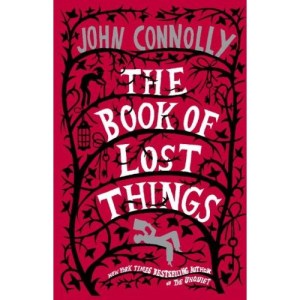
I’m not sure why I was so positive that I would not like The Book of Lost Things by John Connolly. I think I thought it sounded a little clichéd  In fact, it is a magical tale about grief, anger and the power of myths and fairy tales. Connolly successfully gets inside of the head of the main character David, a little boy who has just lost his mother and the point of view is consistent and convincing. He shows clearly David’s lack of understanding of his situation.

As the story continues, David becomes less and less attached to reality. He has blackouts and hallucinations where he is in another land; a land of woodsmen and wolfs, trolls, enchantresses and The Crooked Man. As David’s attacks grow worse, he hears his mother’s voice asking him to rescue her and his adventure truly begins.

book of lost things

Like all fairy tales, this story is instructive and also moral. It is a story of the difficult transition out of childhood when you start to learn life’s lessons. It’s also a book that is about the importance of reading and

how much books can help you when life becomes difficult. This is a view that I wholeheartedly support.