Day two- Favourite side character – Walser, Spud and Ponder Stibbons

As you will discover as this challenge continues, I am incapable of picking a single book for anything. So each post will probably look at two or three books.
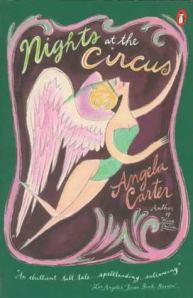
My first choice for favourite side character is Walser from- Nights at the Circus by Angela Carter
Jack Walser is the straight man to the magical, winged woman Fevvers in Angnights-at-the-circusela Carter’s wonderful tale of mystery and intrigue. In a lot of ways, he performs the function of a reader, incredulous and duped by the amazing Fevvers. He gets drawn into her chaotic world almost against his will and is amazed by her along with the reader.
In the course of the novel, Walser is frequently injured and humiliated. He completely loses himself at one point before being reborn a new and wiser man. As a reader, we feel for him and worry for him, in a way that you don’t have to about Fevvers who is strong and confident and although she gets into scrapes, she seems so together that there seems little need to doubt she will survive.
The reason I like him so much is that as a journalist, he should be cynical but in the face of the Fevvers, he cannot remain so. He is described as unfinished and does not reach his true personality until he has been through his series of adventures and falls for Fevvers in every way.
Spud from Trainspotting by Irvine Welsh
Spud is one of my favourite comic characters. He is involved in one of my favourite incidents in Trainspotting – the job interview which he attends with Renton having taken speed and in which he informs the interviewer that htrainspottingas lied on his application form. Welsh perfectly captures his voice, calling everyone ‘cat’ and ‘kitten’ and showing his eternal optimism and friendliness. Unlike Renton, Sickboy and Begbie, Spud is a warm character who maybe a little naive and hopeless but is not as flawed as the others.
Spud has perhaps the most poignant moment in the novel where he begins to feel close to a woman but loses his nerve after remembering a line from There is a light that never goes out by The Smiths. It is heartbreaking.
Ponder Stibbons from the Discworld series by Terry Pratchett
If you have ever worked in an office (or wherever) and felt that you were the only sane person in the place, then you will have a great deal of sympathy for my third choice, Ponder Stibbons. He is the only sensible wizard in Unseen University. Having to deal with Arch-chancellor, Ridcully  on a daily basis would try the patience of a saint and Ponder is often on the very edge of his patience. But what is really great about this character is the strategies he employs in order to ensure that things are actually done his way. The way he plays Ridcully is a joy to behold.

Day 1 – Book series I wish had gone on longer – Ian Rankin’s Inspector Rebus series.

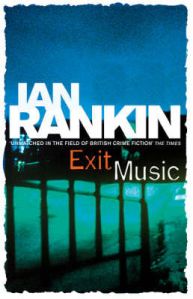
Until recently the most obvious answer to this question would have been Ian Rankin’s Inspector Rebus series. John Rebus is my favourite fictional detective because he is difficult, exasperating and above all anti-authority. His moral code is highly personal which ensures that he does not play by the rules much to the annoyance of his superiors and the entertexit musicainment of the reader. Even more importantly, he had excellent taste in music and Rankin litters the books with musical references as should be apparent by some of the titles – Dead Souls, The Hanging Garden, Let it Bleed, Black and Blue and, of course, Exit Music. And then there is the fantastic Edinburgh and Fife locations, so evocative that they seem like a character in themselves.
In what was the final book of the series, Exit Music, Rebus retired. I admit, even at the time of reading, this seemed unsatisfactory. Rebus is one of those people who would be lost on retirement, who die three weeks after or turn up at work more often than when he worked there. It may that Rankin agreed with this as there is now a new book, Standing in Another Man’s Grave which I am yet to read. It may be that it was always the case that another book would be written. The ending of Exit Music is open to a continuation of the story. It matters not. I am certainly looking forward to reading about the next stage in rebus’ life.
I haven’t read that many other series. Harry Potter, I feel ended when it should. The only way to continue that would be with the next generation of Weasleys and Potters. An adult Harry Potter just wouldn’t be the same. Similarly, His Dark Materials had a pleasing ending and a completely new scenario would have to be invented in order for Lyra to have an new adventure. I love the Game of Thrones series but as yet they do not look like finishing.

A Resolution of Sorts – 30 Day Book Challenge

I don’t really believe in New Years resolutions. They make us all feel better, of course, after the excesses of Christmas. But I find a couple of things about them depressing. For a start, they tend to be negative, giving up things, forcing yourself to do things that you don’t want to. It always seems a strange way to start the year. The other thing is the tendency to break them is high as if making the resolution was enough in itself. This relates to the negative nature of resolutions. No one really wants to keep them. They just want people to admire their potential resolve.

Last year, I decided I wanted to make resolutions I would actually keep so I resolved to choose things that would make my life more pleasurable. I resolved to watch more films and to read more books. This has been great and ensured I have discovered new writers and directors, seen things I wouldn’t have bothered with. I have made an effort because I actually wanted to keep them.

This year, I am resolving to blog more. So to start the year I am going to do the 30 day book challenge as created by Becky

DAY 1. – A book series you wish had gone on longer OR a book series you wish would just end already – Ian Rankin Inspector Rebus Series
DAY 2.  Favorite side character – Walser, Spud, Ponder Stibbons
DAY 3. – The longest book you’ve read – A Dance with Dragons – George R. R. Martins
DAY 4. – Book turned into a movie and completely desecrated – The Other Boleyn Girl – Philippa Gregory
DAY 5. –  Your “comfort” book – Rankin and Pratchett.
DAY 6. Book you’ve read the most number of times – Steinbeck, Ellis, Bulgakov
DAY 7. – A guilty pleasure book.
DAY 8. – Most underrated book – A Disaffection and The People’s Act of Love.
DAY 9.  Most overrated book – David Nicholls and Ian McEwan
DAY 10. – A book you thought you wouldn’t like but ended up loving – THe Memory Keeper’s Daughter and The Book of Lost Things.
DAY 11. – Favorite classic book – Dickens, Salinger, Stevenson.
DAY 12. – A book you wanted to read for a long time but still haven’t.
DAY 13. – A book that disappointed you – A Sense of an ending and Lighthousekeeping
DAY 14.  Book that made you cry – Dancer from the Dance and The Book Thief.
DAY 15.  A character who you can relate to the most – Little Women and The Robber Bride
DAY 16. Most thought-provoking book – Naomi Klein and Joanna Blythman.
DAY 17. – Author I wish people would read more.
DAY 18. – A book you wish you could live in – Jonathan Strange and Mr Norrell
DAY 19. A favourite author – Margaret Atwood
DAY 20. Favorite childhood book – Charlie and the Chocolate Factory, Anne of Green Gables, Little Women
DAY 21. – Book you tell people you’ve read, but haven’t (or haven’t
actually finished) – On the Road, The Old Man and The Sea, The Scarlet Letter.
DAY 22.  Least favourite plot device employed by way too many books you actually enjoyed otherwise – Atonement and The Time Traveller’s Wife
DAY 23. Best book you’ve read in the last 12 months – The Good, The Bad and the Multiplex
DAY 24. – Book you’re most embarrassed to say you like/liked.
DAY 25. – The most surprising plot twist or ending.
DAY 26. – Book that makes you laugh out loud.
DAY 27. – Book that has been on your “to read” list the longest.
DAY 28. Favorite quote from a book.
DAY 29. – A book you hated – 50 Shades of Grey
DAY 30. Book you couldn’t put down.

From the page to the screen

When I first read The Life of Pi and the narrator suggested this book will make you believe in God, I remember thinking bring it on. I was determined that there was nothing that could make me believe in something I knew was a myth. Of course, like anyone who has read this book, by the end, I believed. The story of a boy and a tiger, lost at sea is one that is worth believing. It quickly became one of my favourite books.
So it was with some trepidation that I awaited the film version. Even when I realised that Ang Lee was at the helm, I couldn’t see how justice could possibly be done to this fabulous novel. How could it be possible that the magical nature of this book could be captured on film? After all, the nature of most adaptations of great books make less good films. Especially a book that is so based in faith and magic. That so depends on the suspension of disbelief.
On the journey to the cinema, my husband and I entertain ourselves by trying to think of an adaptation of a novel that is better than the novel itself. We could not.  Don’t get me wrong I’m not suggesting that there are not film versions of novels that are excellent. The Boy in the Striped Pyjamas, Shawshank Redemption, LA confidential, American psycho, Trainspotting to name but a few. But the book is always better. We did debate Slumdog Millionnaire, Schindler’s List and One Flew Over the Cuckoo’s Nest as being better but in each case we had watched before readingand decided that that made a difference.
As to the film, it was magical. It is the first film I’ve seen where I really enjoyed the use of 3D. it enhanced the story and really added to the feeling of being a part of it. There can be no denying that this film is a thing of beauty. Whales, dolphins, meercats, flying fish, not to mention that incredible tiger, all look amazing. The acting is good and the story follows the book fairly accurately. It is hard to fault really. And of course, you know that the story of Richard Parker is the one you want to believe even if it is not the one that is true.
But there is no doubt that the book is better. For a start, in a story about belief, making the story in your head, is much more an expression of faith than watching it. Ang Lee’s version of the story is beautiful and glorious but it is not my version of the story. Belief is a very personal thing. There is no bettering your own imagination, no matter what clever CGI you have at your disposal. In some ways the spectacle of the film detracts from the emotion of it and the ending seems a bit like a damp squib, compared to the emotions I felt when I finished reading the book. This may be due to the difference between watching and reading. Reading is an act of faith. Watching requires you to merely do that. Watch and process. There is no sense in questioning what you can see before your eyes. We didn’t need to believe. We had just seen it. If you could see God walk down the street every day then there would be no need for belief because he would exist. This is the difference between watching and reading The Life of Pi.

This song, picture, book could change your life

It may seem naive but I really do believe that art – and that covers music, literature, film, TV  paintings and sculpture – can change your life. Although perhaps I should explain that I really don’t mean that you see a single film (or whatever) and then you are a completely different person. I don’t believe that that really happens or if it does it is part of a process of change that has already started even if only on a subconscious level.

However, I do think that you are a product of whatever you read, listen to, watch. These are the things that help to shape how we think about the world. The things you love and the things you hate help to create your personality as much as the things that you do and say. They send a message to other people about what you think and about who you are. I really do believe that it is that important.

That’s why I find popular culture a little depressing at the moment. Reality TV. Simon Cowell’s choice of Christmas number one. It’s all so thoroughly empty. What sort of people will the current generation be, with their heads filled up with Made in Chelsea and their ears full of the aural equivalent of candyfloss. What will their world be like if this is all they expect from culture, all they think that people can achieve? A miserable world indeed.

I can still remember the first time I felt truly amazed by a piece of literature. At GCSe, I studied A Taste of Honey by Shelagh Delaney. I was blown away. I was an avid reader even then but I had never read anything that felt quite so relevant to me. The characters seemed like people you might meet. A pregnant teenager, her black boyfriend, her (probably but never directly acknowledged) gay best friend, her scarily uncaring mother. It was much more like reality than anything else I’d read or been taught.

Don’t get me wrong, I love Macbeth and Of Mice and Men which we also studied. But well written as they are, they didn’t feel relevant in the same sort of way. I have no doubt that studying A Taste of Honey started to shape my opinions about important things such as racism, sexuality and freedom. A first step on a lifelong journey.

It is also true that the current educational system is failing students in many ways. For a start, there is no imperative to even study a whole text. As long as you read the scenes that are to be tested in the exam and watch the film, there is no need to read the whole thing apparently. Except for the obvious one of enriching lives by reading a piece of literature which presumably wouldn’t have been included in the syllabus if not considered worthwhile in its entirety.

A lot of young people feel disconnected from the literature that they are made to read at school and this is perhaps understandable when often the most modern thing they read is Of Mice and Men. Perhaps its about time they were encouraged to think that literature is about more than murdered kings and war. If they read something about their lives perhaps they would understand why reading is so important.

I have changed a lot since I was that sixteen year old reading A Taste of Honey for the first time, obviously I suppose. We all grow up, get jobs, study, have relationships and so on. As important as all that is, I would be a different person sat here today if I hadn’t read A Taste of Honey and all of the great books, films, art and music that came after that. I’m grateful to them all for changing my life.

The Eureka Moment

Is it possible to say exactly where your ideas come from and what inspires you to put pen to paper. It is a question that people seem compelled to put now that they know that I have written a novel. I find it hard to answer, to even know exactly what they want me to say.

It may be that it is a long time since I first started to write Shattered Reflections. It was on the back of finishing my MPhil which was on masculinity and violence in Contemporary Fiction and I have no doubt that my reading for that – American Psycho, Frisk, Resentment, Exquisite Corpse, Maribou Stork Nightmares, for example – inspired the themes. But I am not sure that this is what they mean when they ask the question. They seem to want an eureka moment. An incident maybe, a person or a story on the news that sent me running to my laptop. But I am so far removed from the origins of that book now that any such moment is lost in the mists of time.

I am mostly inspired by what annoys me. Which to be honest is quite a lot. This is why I am toying with the idea of Science fiction for my next work. Although I feel more comfortable with the term speculative fiction. Mostly because what I write is unlikely to be very sciency but also because I like what is suggested by the word specualtive – speculate, if you will, on what would happen if… For this I do have an Eureka moment although I am not sure yet where it is going to take me.

I was in the supermarket. (And it goes without saying that this is a task that I hate.) When I got home, I wrote a paragraph about the horror of it, the lighting, the expressions of desperation on the faces of my fellow shoppers. I was a little hungover which made everything seem to be going slower than it actually was. It was a depressing Sunday morning moment.

I’m not sure where this will go yet. I have to think of the characters, the story, really before I can go any further. A lot of planning and reading will need to be done. Still it is the first step on the road to something new. It is exciting, the new ideas flying around like startled butterflies. A new reading list is needed and I’m looking forward to re-visiting old favourites such as Brave New World, as well as discovering a whole new world of science fiction.

A nostalgic longing for the past.

Earlier in the week, I watched a preview screening of Josh Radnor’s new film Liberal Arts. It a film about growing up and is filled with a nostalgic longing for the past, for all those things that everybody claims are lost or dying – reading, letter writing, burning a CD and it left me with a longing for my university days when there was such pleasure in receiving a long letter, hand written and heartfelt, from a friend in a different part of the country. None of us – that is me and my school friends  – communicates like that any more even though we are still scattered all over the place. We don’t even e-mail any more, just message on Facebook or texts. Of course, it is a sign of how busy we all are. There are easier options now then having to find the time to write a letter but part of me still wishes that we had to do it, that there was no other option but to sit down and ponder what news we had to tell. Of course, I could still do it but it would be a bit pointless. Everyone knows my news anyway – facebook has seen to that – and I know their response to it as well. All in far less time then it would take for a letter to arrive and be read. This is progress, apparently.

Early in the film, Radnor’s character, Jesse, is walking along the street reading a book and I was struck   immediately by how this scene would never work with someone walking along with a Kindle.For a start, you would not be able to see what was being read. At least part of the point of reading in public has to do with showing off what you are reading. Not only could you not bear to put this book down but you are showcasing your taste and, possibly, your intellectualism. I know that it irks me that when I read my kindle on the train, no one can tell what I am reading. I always try to see what other people are reading as well. But also, it wouldn’t suggest the same sort of romantic idealism if Jesse was carrying a grey plastic oblong rather than a book with a beautiful cover.

There is a sense of nostalgia at the moment for the loss of something that hasn’t disappeared yet but it seems inevitable that it will. I have seen several articles in the last few weeks about the death of books once everyone has a kindle or the equivalent. And it does seem inevitable. I was never going to have an I-Pod, a kindle or join Facebook and Twitter. Now I have both those things, have joined both those things. I always succumb. Eventually, I guess, books will be like the rows and rows of LP records in my spare bedroom – only present in the houses of people over a certain age.

In some ways, it is strange that so much fuss is being made about the way in which something is read or listened to. Does it matter whether you’re reading from a electronic screen or from a paper page as long as you are reading? Obviously not. I know that some of the sixth formers I taught found it much easier to read from a kindle than from a book. And obviously that pleased me. But this is not a cold logical argument. It is emotional, nostalgic and romantic. It is obviously romantic to take the time to talk about books, to search in second hand book stores for hard to come by editions. It is more romantic to write long handwritten letters rather than a one sentence update on Facebook which someone will then like. And it is far more romantic to hand over a CD you have burned with a handwritten card than to send someone a playlist on Spotify. (Although arguably not as romantic as making a mix tape.) Similarly, when it is my birthday I will still be asking for physical books and CDs. The thought of some sort of electrical exchange seems cold and somehow not real.

Liberal Arts is like a love letter to all these things. All the things that are more time consuming, more difficult but ultimately more meaningful. Reading brings people together in this film and it teaches them how to live their lives. You have to hope that this will still be the case when everyone is reading books from a oblong of grey plastic

Strange Days, Indeed

I wasn’t really sure it could get any stranger. The whole process of publishing Shattered Reflections has seemed surreal. But now that it is out in the world, potentially being read right now, I have to admit that it feels a little bit weird.

Part of it is nerves, undoubtedly. Obviously there has been feedback, checking and what have you before but this is different. For a start, people will actually be paying for it. Previously, it didn’t seem quite real.

Everyone close to me has been superbly supportive. Immediately, people are buying the book, liking my facebook page and I am hugely grateful to them. But it does make me nervous, people I know reading it. It is rude in places, violent in others with a fair bit of bad language thrown in for good measure. I’m not sure I want people who know me to be able to see into the darker reaches of my mind.

My book. My novel. They are exciting words, good words. Not like the words what next. They are frightening, difficult words, no fun words. But they are the ones that I will be working on over the next few weeks.