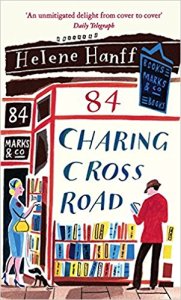
Full House Reading Challenge – 84 Charing Cross Road – Helene Hanff

Genre: Epistolary, Non-fiction

Narrative Style: Exchange of letters between Hanff and Frank Doel of Marks & Co.

Rating: 3/5

Published: 1976
Format: Paperback

Synopsis: Helene Hanff is an American with an interest in classical literature and old books. Marks & co are the British bookshop that she writes to to try and get her hands on some of these books. What develops is a funny and touching relationship between Helene and Frank mainly but also others who work in the shop and Frank’s wife. 

Reading challenges: Full House Reading Challenge – Set in a bookshop 

I was quite excited by the thought of reading this as I loved the film. Really, I should know better. This is already the second post I’ve started off in this fashion this year. It is truly amazing that they managed to get such a rewarding film from such a slim volume.

Not that this was terrible. It certainly wasn’t. It was interesting to watch the relationship between Helene and Frank develop. The contrast between her open and easy going personality and Frank’s careful British reserve was amusing. Watching Frank slowly let his guard down was one of the more interesting aspects of the book.

But I have to admit, Helene got on my nerves. And nothing really happens. Books are ordered and received. Gifts are sent both ways. I suppose if you were reading this blind, then you might have the wonder of whether Helene was going to get to visit London but having seen the film, I knew that wasn’t going to happen.

The main thing I thought when reading this book was how old fashioned it seemed and also how difficult it would be for this  to happen these days. Not only because we don’t really communicate be letter anymore but because these friendly, small businesses with time to treat their customers so well also seem like a thing of the past. I must admit that it gave me a strong sense of nostalgia for when we used to write letters to each other and we didn’t know every aspect of each others lives  through social media.


Full House Reading Challenge – 1984 – George Orwell

Genre: Dystopia

Narrative Style: Third person from the view of Winston Smith.

Rating: 5/5

Published: 1949

Format: Paperback

Synopsis: Winston Smith lives under the eye of Big Brother in a land called Oceania. Constantly observed by tele screens that look outwards as well as showing images and unable to discuss subversive ideas with anyone, Winston wonders if he is the only one who realises the issues with the regime. Before long, he meets fellow subversive Julia and they start meeting in private. This sets in action, a series of events that is unstoppable and inevitable. 

Reading Challenges: Full House Reading Challenge: Genre – Reread.

I realise I am following a trend in reading 1984 but it sprang straight into my mind when I realised that I had to reread a book for this challenge. The alternatives were both equally timely – Animal Farm and The Handmaid’s Tale. However, both of those had been reread more recently than 1984.

And it was timely. With Trump’s determined manipulation of the media and his hatred of the press, the idea that “Who controls the past controls the future. Who controls the present controls the past.” felt all too real. “The best books… are those that tell you what you know already.” also seemed fitting in a time when experts are ignored in favour of unsubstantiated opinions that support what people would rather believe. Now, more than when I last read this more than twenty years ago, did the idea of the loss of the freedom even to think really resonate.

This is not a perfect book. The character of Julia was irritating and she was little more than a tool to help Winston on his journey towards thoughtcrime and his inevitable punishment. Even Winston himself is not a fully drawn, three dimensional character and felt a little flat. However, maybe it is fitting. There is little way to express personality under such a regime particularly on the surface.

Also, the inclusion of the Goldstein’s treatise halfway through slowed down the pace and was quite a dry read. However, I feel it was necessary in order to fully understand what followed during Winston’s torture and to appreciate O’Brien’s position. But these are quibbles really. The message of the novel, the cleverness of the message of Oceania’s government overrides these issues.

I had forgotten how bleak the ending is. It is absolutely devastating that what little personality that Winston has is destroyed and he is now completely unable to think a false thought. The scene where he meets Julia for one last time and they explain their betrayal of each other is particularly depressing. There is no happy ending, no obvious way to escape the regime. And it is true that the level of control exercised by the government in this novel would be impossible to overcome. Winston is merely waiting for the bullet that he knows will come. All you can think in the end is at least it hasn’t got as bad as that here.


Full House Reading Challenge – The Mandibles – Lionel Shriver (Contains Spoilers)

Genre: Dystopia

Narrative Style: Third person, chronological

Rating: 3/5

Published: 2016

Format: Paperback

Synopsis: When every other country in the world changes its currency to the Bancor, the United States finds itself with a problem. When it doesn’t accept the currency, the dollar quickly loses its value and prices start to rise. The Mandibles find their much relied on inheritance disappears and they suddenly are left with nothing. The novel covers their reactions to events from 2029-2047. 

Reading challenges: Full House Reading Challenge – Most recently added to TBR.

This book was a struggle at times. In fact, it took me a month to read it. It is testament to Shriver’s high quality writing that I kept going. She certainly can string a sentence together. That is not the problem with this novel.

Nor is it the idea which I think is a solid one. In fact, given the current economic situation (particularly with Brexit causing so many worries in the UK) some of it seemed a little close to actual reality. There seemed to be dramatic possibilities in the idea of the once privileged losing everything. I always enjoy the rich taking a tumble.

The problem is that nothing really happens. Or it happens off page. An awful lot of  this novel is taken up with dinner party talk – or the equivalent when no one is having dinner parties anymore. In some ways, this is an interesting way of marking the changes in society  – with the way that a simple event changes – but it just isn’t very exciting. There are lots of intellectual debates about what might happen next which would be fine if this were an economic treatise but it’s novel and so it fell a bit flat.

I had some issues with the names in this novel – Willing, Goog, Fifia, Bing. It felt as though Shriver were trying a little hard. And the slang that these young folk used never really rang true and I never got used to it. Maybe that is just a sign of my age but it just sounded false.

When, at last, it feels like things are as bad as they can be, Shriver again doesn’t give  us the details but jumps past it all to a future where things are kind of settled again. The Mandibles are ousted from their house by their neighbours who play on their middle class naivety by pretending their child is ill. Willing, the teenage son, suggests they need to walk to their Uncle’s farm, a whole state away. This, I thought, would make for interesting reading. At last, something terrible was about to happen on the page. But no, this walk and their time on the farm was not described – perhaps because, in actual fact, their surviving this walk would have stretched incredulity to its limits. I felt cheated all the same.

The final chapters are largely taken up with the modern day equivalent of a dinner party where the young folk all sit around and discuss what became of everyone else. Not a very satisfying way of tying up loose ends. Again, there are some clever ideas about the way the world turns out but I felt I was being lectured to rather than being shown events unfolding.

Finally, the ending is a cheat. Nollie, Willing’s ancient aunt has been carefully lugging a box of her old manuscripts around with her from pillow to post. Willing thinks she may be becoming old and senile but, it becomes apparent that their is something precious in the box. Nollie has a large quantity of gold which it just so happens, she can now convert into currency in their new home in the state of Nevada – the one state that has not opted into the new economic rules. So there is a happy ending. Although the last line of the novel suggests that the future might not be exactly perfect, the whole thing ended a bit too nicely. Overall, it was disappointing.

White Rose, Black Forest – Eoin Dempsey – Full House Reading Challenge

Genre: Historical  Fiction

Narrative Style: Two third person narratives that alternate. 

Rating: 2/5

Published: 2018 (Kindle First Purchase)

Format: Kindle

Synopsis: Franka is about to end her own life when she discovers the broken body of a German pilot in the snowy forest outside her family cabin. Instead of committing suicide, she manages to get his body back to the cabin and begins to nurse him. But all is not what it seems. Why does he cry out in English in his sleep?  Who is this man and will Franka be able to trust him? 

Reading Challenges: Full House Reading Challenge – Genre Dual Time Line. 

This was a Kindle First purchase. It sounded interesting, claimed to be based on a true story and had some good reviews so I went for it, despite having read some not so great books through Kindle First. This was no exception.

The story starts from Franka’s point of view. She is wandering through the forest, looking for a spot in which to commit suicide. However, instead she stumbles across the body of an Luftwaffe pilot, still alive but badly injured. She finds herself with a moral dilemma. Should she save the pilot or not, given her ambivalence about the war?

Fairly quickly, we are given the idea that all is not what it seems and the pilot may be a spy. This only furthers the moral issues for Franka, for while she does not approve of the Nazis, she also had issues with the allies who had killed her father in a bombing raid. Nevertheless, she decides that she cannot leave him to die and by some feat of superhuman strength manages to get him back to the cabin.

This was the first time – but not the last – that I felt my incredulity stretched to the limit. How would this one woman manage to move a badly injured pilot and  his heavy kitbag through the snowstorm. Everything is set up just a bit too neatly for my liking.

Then we start to get the story from the pilot, John’s,  point of view. Naturally, he is wary of Franka even though she claims to hate the Nazis, he thinks it is an elaborate plot.  After all, how likely was it that he had fallen precisely into the hands of a nazi hater. I thought it unlikely too but as it was based on a true story, I let it go. After all, strange coincidences do happen. However, when I finished reading this I was curious to know exactly what these events were and it transpires that John and Franka were made up by Dempsey and the ‘true’ elements were the situation in Germany at the time and the details of the White Rose movement. By that logic, all historical fiction could say it was based on a true story.

Over the course of the book, the pair share stories and start to trust each other. Neither story fully convinced although the darker details of Franka’s story were suitably disturbing. In fact, neither character really worked for me. They never truly escaped their stereotypes e.g. the good German and the American hero. As the book continued, the details just got more and more ridiculous and I found the ending particularly irritating. I guess I’m just not enough of a romantic to appreciate this sort of book.


Full House Reading Challenge – Middlesex – Jeffrey Eugenides

Genre: LGBT, Family, History, Bildungsroman

Narrative Style: First person, non-chronological

Rating: 4/5

Published: 2003

Format: Kindle

Reading Challenges: Full House Reading Challenge – Genre Over 500 pages.

This has been on my list for a long time so when it came up for £0.99 on my Kindle, I jumped at it. I’m not really sure what I expected from it (I’d read The Virgin Suicides and had been suitably weirded out by the tone and subject matter) but the story of Calliope / Cal wasn’t it. That isn’t a criticism. I couldn’t have possibly imagined anything as wildly exciting and interesting as the novel actually is.

The story actually starts long before Cal’s birth, on a completely different continent. Admittedly, I know very little about recent Greek history but the details supplied by Eugenides seemed to make sense. And as ever, with really evocative writing, it made me want to find out more. The boat trip to America and the treatment by the American authorities were also emotionally described and I really felt for Lefty and Desdemona (Cal’s grandparents).

Although this novel is described as being about Cal’s transformation from Calliope to Cal, it is a long time before we actually get to this part of the story. Hints are dropped and events alluded to but the main story moves through Cal’s grandparents to parents and then to the present day in order to explain the presence of the genetic mutation that causes all of Cal’s biological problems. There was no sense of impatience on my part though. No detail felt superfluous. The beginning of the novel in particular is a story beautifully told.

Later, it becomes more sensational and a little like a bad TV movie at times. Cal’s hermaphroditism is eventually discovered and he is taken to a doctor who is excited by the possibility of such an exciting case study. Cal is displayed and photographed in a way that seems just as seedy as later on when Cal has run away and ends up in a freak show with other transsexuals at various stages of transition. There is a certain element of magical realism in this part of the novel as Cal tries to come to terms with a new identity. It reminded me of Angela Carter’s Nights at the Circus when Fevvers lives with other freaks such as Sleeping Beauty.

What was pleasing was that Eugenides doesn’t make it straightforward for Cal who feels there is nowhere that he fit. Not male fully or female, not able to fit in with the intersex community, Cal was a little lost. In the present of the novel, Cal is working through a possible romance. Having revealed the entirety of his family history, he was ready at the end, to reveal his body to his lover. It felt like the right place to leave the story with the future possibilities wide open.


Full House Reading Challenge – Americana by Ray Davies

Genre: Autobiography / Memoir

Narrative Style: First person, non-chronological

Rating: 4/5

Format: Hardback

Published: 2013

Synopsis: Ray Davies discusses his relationship with America at various points in The Kinks career. The narrative moves from the very start of The Kinks career and their banning from America to the botched robbery that saw Davies shot and re-evaluating his relationship with the states. 

Reading Challenges: Full House Reading Challenge.:  Autobiography / Memoir

I’d been meaning to read this for a while. Not only do I really enjoy The Kinks music but I knew from reading X-Ray, Davies’ earlier autobiography, that it would be well-written and interesting.  It’s no secret that Davies is a brilliant raconteur; you only have to listen to The Kinks songs to know that so all in all I was looking forward to it.

It did not disappoint. It isn’t really a conventional straight from A to B sort of autobiography. Ray moves from descriptions of his life in New Orleans at the time leading up to his shooting to various points in The Kinks career, touring and recording in America. It was an interesting perspective, showing all the good and the bad about touring in a rock band and trying to keep relationships together.

Ray was willing to examine his own behaviour and to describe mistakes as well as triumphs. The mood moves from great highs – triumphant shows, hit albums – to the low of lying in hospital after the botched robbery that saw him shot. He examines it all with the same critical eye.

The only thing I found a little disappointing was that he didn’t really examine the relationship with his brother, Dave. While the difficulties of this relationship are mentioned, I might have expected more insight into the problems, more detail about the nature of their problems. Of course, I understand fully why this may be difficult for Davies to talk about and it’s not for me to decide what he should talk about but I felt it was a gap in the narrative.

Overall, this was a very enjoyable read. Davies was willing to laugh at himself and also was candid about the difficulties he suffered and the relationships he lost. It was touching, amusing and informative in equal measure. Well worth a read, even for the casual fan.

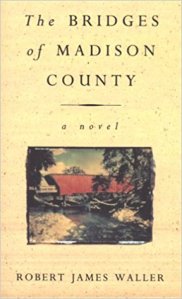
Full House Reading Challenge – The Bridges of Madison County – Robert James Waller

Genre: Romance

Narrative Style: A mix of first person, third person, and letters.

Rating: 2/5

Published: 1992

Synopsis: A writer is presented with the diaries of Francesca Johnson by her children. They detail the brief affair that she had with Robert Kincaid who came to photograph the covered bridges of Madison County. It shows the sacrifice she made by staying with her family. The writer promises to tell the story. 

Reading Challenges: Full House Reading Challenge: Made into a movie.

I read this because I really enjoyed the film. Romance is not really my thing but I remembered crying at the film so I thought that maybe the book would be as emotional. Instead, I found it sentimental and slightly irritating.

At the beginning, there is a preface explaining how the writer came by this story when Francesca’s children brought her journals to him. This makes it feel like you are reading a true story and I admit, this made me like the story more. It also explained some of the worst excesses of the text – Kincaid’s pseudo hippy talk, for example – as he was working from real people. However, about halfway through, I decided to investigate whether it was true or not and it isn’t. I admit, my impressions of Waller as a writer went down from this point.

Looking at the Goodreads reviews of this book shows that it completely splits opinion. There were a whole raft of one star and five star reviews. I don’t really understand this book inspiring either extreme love or extreme hatred (and some of the one star reviews are pretty angry). It left me feeling empty. I felt little sympathy for either party.

Of course, in the film you have Clint Eastwood (who easily embodies this sort of masculinity) and Meryl Streep, both capable of making an okay story into something special through their performances. Things that had niggled only a little after the movie became downright irritating after the book. Why was it that Francesca had to sacrifice her happiness and stay with her family and  then spent all her time holding onto the few things that reminded her of Robert. The whole ‘last cowboy’ and Kincaid as the end of an evolutionary line of masculinity was irritating as well. Presumably this is the type of man Waller would have liked to be: no ties or responsibility but with the secret of a lost love in his past to explain his solitariness.

At the end of the day, the best thing I can say about this book is that it didn’t take long to read.


Full House Reading Challenge – Journey to the Centre of the Earth – Jules Verne

Genre: Adventure, Classics

Narrative Style: First person, chronological

Rating: 3/5

Published: 1864

Format: Kindle

Synopsis: On discovering an ancient manuscript that suggests it is possible to travel to the centre of the earth, Professor Liedenbrock sets off for Iceland immediately. The narrator, his nephew, is less keen on the journey, believing that they will be suffocated by the heat of the interior world. The novel catalogues the ups and downs of the expedition. 

Reading Challenges: Full House Reading Challenge – Genre – A Classic. 

The first thing to say about this book is that it is very much a book of its time. Verne, like many other writers at the time, was clearly fascinated by the discovery of  dinosaur bones, fossils and the early theories about the different stages of man’s development. It may seem strange to us now, with the knowledge we have, but at the time it would have made more sense to readers.

The story takes a while to get started and it would certainly try the patience of younger readers, who might otherwise have been intrigued. 35% of the way into the text and we were still not underground. I’m not a big fan of the way modern novels often dive straight into the story without building character at all but this was the other extreme and I felt I waited a long time for things to get going.

The narrative voice was enjoyable. Axel clearly wasn’t enjoying his journey and his tendency to disagree with his uncle made for some interesting exchanges. He managed to get himself into trouble regularly and often despaired of getting out of their predicament alive. His melodrama was an excellent foil to the Professor’s stubborn determination.

My main problem with this book was the ending. It really stretched my ability to suspend my disbelief. You may say that the whole thing was beyond belief but it was possible to go along with it. It had a certain logic. However, the long ascent, and eventual eruption, of the volcano that rockets them back into the real world really was ridiculous and left me feeling a bit irritated. They also escaped death perhaps one time too many and often by coincidence rather than by any effort on their part.

I’m glad I read it though and would read more of Verne’s work. It makes me imagine what it must have been like at this point in history. These days, science fiction is often taken with the idea of technology and AI, it is interesting to think of what previous generations were interested in and worried about.


Full House Reading Challenge – It’s Not Me, It’s You – Jon Richardson

Genre: Humour, Autobiography

Narrative Style: First person

Rating: 5/5

Published: 2011

Format: kindle

Synopsis: Jon Richardson is looking for love. The only problem is will he be able to find someone who meets his exacting standards. When Richardson has lived with people before, it hasn’t ended well. Will his imminent date with waitress Gemma prove to be the romantic escape that he hopes?

Reading Challenges: Full House Reading Challenge – genre: humour. 

This isn’t really an autobiography or if it is, it is very selective, covering as it does only a few days in Jon Richardson’s life. What it does do – and very well – is give an insight into his obsessive need for neatness in all aspects of his life.

It is extremely funny. Although at times I felt guilty laughing. Of course, there is likely to be an element of comic exaggeration but even adding that in to the mix, it felt more like tragedy then comedy at times. Of course, we all have those things that bug us. Every time you get on a bus or carry out a transaction in a shop, you are risking annoyance. However, few of us would go to the trouble of having a landline phone that no one knows the number to so they are not disturbed. Few of us are so anxious about a future relationship that they sabotage it before it even gets to the first date.

Richardson’s written style is very much like the voice of his stand up comedy and so was easy to read. Whilst ruminating on the possibility of his future relationship, he discusses what he feels are the elements of his personality that will affect his future. It is very intimate in places. It is like being inside his head and that is when it feels wrong to be laughing.

Of course, this book is quite old now and all the way through, I kept thinking how on earth is he coping with having a baby. But maybe I should have been thinking how is his wife coping with him and a baby.

Full House Reading Challenge – Resurrection Men – Ian Rankin – Contains spoilers

Genre: Detective Fiction

Narrative Style: Third person from various points of view

Rating: 4/5

Published: 2001

Format: Paperback

Synopsis: John Rebus is in trouble. So much trouble that he has been sent back to  cop school to re-learn how to be a team player. There he meets with a group of equally disgruntled and mis-behaving cops but why is he especially interested in three of them? Meanwhile Siobhan Clarke is working the death of an art dealer and although they have a suspect, she is unconvinced. Could there be a link between her case and Rebus’ tribe of bad cops? 

Reading Challenges: Full House Reading Challenge – Genre – Plot twist. 

You know it’s going to be a good Rebus novel when it starts with the surly detective throwing a mug of tea at his superior officer, Gill Templer. He is then stuck onto a training course with other equally badly behaved coppers. It’s apparent straightaway that all is not quite what it seems and Rebus is there for more than just his own betterment. This is the first plot twist in a typically twisty effort.

All of the typical elements are here. Rebus goes to extremes in trying to out the corrupt cops and quickly gets in over his head. There in the background is his nemesis, Big Ger Caffety, fingers in all of the pies but also as usual, nothing can be pinned on him. Then there is Clarke and her new partner trying to solve the murder of art dealer, Eddie Marber. Clarke is a compelling character worthy perhaps of a series of her own. Not that she plays second fiddle to Rebus. They are both interesting leading characters.

This hooked me straightaway. Reading about Rebus’ exploits always involves a certain level of despair and worry as to whether this will be the time he finally gets caught. When he comes up with a scheme to steal some drugs from a warehouse in order to test the three cops he is supposed to be flushing out, you know it is not going to go smoothly. (It did make me wonder why you would choose such a loose canon as Rebus to do something so sensitive but that is my only quibble.)

Some of the twists were easy to work out. It is apparent that Rebus is acting when he throws the mug of tea before his ulterior motive is revealed. But Rankin to get the balance right, offering just the right amount of hints to the reader while not revealing everything. I was actually worried for Rebus’ life when at the end, he is kidnapped by the rogue cops. Of course, I knew he must survive because this is the middle of the series but quite how that would happen, I didn’t know. The best twist I feel was the way that the drugs were able to be stolen. I won’t reveal it because its just too good a moment when you read it for yourself.  Sometimes it’s good to be fooled when it’s by someone who so clearly knows how to do it.