Day 15 – A character who you can relate to the most – Little Women and The Robber Bride

This gave me food for thought as a lot of the books I read include narrators / characters that are not the sort of people that you would want to identify yourself with – Patrick Bateman, for example or Vernon God Little, any of McEwan or Amis’ impossibly difficult narrators. Also, I felt that didn’t identify with any narrators who are mentally ill in The Bell Jar, Surfacing, Catcher in the Rye or One Flew Over the Cuckoos nest, for example.

The first character that I can remember really appealing to me was Jo in Little Women. In fact, I went on to read the rest of that series of books many times because I liked her character so much. One of the first things that Jo does in Little Women is cut off her beautiful long hair and she is frequently found to be doing things that were considered slightly unsuitable for her sex. This appealed to me at age 12 when I first read it as I was a tomboy and really didn’t see the point in make-up, dolls, jewellery or any of the other things that nearly teenage girls seem to be obsessed with. It was good to find a kindred spirit.

It is surprising that I have managed to get this far in this challenge without mentioning Margaret Atwood who is one of my favourite authors and one of the few writers where I have enjoyed all that I have read by her. Her female characters often seem to find life difficult in similar ways to me. The character I have chosen is Tony from The Robber Bride. I related to her straight away as she is left handed (as am I) and as a result of this learns how to write backwards. (This is a logical conclusion. If you have ever watched anyone left handed write, you will see how awkward it is. It would make much more sense to write backwards.) Furthermore, she is constantly reversing words in her head and sometimes out loud in conversation. It often feels as if the world is entirely the wrong way round when you are left handed. It seems that this has even effected Tony’s thought patterns and language use. Often the backwards words were exotic looking, forming a new language that only Tony could understand. It made me wish for the ability myself.

Eclectic Reader Challenge 2013

So I have decided that as I have currently got so many new books – due to very kind people who know how much I read giving me Amazon or Waterstones vouchers for my 40th birthday and the fact that I have serious difficulty deciding on the next book at the best of times – that I need some serious focus. So I am going to do the Eclectic Reader Challenge this year. It requires the reading of 12 books in different categories, all of which sound quite interesting. It was surprisingly exciting to choose the books in advance. I thought it might spoil my enjoyment to have planned what I was going to read but in fact it is more enjoyable because I know what is coming next. Here are the books I have chosen to read for each category.

  1. Translated fiction – The Prague Cemetery – Umberto Eco, Venus in Furs – Leopold Sacher-Masoch
  2. Historical mystery – The Moonstone – Wilkie Collins, A Test of Wills – Charles Todd
  3. Romantic suspense – Come Onto These Yellow Sands – Josh Lanyon, Awaken – Katie Kacvinsky
  4. Made into a movie – The Virgin Suicides – Jeffrey Eugenides, Election – Tom Perotta
  5. New Adult – The Hunger Games – Suzanne Collins,  The perks of Being a Wallflower – Stephen Chbosky
  6. Urban Fantasy – Stardust – Neil Gaiman, Something Wicked This Way Comes – Ray Bradbury
  7. Dystopian – The Testament of Jessie Lamb – Jane Rogers,  The Road – Cormac McCarthy
  8. Memoir – Girl Interrupted – Susanna Kaysen. It’s Only a movie – Mark Kermode
  9. LGBT – The City and the Pillar – Gore Vidal, Rent Boy – Gary Indiana
  10. Action Adventure  – The Zombie Room – R. D. Donald, The Lost World – Arthur Conan Doyle
  11. Humour – A Walk in the Woods – BIll Bryson, I Can Make You Hate – Charlie Brooker
  12. Published in 2013 – Levels of Life – Julian Barnes

Day 13 – A book that disappointed you. Lighthousekeeping and The Sense of an Ending

I try to avoid disappointment when reading. That is probably an obvious thing to say but I am quite a careful reader and I know what I like and what I don’t like. If, for whatever reason, I end up reading something I’m fairly sure I won’t like then I have lower expectations and so no disappointment ensues. I think the only time I am disappointed is when I read a book by a writer I really like and it isn’t as good as I expect. It is probably still a lot better than a lot of other books I read but my expectations lead me to expect too much from it.

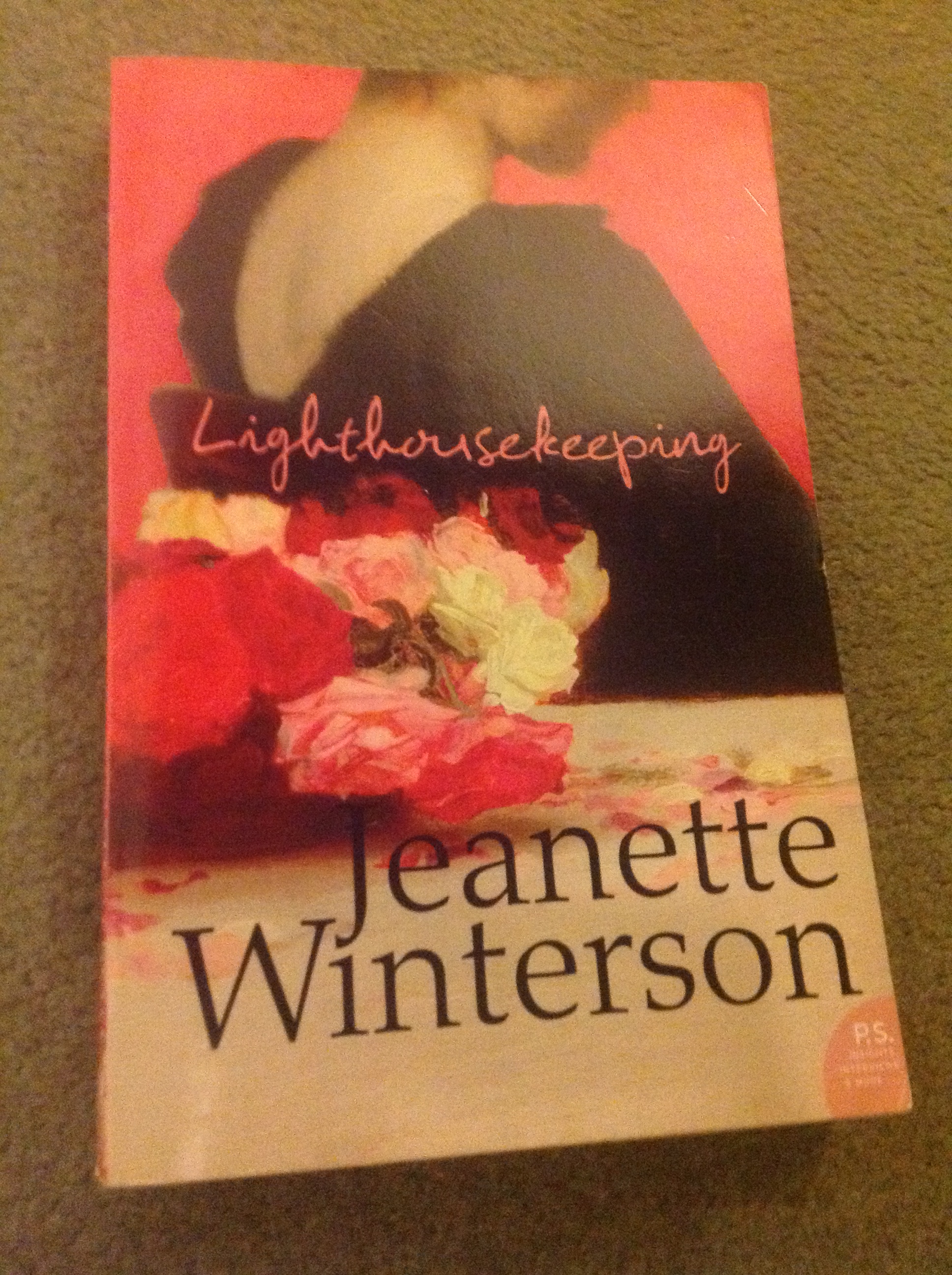
I first discovered Jeanette Winterson when I was at University and The Passion is one of my all time favourite books and I’d liked everything that she had written before. I couldn’t wait to read Lighthousekeeping. The excitement behind reading this book was made all the greater by the fact that as part of Off The Shelf, I went to hear her read an extract from the book. I was really expecting to love this book.

And it still contains all those things that Winterson is so good at;

photo (1)the poetic imagery, the love of language and playing with language, the telling of and de-constructing of the stories we tell ourselves. But at the end I felt dissatisfied. It was even difficult to say exactly why or what the problem was. It just felt a little hollow, as if I had expected this book be a three course meal and to fill me up but I was left still feeling peckish.

It was too insubstantial for me. The language didn’t seem to lead anywhere and I was left with a feeling that I had greatly missed the point.

I had a similar feeling when I got to the end of A Sense of an Ending. Again, I love Julian Barnes and have read The History of the World in 10 and a half chapters a number of times, as well as a lot of his other novels. Again the story is well told, the narration is strong and the main character is convincing

photo

but it didn’t seem to add up to a lot.

I’m sure I’m not the first person to say that I was both glad and not when this book won the Booker. Glad because it surprised me that Barnes had not won before with say Arthur and George, to name but one possibility. Not glad because I do not feel that this is Barnes’ best work by some stretch.

Perhaps my tastes are changing and both these authors are no longer what I really want to read. I hope not. I haven’t really returned to Jeanette Winterson after reading Lighthousekeeping which seems a little churlish considering how many of her books I have enjoyed. As for Barnes, I will have to wait and see what his next novel will be.

Day 12 – A book you wanted to read for a long time but still haven’t.

I have actually been quite good at hoovering up some of the long-standing members of my bookshelf. Over the last couple of years I have tried to make sure I read some things that have been shelf residents for a while. So, for example recently I have read Schindler’s Ark, Day of the Triffids, Ark Baby, The Pianist, Half a Yellow Sun, all of which had been hanging around for a while.

However, it really is a list that never ends. I almost never buy books in just ones. (Especially as the kind people at Waterstones often seem to have offers such as buy one get one half price or three for two and it would be rude not to indulge them.) So inevitably there are always books that wait along time to be read.

Here is a list of the long standing ones that I hope to read this year:

  1. The Virgin Suicides – Jeffrey Eugenides
  2. The City and the Pillar – Gore Vidal
  3. Girl Interrupted – Susanna Kaysen
  4. The Moonstone – Wilkie Collins
  5. The Player of Games – Iain M Banks
  6. Something Wicked This Way Comes – Ray Bradbury
  7. Glamorama – Bret Easton Ellis
  8. Rentboy – Gary Indiana

No doubt their places will be taken by other books that I have bought or have been bought for me and are even now waiting eagerly to be read, only to be bitterly disappointed.

Day 10. – A book you thought you would hate but ended up loving – The Memory Keeper’s Daughter and The Book of Lost Things.

I always feel a bit suspicious when someone says that they’ve just read something and think I will really like it. For a start, it says something about what they think of me and if I don’t like it, might suggest that they don’t know me as well as they thought. No pressure then.

Both of the the books I am going to talk about today were recommended in such a way. Both times, I was not immediately convinced that I would like them but because the two friends were avid readers and generally had good taste. I gave it a go.

The first book is The Memory Keeper’s Daughter by Kim Edwards. I was not looking forward to starting to read this book for a couple of reasons. It is about a girl with Down’s Syndrome and having lived with a brother who, although he didn’t have Down’s, was physically and mentally disabled, I was worried what emotions the book might bring up for me. My brother had died not long before I read this book and there were a lot of feelings that I didn’t want to examine too closely.

The second reason I didn’t want to read it was more mundane. I

memory-keepers-daughter

was worried it would be like some dreadful American movie that gets shown on daytime TV in order to make housewives cry. I am not good with sentiment or melodrama (unless of course, it is me being melodramatic. Obviously, that is different.)

Of course, the book is nothing like this. It is emotional, definitely, and it did make me think about my own feelings towards my brother. That was a good thing, in the end, and helped me understand the way I was feeling. The ending of this book is truly hopeful and life-affirming. I would never have picked this book for myself and was immensely grateful to the person who suggested it to me.

I’m not sure why I was so positive that I would not like The Book of Lost Things by John Connolly. I think I thought it sounded a little clichéd  In fact, it is a magical tale about grief, anger and the power of myths and fairy tales. Connolly successfully gets inside of the head of the main character David, a little boy who has just lost his mother and the point of view is consistent and convincing. He shows clearly David’s lack of understanding of his situation.

As the story continues, David becomes less and less attached to reality. He has blackouts and hallucinations where he is in another land; a land of woodsmen and wolfs, trolls, enchantresses and The Crooked Man. As David’s attacks grow worse, he hears his mother’s voice asking him to rescue her and his adventure truly begins.

book of lost things

Like all fairy tales, this story is instructive and also moral. It is a story of the difficult transition out of childhood when you start to learn life’s lessons. It’s also a book that is about the importance of reading and

how much books can help you when life becomes difficult. This is a view that I wholeheartedly support.

Day 8 – Books that are underrated – A Disaffection and The People’s Act of Love.

I have to confess that I don’t really follow fashion or know what is underrated. So the books I am going to mention are ones that I have read but not many people I know have read and I feel that they would enjoy.

The first book I have chosen is A Disaffection by James Kelman. It has one of my favourite opening lines – “Patrick Doyle was a teacher. Gradually he had become sickened by it.” It sums up very neatly exactly what happens in the novel as Patrick becomes more and more disaffected with his life in gen9780330307369 (1)eral and his career choice in particular. Gradually, his behaviour becomes more erratic and the narrative voice- although third person – becomes increasingly rambling along with it. It becomes difficult to tell where the third person narrator ends and Patrick’s thoughts begin. This could show just how removed Patrick is from his own life, unable even to grasp a first person narration of his own life.

This is a very down to earth novel and was one of the first books  I read that used dialect words and to have the rhythm of working class language. This appealed to me and also influences me as a writer as I am from a working class background myself. It was also the first time I had read a book that played around with the rules of grammar and punctuation – for example not using apostrophes in words such as shouldnt or question marks at the end of questions. Sentences break off without warning into new paragraphs. Others are left unfinished. This cleverly shows the fragmented nature of Patrick’s thoughts. After all, few people’s thought processes are as clear cut as they appear in most novels. Inside your own head, you don’t have to make complete sense as you are the only one who needs to understand.

This novel is an examination of the human state reminiscent of Kafka and just as surreal at times even though it is grounded in realism. The end of the novel is one of the most poignant I have read. The reader knows that the future is not looking good for Patrick as his final thoughts in the novel are about suicide. The final words are “Ah fuck off, fuck off.” This shows that Patrick is no closer to being able to deal with the world now then he was at the beginning, in fact things are an awful lot worse and likely to continue in that fashion. There is no need to continue the novel as the rest of Patrick’s life is summed up in those five words.

The second book I have picked is The People’s Act of Love by James Meek. It is set in Siberia in 1919, a time and a place I knew nothing about. It begins with the appearance of a mysterious stranger who has escaped from an Arctic prison and who claims he is being chased by a cannibal. This is an exciting narrative that is full of twists and turns and containing some of the

peoples_act_of_love

most interesting characters I have come across.

For me, the main success of the book was making interested in a time in history that I had previously not even considered and the author is clearly knowledgeable about the era, including things such as the Russian sect of Castrates called Skoptsky and also about The Czechoslovak Legion fighting in the Russian Civil War which i don’t think are common knowledge. When I finished this book, I had an urge to find out more, surely the sign of an excellent book.

Day 7 A book that is a guilty pleasure

I’m not sure that I really believe in the concept of a guilty pleasure when it comes to reading. I like what I like and I am not ashamed of any of it. Nobody else should be either. I tend to assume that because I like it, it must be of a quality. I know, that’s a particularly circular argument but I genuinely believe it. And it’s quite an easy thing to say when you don’t read anything that might be considered particularly trashy.

Of course, it is only my opinion. For example, my father in law cannot understand why I read any of the fantasy books I like. In fact, he says he wouldn’t even call them literature. I know that he means Terry Pratchett when he says that. So maybe I should view them as a guilty pleasure but to me, they just are a straightforward pleasure. They make me laugh and they make me think. Surely, you can’t get better than that.

Day 5 – Comfort book – Pratchett and Rankin

When I am feeling a bit low, I tend to look for reading that is either going to make me laugh or that is going to be nicely tied up at the end. There are two things that I periodically turn when I am in this mood – one of the many Discworld books, guaranteed  to lift your spirits or detective fiction of some description which would give me a puzzle to solve and hopefully leave me with the correct answer.


The next task for me was to decide which Discworld book to talk about. This was stupidly difficult. As far as I am concerned, they are all good so it wasn’t even a question of eliminating the ones that were bad. Eventually, it came down to favourite characters – and that came down to Death. Of the

reaper-man-1books which feature Death as a main character, Reaper Man is my favourite. In this, Death goes miss and lives as a human called Bill Door. Appropriately, he becomes a reaper of corn. There is a wonderful scene where he becomes aware of the nature of time, something he has never had to worry about before. He cannot imagine how humans manage to live with clocks in their houses, quietly ticking off the seconds of their all too brief (from the point of view of an immortal) lives. As Death is no longer doing his job, life force starts to build up and Ankh-Morpork becomes home to a number of undead – vampires, zombies and old wizards who fail to die when they are supposed to – all of which add to the humour.

This is a novel that manages to be both comic and profound. It tackles big ideas without them seeming big or pretentious. It makes you think about life and death without being the least bit depressing.


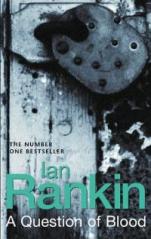
The other type of novel I like when I feel a bit under the weather is detective fiction. Although I have read Rendell, Kellerman, Patterson and others, I find that Ian Rankin’s Rebus just resonates the most with me. My favourite

question of blood

Rebus Novel is A Question of Blood. The murder takes place in a school; a shooting by a loner who then kills himself. I like this because it appears an open and shut case but, of course, it isn’t. As ever, Rebus’ personal life gets him into trouble and is as much a concern as the case he is working on when it seems he may have committed a crime in order to help DS Siobhan Clarke.

I try not to read books that I have read before especially when there are so many books waiting patiently on my to-read list but there are times when it is comforting to know exactly what you are going to get. And both Pratchett and Rankin never let you down.

Day 4 – Book turned into a movie and completely desecrated.

It took me quite a while to think of an answer for this one. As I have mentioned before, I think that the book is generally better than the film. Having said that, it was still difficult to think of a film that had completely ruined the book.

Don’t get me wrong, there have been things that have annoyed me about adaptations. For example, the chase scene at the end of The Boy in the Striped Pyjamas annoyed me immensely. The ending in the book is much more subtle and therefore more poignant. The rest of the film was, I thought, quite well handled though. The word desecrated seemed to suggest a bit more than mere irritation.

Eventually, I remembered my disappointment after watching the film

boleyn girlof The Other Boleyn Girl. I had been quite excited to watch it as it was an excellent read so expectations were high when I sat down to watch it with my mam who had also read the book.

I’m not sure how it is possible to take a book that is so packed with action and intrigue and make it limp and insipid but they managed it. Events were missing, the characters didn’t sparkle, there was no tension at all. Normally, I would have stopped watching but because I knew that the book was so good, I persevered. I kept thinking surely it must get better. I was wrong. This was a real damp squib of a film even when considered on its own merits and not compared to the book.


Day 3 – the longest book I’ve read

adwdAfter saying yesterday that I would probably always choose 2 or 3 books for each blog, there can be only one answer to this question so, for once, I was easily able to make
a decision. I will at least say that A Dance with Dragons is the longest book that still resides on my book shelf at 959 pages. If I have read a longer one than I can’t remember.
I’m a bit of a recent convert to the series, I have to admit. I read the first book ages ago but for whatever reason didn’t carry on with the series. However, the TV series reminded me how good it was so I decided to read all the books. This happened to coincide with the release of A Dance with Dragons earlier this year so I was able to continue reading without a break.
As the series is filled with action and surprises, I did not feel aware of reading a really long book. I could not put it down, in fact and read it far quicker than I expected. The only bad thing about finishing this book was the knowledge that I’d have to wait for the next one to be published.
This was made all the more difficult by the fact that Martin had created a series of cliffhangers; not just one but many. The novels are divided into chapters giving the life events of a particular character. By the end of
the novel, it became apparent that a number of characters were going to be left in great danger. I cannot wait for the next instalment.