Eclectic Reader Challenge 2013

So I have decided that as I have currently got so many new books – due to very kind people who know how much I read giving me Amazon or Waterstones vouchers for my 40th birthday and the fact that I have serious difficulty deciding on the next book at the best of times – that I need some serious focus. So I am going to do the Eclectic Reader Challenge this year. It requires the reading of 12 books in different categories, all of which sound quite interesting. It was surprisingly exciting to choose the books in advance. I thought it might spoil my enjoyment to have planned what I was going to read but in fact it is more enjoyable because I know what is coming next. Here are the books I have chosen to read for each category.

  1. Translated fiction – The Prague Cemetery – Umberto Eco, Venus in Furs – Leopold Sacher-Masoch
  2. Historical mystery – The Moonstone – Wilkie Collins, A Test of Wills – Charles Todd
  3. Romantic suspense – Come Onto These Yellow Sands – Josh Lanyon, Awaken – Katie Kacvinsky
  4. Made into a movie – The Virgin Suicides – Jeffrey Eugenides, Election – Tom Perotta
  5. New Adult – The Hunger Games – Suzanne Collins,  The perks of Being a Wallflower – Stephen Chbosky
  6. Urban Fantasy – Stardust – Neil Gaiman, Something Wicked This Way Comes – Ray Bradbury
  7. Dystopian – The Testament of Jessie Lamb – Jane Rogers,  The Road – Cormac McCarthy
  8. Memoir – Girl Interrupted – Susanna Kaysen. It’s Only a movie – Mark Kermode
  9. LGBT – The City and the Pillar – Gore Vidal, Rent Boy – Gary Indiana
  10. Action Adventure  – The Zombie Room – R. D. Donald, The Lost World – Arthur Conan Doyle
  11. Humour – A Walk in the Woods – BIll Bryson, I Can Make You Hate – Charlie Brooker
  12. Published in 2013 – Levels of Life – Julian Barnes

DAY 14 – Book that made you cry – Dancer from the Dance and The Book Thief.

I don’t want to sound hard-hearted but I’m not really given to crying when I read. It’s at least partly because I don’t read the right sort of fiction – or what I imagine is the right sort of fiction. Jodi Picoult for example, I imagine from the subject matter of her books would probably move me to tears. As I have already noted, I am not really romantic so those sort of stories pass me by. So it took me a little while to decide what I was going to write about.

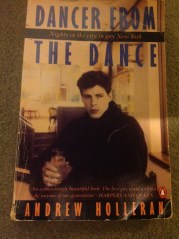
Dancer from the Dance by Andrew Holleran is one of those marvellous

photo (2)books that can have you laughing one minute and crying the next. Set in the New York Gay Scene in the 1970s, it is about one man’s search for some sort of meaning and some version of love in amongst the superficiality. Holleran brings the scene to life vividly. All of the characters are memorable, even if they only swim into the limelight briefly. In amongst all the chaos of the scene is Malone, exquisitely beautiful and extremely lonely. He seems untouched by everything while so desperately wanting to feel something. 

His friendship with the superbly catty queen Sutherland is at the centre of the novel and the reader becomes close to the both of them. It is this that renders the ending so very tragic and is so upsetting, Holleran frames the novel with letters from a friend who has left the scene and the details of the lives that have continued contained in these letters save the book from being too tragic and instead leave the reader with a more hopeful feeling.

My second choice is The Book Thief by Markus Zusak which is set in Germany in the second world war and is narrated by Death. I’m not sure what it was that was so devastating about this book. I have read other books

photo (3)

with similar subject matter (Schindler’s Ark, The Boy in the Striped Pyjamas, The Pianist, for example) without getting upset.

Perhaps it is the idea of Death watching us and narrating. The tone is strangely distant from the events that it sees. There are tragedies in this book and they are upsetting but the moment in this book that finally made me cry is a happy one. it is a hopeful moment that speaks of true friendship. And it is a relief.


Day 13 – A book that disappointed you. Lighthousekeeping and The Sense of an Ending

I try to avoid disappointment when reading. That is probably an obvious thing to say but I am quite a careful reader and I know what I like and what I don’t like. If, for whatever reason, I end up reading something I’m fairly sure I won’t like then I have lower expectations and so no disappointment ensues. I think the only time I am disappointed is when I read a book by a writer I really like and it isn’t as good as I expect. It is probably still a lot better than a lot of other books I read but my expectations lead me to expect too much from it.

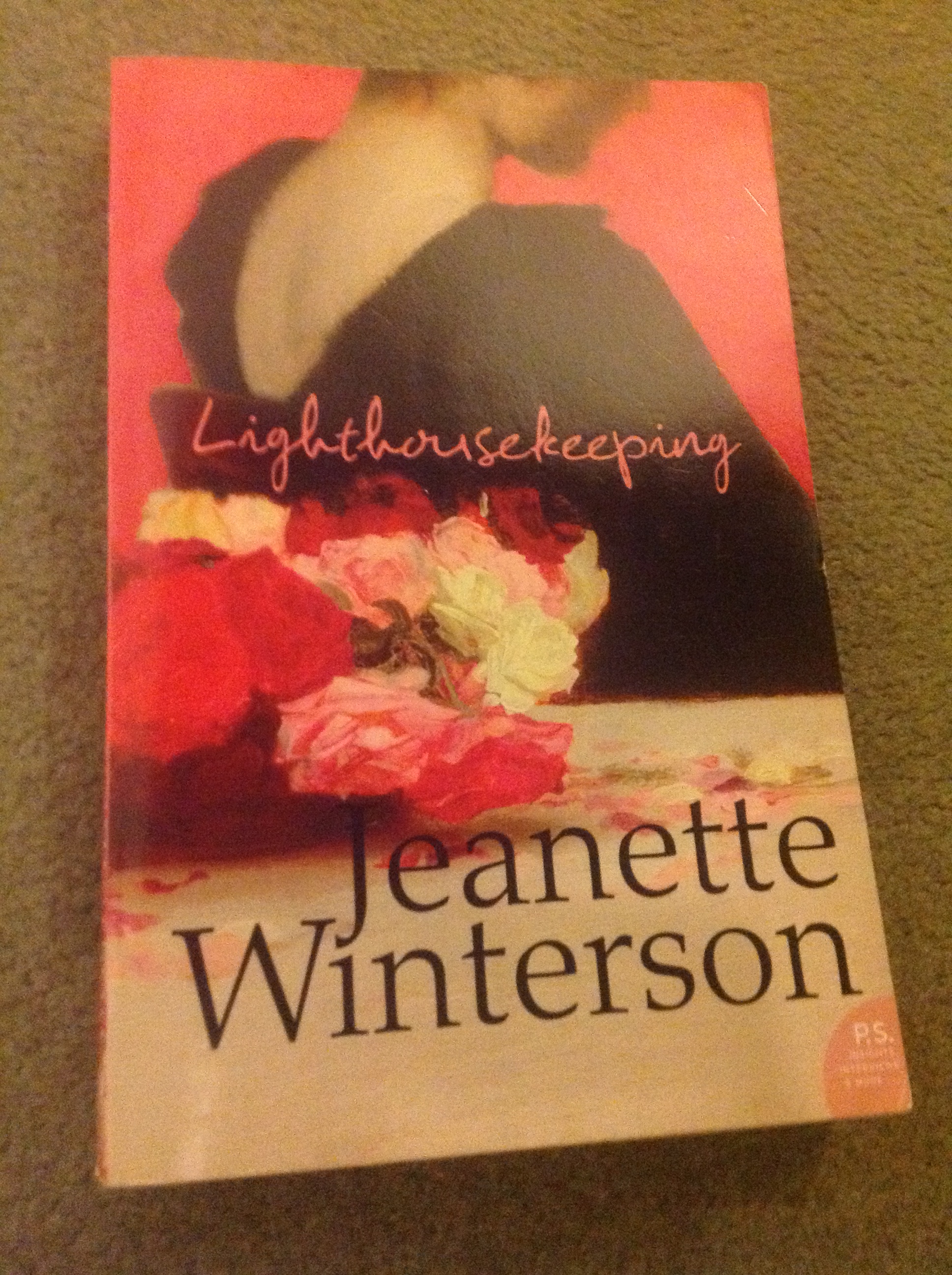
I first discovered Jeanette Winterson when I was at University and The Passion is one of my all time favourite books and I’d liked everything that she had written before. I couldn’t wait to read Lighthousekeeping. The excitement behind reading this book was made all the greater by the fact that as part of Off The Shelf, I went to hear her read an extract from the book. I was really expecting to love this book.

And it still contains all those things that Winterson is so good at;

photo (1)the poetic imagery, the love of language and playing with language, the telling of and de-constructing of the stories we tell ourselves. But at the end I felt dissatisfied. It was even difficult to say exactly why or what the problem was. It just felt a little hollow, as if I had expected this book be a three course meal and to fill me up but I was left still feeling peckish.

It was too insubstantial for me. The language didn’t seem to lead anywhere and I was left with a feeling that I had greatly missed the point.

I had a similar feeling when I got to the end of A Sense of an Ending. Again, I love Julian Barnes and have read The History of the World in 10 and a half chapters a number of times, as well as a lot of his other novels. Again the story is well told, the narration is strong and the main character is convincing

photo

but it didn’t seem to add up to a lot.

I’m sure I’m not the first person to say that I was both glad and not when this book won the Booker. Glad because it surprised me that Barnes had not won before with say Arthur and George, to name but one possibility. Not glad because I do not feel that this is Barnes’ best work by some stretch.

Perhaps my tastes are changing and both these authors are no longer what I really want to read. I hope not. I haven’t really returned to Jeanette Winterson after reading Lighthousekeeping which seems a little churlish considering how many of her books I have enjoyed. As for Barnes, I will have to wait and see what his next novel will be.

Day 12 – A book you wanted to read for a long time but still haven’t.

I have actually been quite good at hoovering up some of the long-standing members of my bookshelf. Over the last couple of years I have tried to make sure I read some things that have been shelf residents for a while. So, for example recently I have read Schindler’s Ark, Day of the Triffids, Ark Baby, The Pianist, Half a Yellow Sun, all of which had been hanging around for a while.

However, it really is a list that never ends. I almost never buy books in just ones. (Especially as the kind people at Waterstones often seem to have offers such as buy one get one half price or three for two and it would be rude not to indulge them.) So inevitably there are always books that wait along time to be read.

Here is a list of the long standing ones that I hope to read this year:

  1. The Virgin Suicides – Jeffrey Eugenides
  2. The City and the Pillar – Gore Vidal
  3. Girl Interrupted – Susanna Kaysen
  4. The Moonstone – Wilkie Collins
  5. The Player of Games – Iain M Banks
  6. Something Wicked This Way Comes – Ray Bradbury
  7. Glamorama – Bret Easton Ellis
  8. Rentboy – Gary Indiana

No doubt their places will be taken by other books that I have bought or have been bought for me and are even now waiting eagerly to be read, only to be bitterly disappointed.

Day 11 – Favourite classic book – Great Expectations, The Catcher in the Rye, Dr Jekyll and Mr Hyde

This is a bit of a grey area for me, I must admit. I don’t do much in the way of reading classics and a lot of the ones I have read I don’t like very much. Tess of the D’urberville’s, for example. Really didn’t like that. Not a big fan of Jane Austen either. Some Dickens I have loved, some I have hated – A Tale of Two Cities is a good example of a book not enjoyed. For a relatively short book, it took a long time to read because I could hardly bare to pick it up. I have tried to read Middlemarch three or four times. (This is another area that I fall out with my father in law about. Hardy is his favourite author. Middlemarch is one of his favourite novels. It is definitely a case of what I love he hates and vice versa.)

My first choice is a book I first read when I was at school and have since read and taught myself. Great Expectations is a great story and
great expectations

I think as a teenager, it was the pace and the plotting that I appreciated. That is why there have been so many adaptations of this novel. Even when you know how it all works out in the end, the run up is tense and exciting.
Then there are the great characters – the ones that everyone knows even if they have never read it – Miss Havisham in her wedding finery, Magwitch the archetypal convict and Estella, so very cold and proud. Even the minor characters are well written and convincing.

As a teacher, what I appreciate are the descriptions and the atmosphere that Dickens creates. The descriptions of the graveyard at the beginning are haunting as is the decay and despair of Miss Havisham’s quarters.

The Catcher in The Rye by J D Salinger starts with a reference to Dickens with the narrator, Holden Caulfield, saying I suppose that you want to hear about my childhood and all ‘that David Copperfield kind of crap’ but
catcher-in-the-rye

he refuses to go into it because ‘that stuff bores me.’ This is a good indication for the reader of what the novel is going to be about and also the nature of Holden’s character. He spends the a lot of the novel avoiding issues and his own emotions.

This is a novel about grief, alienation and the pain of growing up. Holden finds it hard to deal with his peers and has equal amounts of trouble dealing with the adults in his life. He feels that everyone else is phoney and so leaves his expensive school. However, he is unable to settle anywhere else. Whilst this novel could be described as a bildungsroman, it seems to me that Holden does not really learn anything throughout the novel. His psychological journey does not lead him to any new understanding. Whilst this may be a little depressing, it seems to me that this is apt. It would be unlikely for Holden to suddenly be able to see clearly. After all, he is still young at the end of the novel and is likely in a mental hospital. His psychiatrist asks him if he is going to apply himself when he goes back to school. Holden is still unwilling to play the game and give the answer that is expected of him. Instead he says it is a stupid question because he couldn’t possibly know. It seems unlikely to me that he will be any more able to cope.

Finally, I have chosen The Strange Case of Dr Jekyll and Mr Hyde, a masterpiece of horror. This is another story that has been adapted many times but unlike Great Expectations, I do not think that any of the films really live up to the horror of the original story.

The structure of the story describes events to the reader, suggesting and hinting at the horrors that have occurred and although there can

dr-jekyll-mr-hyde-robert-louis-stevenson-paperback-cover-art

be few who come to this book unaware of the relationship between Jekyll and Hyde, it is still a masterful set-up which leaves the full truth until the very end of the novel when Dr Jekyll finally getting to describe events from his point of view.

Jekyll’s story is truly horrific as he starts to lose control of the baser side of his nature. His horror at what he has done is unbearable, for him as well as the reader. Hyde represents the childlike, socially unreconstructed side of human nature which grows stronger as soon as it is given some free reign. The tale is a powerful metaphor about the nature of respectability and the binary opposition of good and evil. It suggests that we should look closely for what is hidden.

 

Day 10. – A book you thought you would hate but ended up loving – The Memory Keeper’s Daughter and The Book of Lost Things.

I always feel a bit suspicious when someone says that they’ve just read something and think I will really like it. For a start, it says something about what they think of me and if I don’t like it, might suggest that they don’t know me as well as they thought. No pressure then.

Both of the the books I am going to talk about today were recommended in such a way. Both times, I was not immediately convinced that I would like them but because the two friends were avid readers and generally had good taste. I gave it a go.

The first book is The Memory Keeper’s Daughter by Kim Edwards. I was not looking forward to starting to read this book for a couple of reasons. It is about a girl with Down’s Syndrome and having lived with a brother who, although he didn’t have Down’s, was physically and mentally disabled, I was worried what emotions the book might bring up for me. My brother had died not long before I read this book and there were a lot of feelings that I didn’t want to examine too closely.

The second reason I didn’t want to read it was more mundane. I

memory-keepers-daughter

was worried it would be like some dreadful American movie that gets shown on daytime TV in order to make housewives cry. I am not good with sentiment or melodrama (unless of course, it is me being melodramatic. Obviously, that is different.)

Of course, the book is nothing like this. It is emotional, definitely, and it did make me think about my own feelings towards my brother. That was a good thing, in the end, and helped me understand the way I was feeling. The ending of this book is truly hopeful and life-affirming. I would never have picked this book for myself and was immensely grateful to the person who suggested it to me.

I’m not sure why I was so positive that I would not like The Book of Lost Things by John Connolly. I think I thought it sounded a little clichéd  In fact, it is a magical tale about grief, anger and the power of myths and fairy tales. Connolly successfully gets inside of the head of the main character David, a little boy who has just lost his mother and the point of view is consistent and convincing. He shows clearly David’s lack of understanding of his situation.

As the story continues, David becomes less and less attached to reality. He has blackouts and hallucinations where he is in another land; a land of woodsmen and wolfs, trolls, enchantresses and The Crooked Man. As David’s attacks grow worse, he hears his mother’s voice asking him to rescue her and his adventure truly begins.

book of lost things

Like all fairy tales, this story is instructive and also moral. It is a story of the difficult transition out of childhood when you start to learn life’s lessons. It’s also a book that is about the importance of reading and

how much books can help you when life becomes difficult. This is a view that I wholeheartedly support.

Day 9 – Most Overrated Book – David Nicholls and Ian McEwan

The words don’t get me started spring to mind. Narrowing this post down to just a few books was not easy, believe me. For this reason, I decided not to have another swing at 50 Shades of Grey when I have already blogged about it once. I don’t really feel that it is worthy of more of my blog space. So let’s just take it as a given that I think that 50 Shades, Twilight and their ilk are overrated and I’ll have a rant about some other books instead.

My first choice is One Day by David Nichols. This book went round my co-workers like a particularly virulent dose of the flu. Everybody loved it. Everybody thought it was tragic when… I was one of the last to succumb as I already knew it was probably not the sort of thing that I would like (due to my anti-romantic nature). Nevertheless, I gave in and bought a copy. Perhaps my expectations were too high.

It is quite a neat idea – the same day year after year but it quickly seemed that the days were not that different from each other, particularly at the beginning. Then there was the fact that both characters were unappealing but particularly Dexter. If the novel was building towards a romantic end

one_day_big

for these two, I felt that it seemed more than a little unfair on Emma, who although annoying was nowhere near as obnoxious as Dexter. So the romance was already alluding me.

Don’t get me wrong, it isn’t badly written and I have read another David Nicholls book which I did like better, I just thought it was a little forced and the characters seemed more like types than people. I wasn’t bothered really even though the events could be described as tragic. There was no emotional resonance. I felt like I should be saying please try harder.

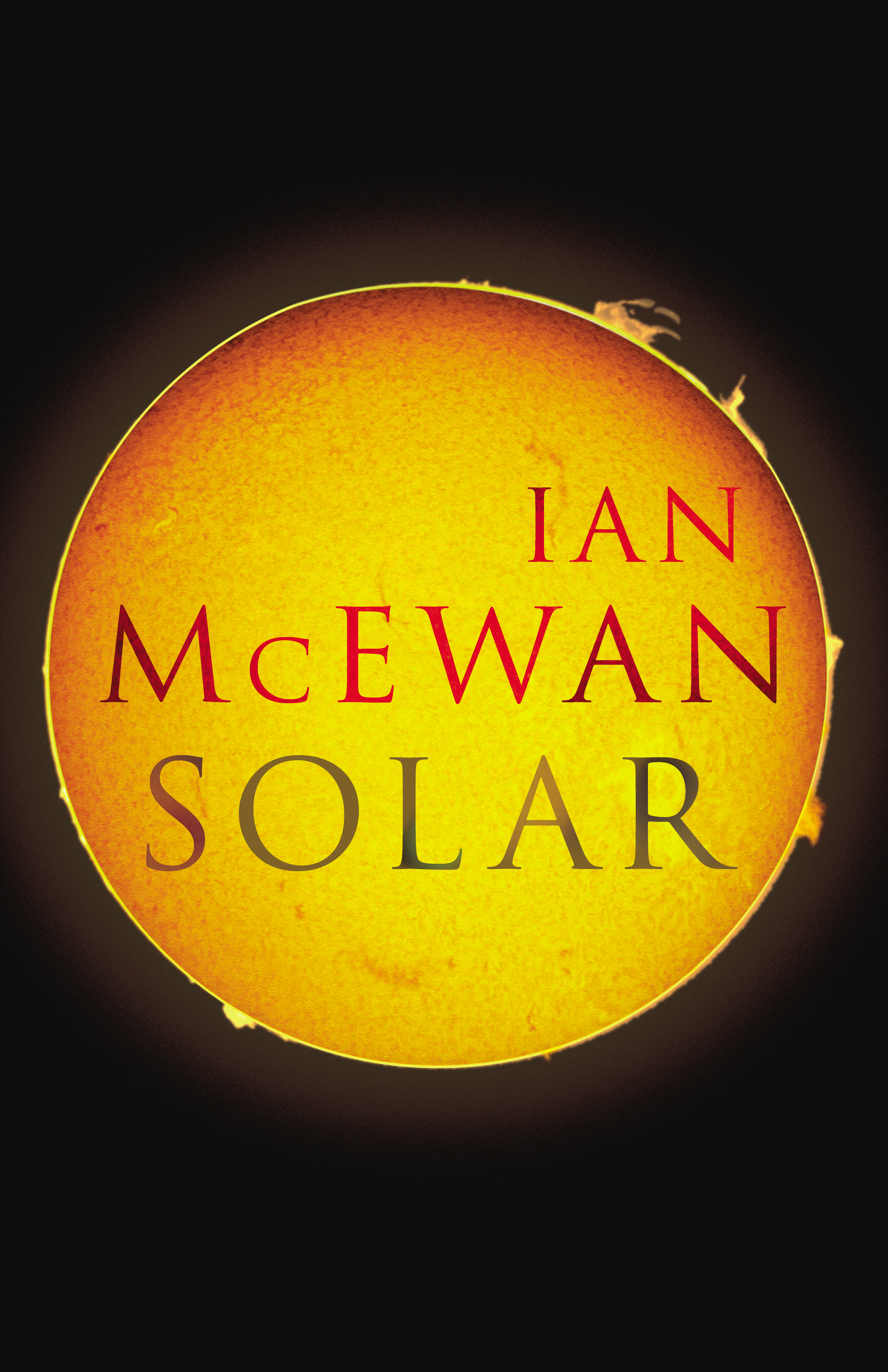
My second choice is Solar by Ian McEwan but it could be any of his more recent novels. I used to quite like Ian McEwan and was happy studying him for my MPhil. I don’t know if my tastes have changed or if his writing

Solar_2331

style has become more pretentious but I find it harder and harder to read his work. It seems, more and more, that he writes like a man in love with his own prose. The sentences scream off the page ‘look at me, look at how clever I am’. This is more than a little off putting.

His characters are also becoming more and more obnoxious. Michael Beard, the protagonist of Solar is a womaniser, he steals another’s ideas and claims an enormous amount of fame and money afterwards. I’m quite fond of unreliable narrators who are difficult to like but there was little that was appealing or even worthy of empathy. Again, I was left not caring about his inevitable downfall. It is disappointing that McEwan seems to have almost become a parody of himself.

Day 8 – Books that are underrated – A Disaffection and The People’s Act of Love.

I have to confess that I don’t really follow fashion or know what is underrated. So the books I am going to mention are ones that I have read but not many people I know have read and I feel that they would enjoy.

The first book I have chosen is A Disaffection by James Kelman. It has one of my favourite opening lines – “Patrick Doyle was a teacher. Gradually he had become sickened by it.” It sums up very neatly exactly what happens in the novel as Patrick becomes more and more disaffected with his life in gen9780330307369 (1)eral and his career choice in particular. Gradually, his behaviour becomes more erratic and the narrative voice- although third person – becomes increasingly rambling along with it. It becomes difficult to tell where the third person narrator ends and Patrick’s thoughts begin. This could show just how removed Patrick is from his own life, unable even to grasp a first person narration of his own life.

This is a very down to earth novel and was one of the first books  I read that used dialect words and to have the rhythm of working class language. This appealed to me and also influences me as a writer as I am from a working class background myself. It was also the first time I had read a book that played around with the rules of grammar and punctuation – for example not using apostrophes in words such as shouldnt or question marks at the end of questions. Sentences break off without warning into new paragraphs. Others are left unfinished. This cleverly shows the fragmented nature of Patrick’s thoughts. After all, few people’s thought processes are as clear cut as they appear in most novels. Inside your own head, you don’t have to make complete sense as you are the only one who needs to understand.

This novel is an examination of the human state reminiscent of Kafka and just as surreal at times even though it is grounded in realism. The end of the novel is one of the most poignant I have read. The reader knows that the future is not looking good for Patrick as his final thoughts in the novel are about suicide. The final words are “Ah fuck off, fuck off.” This shows that Patrick is no closer to being able to deal with the world now then he was at the beginning, in fact things are an awful lot worse and likely to continue in that fashion. There is no need to continue the novel as the rest of Patrick’s life is summed up in those five words.

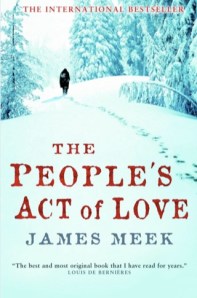
The second book I have picked is The People’s Act of Love by James Meek. It is set in Siberia in 1919, a time and a place I knew nothing about. It begins with the appearance of a mysterious stranger who has escaped from an Arctic prison and who claims he is being chased by a cannibal. This is an exciting narrative that is full of twists and turns and containing some of the

peoples_act_of_love

most interesting characters I have come across.

For me, the main success of the book was making interested in a time in history that I had previously not even considered and the author is clearly knowledgeable about the era, including things such as the Russian sect of Castrates called Skoptsky and also about The Czechoslovak Legion fighting in the Russian Civil War which i don’t think are common knowledge. When I finished this book, I had an urge to find out more, surely the sign of an excellent book.

Day 7 A book that is a guilty pleasure

I’m not sure that I really believe in the concept of a guilty pleasure when it comes to reading. I like what I like and I am not ashamed of any of it. Nobody else should be either. I tend to assume that because I like it, it must be of a quality. I know, that’s a particularly circular argument but I genuinely believe it. And it’s quite an easy thing to say when you don’t read anything that might be considered particularly trashy.

Of course, it is only my opinion. For example, my father in law cannot understand why I read any of the fantasy books I like. In fact, he says he wouldn’t even call them literature. I know that he means Terry Pratchett when he says that. So maybe I should view them as a guilty pleasure but to me, they just are a straightforward pleasure. They make me laugh and they make me think. Surely, you can’t get better than that.

Day 4 – Book turned into a movie and completely desecrated.

It took me quite a while to think of an answer for this one. As I have mentioned before, I think that the book is generally better than the film. Having said that, it was still difficult to think of a film that had completely ruined the book.

Don’t get me wrong, there have been things that have annoyed me about adaptations. For example, the chase scene at the end of The Boy in the Striped Pyjamas annoyed me immensely. The ending in the book is much more subtle and therefore more poignant. The rest of the film was, I thought, quite well handled though. The word desecrated seemed to suggest a bit more than mere irritation.

Eventually, I remembered my disappointment after watching the film

boleyn girlof The Other Boleyn Girl. I had been quite excited to watch it as it was an excellent read so expectations were high when I sat down to watch it with my mam who had also read the book.

I’m not sure how it is possible to take a book that is so packed with action and intrigue and make it limp and insipid but they managed it. Events were missing, the characters didn’t sparkle, there was no tension at all. Normally, I would have stopped watching but because I knew that the book was so good, I persevered. I kept thinking surely it must get better. I was wrong. This was a real damp squib of a film even when considered on its own merits and not compared to the book.