Eclectic Reader Challenge 2016 – The Kraken Wakes – John Wyndham

2016eclecticreader_bookdout

Genre: Dystopia, Disaster

Narrative Style: First person

Rating: 4/5Unknown

Published: 1953

Format: Paperback

Synopsis: The first sign that anything is amiss is when strange globes start to appear over the sea and then sink under the waves. Nobody thinks anything of it at first but then ships start to disappear and worse, islands start to be attacked. Mike Watson and his wife, Phyllis are caught in the reporting of the events as they quickly escalate. 

Unlike a lot of disaster style fiction, this novel takes you through events as they happen rather than what happens afterwards. At the beginning, Mike and Phyllis Watson are watching icebergs flow past them. Clearly something has gone very wrong. They decide that an account needs to be written of what has brought the world to this sorry state.

There are three separate stages to events. The first is the seemingly harmless phenomenon of strange red balls in the sky that seem to disappear under the waves. Next ships start to disappear and attempts at discovering what may be beneath the waves end with ships being destroyed along with strange creatures starting to invade islands and coasts. When people start to fight back and the creatures are curtailed then the icebergs start to mysteriously melt and the flood waters start to rise.

Mike and Phyllis are journalists and this is apparent in the report that Mike writes. There is a distance between them and events – with them often reporting back about events that they have not actually seen. Consequently the reader is a little distanced from it as well. There was little in the way of emotional response from Mike even when he describes having to get away from it all because he is stressed by events.

Wyndham allows Mike to comment on world affairs and reactions and this is much more successful. The comments about Russian and American reactions and about Government propaganda were apt and clever. The character of Bocker, who in the beginning prophesies doom, goes through many stages in the book – starting off being ostracised until finally he is the only one who has actually got anything right. This shows how the media works to create heroes and villains when it suits them.

I found the ending a bit disappointing. Perhaps because it seemed a bit too neat. It reminded me a little of my disappointment at the end of H G Wells The War of the Worlds. It was almost like a cheat. Or like Wyndham had got fed up with telling the story. Apart from that, this was a very enjoyable and very clever tale of disaster and the way that Governments respond to them.

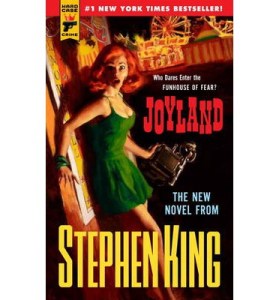
Eclectic Reader Challenge 2016 – Joyland – Stephen King

2016eclecticreader_bookdout

Genre: Crime, Supernatural

Narrative Style: First person recount

Published: 2013 – part of the Hard Case Crime series9781781162644

Rating: 3/5

Format: Kindle

Synopsis: Devin Jones takes a summer job at Joyland funfair and discovers the ghost of a girl murdered on the ghost train. After he and his friend Erin investigate, they discover other girls killed while the carnival was in town. Was there a serial killer on the loose?

Reading Challenges: Eclectic Reader Challenge 2016 – genre Serial Killers

That synopsis makes this story sound a whole lot more exciting than it really is. I was hoping for a hard boiled crime story with some blood and gore on the side. I haven’t read any Stephen King for a while (in fact that last one I read was probably Needful Things when that came out in 1991) but I was hoping for good things.

To be fair, a lot of the things that King is really good at are present here. The sense of Devin looking back on his life with a sense of nostalgia and pain was very well written. Devin himself was believable and likeable. The ghostly elements were quite well handled and I was willing to suspend my disbelief.

The problem was there was just too much other plot going on. The ghost is introduced quite early on and then there is a lot of setting the scene with Devin explaining about his soon to be ex-girlfriend. I kept thinking, when are we going to get on with the action. In the middle, there is a flurry of activity and we learn that there is indeed a serial killer but this is quickly put on the back burner again.

This is supposed to be a crime novel but it really wanted to be a romance. The story of Devin and Annie and her disabled son Mike was necessary to the plot but I felt it took up too much time. It really slowed the pace. As a consequence, when the killer is revealed at the end, it seemed rushed and unbelievable. I didn’t spot who the killer was although the clues were all there. That wasn’t the problem. I don’t want to give any spoilers but I found it unsatisfactory.

I haven’t read any of the other books in this series but in this case Hard Crime is a misnomer. There is nothing hard about this book. It is completely soft and the ending was overly sentimental and corny. I couldn’t help feeling that King could have done better.

Finally, I feel the carnival setting was ultimately wasted. Carnivals are a little strange and sinister at the best of times. This could have been exceptionally creepy. Instead, it is all giant dogs dancing the hokey cokey and disabled kids getting the ride of their lives. Too sweet for my tastes, I’m afraid.

The Non-Fiction Challenge – We of the Never Never – Jeannie Gunn

2016 Nonfiction Challenge

Genre: Autobiography / memoir

Narrative Style: First person, chronological

Rating: 3/5

Published: 1908Unknown

Format: Kindle

Synopsis: Jeannie Gunn is newly married and has moved out to Elsey Station with her husband. This is an account of the first year. Although published as a novel, the work is recognised as being autobiographical. Jeannie changed the names of the principal characters to keep their identity secret.

I must admit, I thought I might enjoy this more than I did. It does give a strong impression of what life must have been like in the Never Never. The difficulties are described vividly and I know that I would not have been able to cope. Jeannie herself is a strong character who faces all challenges head on including the attitudes of the men already at the station.

The problem is there is no real tension. Events never build to a climax nor is there any sense of real danger. Jeannie is unrelentingly cheerful no matter what is thrown at her and that is a little wearing as well.

I found it hard to keep in my head who was who and I would have preferred it if the others had real names rather than the Dandy, the Quiet Stockman and so on. I found I couldn’t distinguish between them or get a handle on what they were like.

Finally, there is a liberal use of the N-word and that was a little hard to take even when I know that it wasn’t racially charged in the same way it is now. Events such as the ‘nigger-hunt’ are described as if it were merely a picnic and not a potentially lethal clash between white and black.

As a historical document, this is interesting and shows what life was like at that time. As a casual read, it wasn’t a lot of fun.

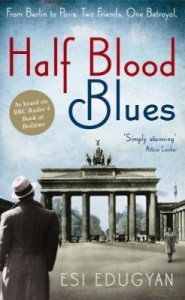
Eclectic Reader Challenge – Half Blood Blues by Esi Edugyan

2016eclecticreader_bookdout

Genre: Historical Fiction, War

Narrative Style: First person moving between present and 2nd world war11076123

Rating: 4/5

Published: 2011

Format: Paperback

Reading Challenges: Eclectic Reader Challenge 2016 – genre – nominated for the Booker Prize (2011)

Synopsis: In 1940, rising jazz star Hiero Falk is picked up by nazi soldiers in Paris. No one is sure what happened to him after that but he is presumed dead. In 1992, a documentary is made about him that brings Hiero’s friends and bandmates Chip and Sid back to Berlin. Sid was the only witness on the day Hiero disappeared and he finds memories coming back to him that he had thought long buried. 

Edugyan’s novel is written from Sid’s point of view and in his voice which gives the prose an almost jazz like rhythm. It was very easy to read and also gave a clear picture of what Sid was like.

At the beginning of the novel, he and Chip are preparing for a trip to Berlin for an airing of a documentary about Falk and the record they made called Half Blood Blues. Sid is clearly reluctant. Even more so when Chip announces that he has been contacted by Falk who is not dead but living in Poland and he intends to go to see him. It is clear what Sid has secrets and memories that he does not want to face. Nevertheless, he goes with Chip to Berlin.

The story shifts easily between the present day (1992) and 1939-40 in first Berlin and then Paris. Sid is a bit of a nervous character and his fear and worries give the reader a good impression of what it must have been like to be black at that point in history. It was an angle I hadn’t really considered and it certainly made me want to find out more it.

Sid and Chip are both scarred by their experiences, as is Hiero when they finally meet up with him. The revelation of what Sid has done is shocking and his final confession to Hiero is touching. I felt that the novel ended a little awkwardly and it could have been taken a little further. As it was, it just stopped suddenly, leaving a lot of questions unanswered.

Overall, this was a very enjoyable story which gave an unusual (to me anyway) perspective on the second world war.


The Power of Beauty – Nancy Friday

2016eclecticreader_bookdout2016 Nonfiction Challenge

41M5MWGCWDL._SX296_BO1,204,203,200_

Genre: Psychology, feminism

Narrative Style: Informal, first person

Rating: 2/5

Published: 1997

Format: Hardback

Synopsis: Friday analyses the way beauty effects female lives. She uses psychoanalysis to investigate events early in her own life that she feels have held her – and all women – back. She uses anecdote and fictional examples to support her ideas.

Challenges: Eclectic Reader Challenge and Non Fiction Challenge

This book was a slog. I very nearly didn’t finish it. (It took me a month to read it, I was that irritated with it and it has gone straight on the charity pile.) The main problem is Friday’s tone. She sounds hard done by – especially in the early chapters. She blames a lot of her issues on problems with her early childhood. Her father abandoned their family and she felt her mother loved her sister more as she was prettier. This lack of loving gaze meant that Friday was lacking in confidence about her looks. This seems disingenuous when you look at the author picture and Friday is indeed a beautiful woman. She later says that by the time her looks came in, it was too late for her to believe that she was beautiful. She uses psychoanalysis to help her understand how her formative years were so important in making her the person she is. To a certain extent this is fine. I am happy to agree that psychoanalysis is a useful therapeutic tool but Friday takes this one step further. She then extrapolates from her personal experience to all women lacking the gaze from their mothers. My own experience of childhood was completely different from Friday’s. My father was very much involved in childrearing and my mother worked because she had to. How can Friday assume that my issues will be the same as hers?

Friday does seem to see all women as being the same as her. That is white, privileged, straight and American. She sees gender as the only issue affecting women and men. (And men are masculine and women are feminine in this little world.) All of the examples she gives are from the business world or from friends who are writers and artists. Hardly representative of the whole human race. Which is also fine but if you are going to talk about all women, perhaps you should think about what that really means.

At one point, Friday talks about sexual harassment in the office. Instead of blaming men, she says, we ought to think about how women have changed the atmosphere of the office by coming in to work dressed sexually and making it hard for men to understand the new rules of the office. There may be some truth to this. Undoubtedly more women being in the office has changed the dynamic between men and women but lets not let men completely off the hook. Harassment suggested a sustained campaign. Sexy clothes are no excuse for that sort of behaviour.

Similarly, when Friday talks about the media and its affect on women’s perception of beauty, she seems to let the media off the hook as well. She says that women aren’t so easily brainwashed. Well, true, women can think for themselves but there is also no doubt that the media influences how we feel about and see beauty around us. How Friday can discuss beauty for older women and not challenge the way beauty is seen in the media as a youthful characteristic, I do not know. Again, she puts the blame squarely at the feet of other women without stopping to think about what may make women act in this way.

Rightly, Friday says that we shouldn’t blame men for all of our ills. I remember being thoroughly depressed by some of the authors she mentions – Dworkin and McKinnon, for example. But instead of suggesting that patriarchy affects all of us, she goes on instead to blame other women. This is no more helpful that saying all men are evil. It is finding just another scapegoat instead of actually challenging any of patriarchy’s expectations.

Overall, I was disappointed with how personal this book was. I enjoy reading about others’ experiences, however, this was not an autobiography, this was supposed to be about men, women and beauty. Really it is just about Nancy Friday.


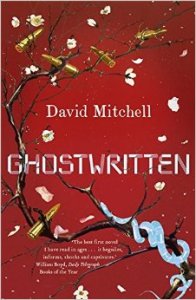
Books Read in 2015 55. Ghostwritten by David Mitchell

Genre: Post-modern, literary fiction

Narrative Style: A range of first person monologues that are linked in subtle ways51MnXKfLFfL._SY344_BO1,204,203,200_

Rating: 4/5

Published: 1999

Format: Kindle

Synopsis: The story starts with a member of a cult who is on the run then moves to a jazz lover in Tokyo and then to a lawyer in Hong Kong who is in over his head and continues moving through seemingly disparate narratives to the end. However, there are links between the characters – some more subtle than others – and slowly an overarching narrative is revealed.

This is an exceptionally clever book. The range of different voices is astonishing and all are carried off with aplomb, all the more remarkable given that this is Mitchell’s debut novel. As the novel progresses and more of the underlying plot is revealed, the more you have to admire Mitchell’s skill.

As you might expect, with such a novel, some of the characters were more appealing than others. Some I could have read a whole novel about and felt bereft when the story moved on, others I found I just wanted to get through their chapter. This is particularly true of the chapter from the point of view of a spirit (if that is the right word) who has floated from person to person until they are eventually reborn in Mongolia.

However, the overarching narrative kept me reading and I was curious as to how the tale would end. The ending was satisfying whilst also offering a scary commentary on the uses of AI in war. The different narratives investigate different ways of being, different ideas about the soul, about intelligence and about free will. It makes sense then that this novel would end with a machine that is virtually sentient.

Overall, this was an enjoyable novel where the reader had to work in order to put the pieces together and make the links that Mitchell requires. I always enjoy having to work in this way and it certainly made me feel that I wanted to read more of Mitchell’s writing.

Books Read in 2015 – 54. The 100 Year Flood – Matthew Salesses

Genre: Literary Fiction, Magic Realism51HTxer-rdL._SX331_BO1,204,203,200_

Narrative Style: Third Person from different perspectives, non-chronological

Rating: 4/5

Published: 2015

Format: Kindle

Synopsis: Tee is living in Prague when the floods come. He is trying to find a new identity for himself and a new home. When he is asked to model for artist, Pavel, his life begins to change. Little does he realise exactly how much of his identity will be washed away when the floods come and he finds himself back in America.

It has to be said that Prague is the perfect setting for a story that is full of magic and legends. The city is beautiful and has an air of wonder about it that I have never experienced in any other city. Salasses certainly does justice to the setting with this tale of love, identity and wonder. The city is almost like another character, adding its own personal touch to the story.

The action shifts between Tee in America in hospital with no memory and his life in Prague after he meets Pavel, the artist and his beautiful wife, Katka. Tee immediately falls in love with the older woman and soon they are having an affair. Katka seems almost magical herself, spinning stories of her childhood and of the legends of the city.

As they only meet when it is raining, it makes sense that when she finally leaves Pavel, it should be at the start of the flood. However, when the pair ignore the warnings about evacuating, things start to take a darker tone.

This was one of those books where I wanted to start it over again immediately so I could try and recapture some of the magic and wonder that was destroyed by the horror of the ending. I could not put this down and felt bereft at the end, a sign of how powerful the characters and the story were. An excellent debut.

Books Read in 2015: 53. Persuasion – Jane Austen

2015tbrbutton

Genre: Romance, Classics

Narrative Style: third personimages

Rating: 3/5

Published: 1818

Format: Paperback

Reading Challenges: TBR Challenge

Time on Shelf: I’m not really sure where this copy of Persuasion came from – my husband wasn’t sure either – but it was definitely with us when we moved to this house 8 years ago and quite possibly has lived with us for a lot longer.

Synopsis: Eight years before the start of the story, Anne Elliot allowed herself to be persuaded against marrying Captain Wentworth. Anne completely regrets this decision. She is 27 and still unmarried when Wentworth reappears in her life. Her family are on the brink of financial ruin and Wentworth is in a much better position than before. Will they be reunited in their love or will persuasion again work against them?

I may have mentioned before that I don’t often read the classics. And one of the reasons is that it always feels a little like a school assignment. I’m reading this because it has been deemed a classic rather than I have chosen this because it sounds good. This was no different. It wasn’t particularly a chore – indeed Austen’s prose is pleasurable enough to read – but it didn’t really grab me.

The other thing against it is the fact that it is a romance. This is not my favourite genre. And while there is some interest to be had from the ironic social observations and the well drawn characters, in the end it was just another love story. The only thing that saved this from a lower rating is the fact that it is so well written.

Austen is very good at satirising vanity. The satire was particularly sharp when it came to the vanity of Anne’s father and her sister, Elizabeth. Their vanity was out of keeping with their financial standing and Austen never missed an opportunity to point out their ridiculousness. There was also amusement to be had from the description of the third Elliot sister, Mary who is ridiculously self serving. Their is no doubting that Austen is a master of her craft, this is just not really the sort of book I enjoy.

Books Read in 2015 52. The Woman in Black – Susan Hill

Genre: Supernatural Thriller, Historical Fiction

Narrative Style: First person, flashback framed by a story telling session on Christmas Eve51cxm9AmChL._SY344_BO1,204,203,200_

Rating: 3/5

Published: 2001

Format: Kindle

Synopsis: It’s Christmas Eve and the Kipps family have settled down for the traditional telling of ghost stories. Arthur Kipps is reminded of his own supernatural experience, something that is has taken him years to recover from. He then tells the tale of Eel Marsh House and the Woman in Black that haunts it. 

I’d been meaning to read this for a long time – from before the release of the film. I love a good ghost story and this had a lot of promise. And indeed, the beginning of the tale sets the scene quite successfully. Kipps is reluctant to tell his story and the descriptions of Eel Marsh House also seem to suggest that there is a terrible tale to be told.

And at first, it is suitably creepy. The locals warn him against staying at the house but everybody clams up when the probed too closely. However, Kipps is young and determined to prove his bravery so he does not take heed. It isn’t long before things start to go bump in the night and Kipps nerves (like those of the reader) are in shreds.

However, this early tension is wasted and the story fizzles out. Although Kipps finds evidence of who the Woman is Black is and why she is haunting the area and even though she exacts a final revenge, I was left oddly untouched. It seemed hurried and so the scares were not as effective as they could have been.

It may be another case of better read before the movie is viewed. Or maybe it is just that film as a medium is so much better able to scare. Whatever the reason, I felt let down by this in a way I didn’t by the film.


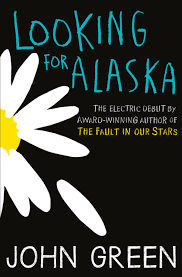
Books Read in 2015 51. Looking for Alaska – John Green

Genre: Young Adult, Bildungsroman

Narrative Style: First person

Rating: 4/5Unknown

Published: 2006

Rating: 4/5

Format: Kindle

Synopsis: Miles Halter thinks that going away to boarding school is going to be a great adventure but little prepares him for the way his life is going to change when he meets Chip Martin and Alaska Young. 

I had mixed feelings about reading another John Green. While I enjoyed the others that I read, I also found his style a little annoying as everything is overblown with significance. However, I enjoyed this more. Maybe it is because it was his first novel but it isn’t quite so over the top.

The characters were well drawn and I took to Miles straightaway with his obsession with last words and his longing for something more. I have to say that these kids are much more well read and intellectual than most of the teenagers that I come into contact with but that is not to say such kids don’t exist. Both Alaska and Chip were convincing as well, both representing different sorts of teenage angst.

The story counts down – some many days before – to an event and I have to admit, I did not see what this event would be. I assumed that this was the prank they were planning and not the terrible thing that actually happened. As a result, I was completely shocked and upset by it – almost as much as Miles himself.

Ultimately this is a book about grief and about learning to let go, lessons Miles in particular finds it hard to learn. it is about growing up and about not giving up. In the end, I felt hopeful for Miles and for his future.