Books Read in 2014 – 13. The Sociopath Next Door – Martha Stout

Genre: Academic, Psychology
narrative style: first person, case studies and analysis
Rating:3/5
Format: Paperback
Published: 2005

Synopsis: Stout recounts examples of sociopathy from her practice as a psychologist and analyses what the origins of such behaviours are. 

This book was part research, part pleasure. I have always been fascinated by the psychopath or sociopath in fiction and film. As such, in my next book, I have a character who has some features of sociopathy and I have been reading around the subject for a while.

The book opens with a discussion of conscience and the way most of us react in circumstances when we might have to make a sacrifice in order to help others. This is called the seventh sense and according to Stout 96% of us have it. The other 4% are sociopaths. This seems quite a large amount. And it seems that most of us will have come across at least one in our lives. She then describes exactly what she means by living without conscience. This is by far the most interesting part of the book. Stout uses case studies to illustrate the symptoms of sociopathy and they are quite horrific to read. But also, I must admit, fascinating. Perhaps it is the thought of what it would be like to never feel any obligation towards another person – intriguing but almost impossible to imagine.
She also charts the origins of conscience in a few different ways – religious, evolutionary, psychologically – all of which are also interesting. Personally, I am most drawn to evolutionary theories – what’s good for the group is good for the species. After all, as Stout points out, if we all did exactly as we pleased, the whole species would very soon die out.
However, there are irritating things about this book. There is something deeply spiritual about Stout’s version of conscience which, as an atheist, I found quite hard to stomach. One of the later chapters is devoted to religious leaders who have suggested do into others as you would to yourself as a way of life. This is not really what I would have expected from a psychological all study. It all gets a bit subjective.
Stout seems to want to have her cake and eat it. She obviously feels that she can judge sociopaths lacking as they do not have the emotional connections that we good folk with consciences have. Which maybe true. But she also suggests that sociopathy is a mental illness and may be, at least partly, innate. If this is the case, the it is hardly fair to pass moral judgement.
Finally, there is a sense of either you are a sociopath or you are not. It is black or white. I would suggest that, as with most things to do with the mind, it is a lot more complicated than that.

Books read in 2014 – 12. Red Carpets and Other Banana Skins – Rupert Everett

Genre: Autobiography, film, glbt
narrative style: first person, mostly chronological
Rating: 4/5
Format: Paperback
Published: 2006

Synopsis: Everett recounts his life in film and theatre with amusing rupert everett_vividness. This takes the reader from the very beginning to the Hollywood years and beyond. Full of vignettes and asides about various stars and directors.

I’ve been a fan of Rupert Everett since I was a teenager and saw Another Country and Dance with a Stranger in close succession – both of which feature stunning performances from Everett. Even though his career has been patchy – to say the least – when he is good, he is very good. Of course, he is also intensely outspoken (as his recent comments about gay marriage show) and so it could be assumed that this would be an exciting read.

And so it was. Everett is a consummate story teller. His tales are full of vivid detail and are often at his own expense. He spares himself no humiliation in describing his own diva tendencies and ability to choose the wrong script. Where he is most amusing is in his descriptions of the stars that he met and worked with. (Who’d have thought that the cocky arrogance that led to Live Aid was due to Geldof literally having a big one.) There were a number of laugh out loud moments. This was delightfully camp and intelligently witty.

There are also a number of tender moments. Everett’s description of his relationship with Paula Yates, for example, was particularly poignant as was his description of a holiday with his ageing father. Everett certainly knows how to draw the reader in and there were times when this felt like an intimate chat with a good friend.

However, there is a limit. This is very much a Hollywood memoir and it is great as far as that goes. You are left with a feeling that there is more to Everett than this but you aren’t going to get to see it. And maybe that is fair enough. After all, we are only the audience and this is only one more great performance.


Books Read in 2014 – 11. In Other Worlds: SF and the Human Imagination

Genre: Literary criticism, Science, Science Fiction
narrative style: first person, academic
Rating: 5/5
Format: Paperback
Published: 2011

Synopsis: A series of essays from varying points in Atwood’s career covering her views on science fiction and dystopia, the origins of her own ideas, reviews of science fiction that has influenced her and finally some short stories.

This was an excellent read. Atwood is an intelligent commentator on fiction and on culture. She traces the impulse towards utopia and dystopia, in both her own writing and within our culture.
The descriptions of her early reading and the differences between then and now are interestingly examined. It is fascinating to me, a person who has always known a certain level of technology, to imagine what it must have been like pre-television when people listened to the radio so much more. No doubt when space travel first began, it must have seemed so exciting and so beyond what anyone else had done. These days, it seems almost old hat. Atwood shows the same unfailing intelligence when examining her own fictional impulses as others which offers the reader a new insight.
Her reviews of classics such as The Island or Doctor Moreau, Women on the edge of time, 1984 and such like are equally intelligent. In fact, I was made to rethink my position on these books a couple of times because her views were so well thought out. I now have a long list of books that I need to read based on all the books that were mentioned that I hadn’t read.
Finally, tucked away at the end of this book are five short science fiction stories, all of which are filled with Atwood’s trademark sly humour and love of langauage. My favourite of these takes the form of a dinner party conversation about the perils of having your head cryogenically frozen. Atwood really picks the issue apart.
All in all a great read for anyone with an interest in science fiction.

642 things to write about – A woman thinks she might be living next to her grandson

From 642 things to write about – A woman thinks she is living next door to her grandson.

He was playing outside again. His features were so familiar, she almost expected that he had jumped out of a family photo. The bright blue eyes and fair, curly hair. Family traits that had been passed onto all three of her children. The one he was most like was her youngest. The daughter she hadn’t seen for so long it was an effort of mathematics to remember the number of years. She watched him through her net curtain. He was so full of energy; darting here and there, never completely still. She’d been like that too, such a live wire. 

It was impossible. That was what she had to keep running through her mind. She knew the couple next door and there was no possible link. They’d moved in with the boy when he’d been six months old. It hadn’t been so obvious then. Just another baby. But now, it was heartbreaking. He turned and was momentarily facing her. He grinned, holding up something in his hand so his mother could see it. He was so much the image of her daughter that she almost ran out and snatched him up. Then he turned away and she made herself repeat again the impossibility of it all.

Perhaps it was just a product of her own longing. She saw her other children and the ones they had produced but the one she really wanted to see would never be coming back. And she knew whose fault that was. She watched as the boy trotted into his house, trying to keep a hold on herself. Why was she so intent on this form of torture? Everyday she came to the window to remind herself how impossible it all was. She couldn’t rest until she had seen the boy and reminded herself that he was nothing to do with her. Her mind would not let go until she was utterly destroyed.

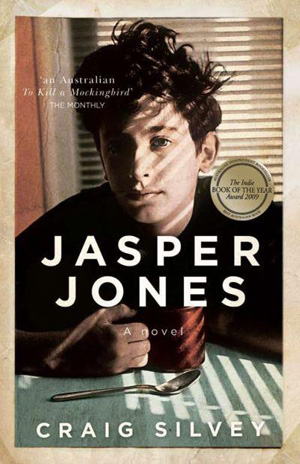
Books Read in 2014 – 10. Jasper Jones by Craig Silvey

Genre: Young Adult, Bildungsroman, Crime

Narrative Style: First person narrative, Straightforward chronological timeline

Rating 4/5jasper-jones-book-cover1

Format: Kindle

Published: 2009

Synopsis: Charlie Bucktin is both alarmed and gratified when Jasper Jones first knocks on his window. However, he soon wishes not to share Jasper’s secret and it weighs heavily on him over the summer. The sleepy town where he grew up, that seemed so safe becomes a place of secrets, violence and prejudice that he desperately wants to escape. 

This book had me from the first. Charlie’s excitement and worry is almost palpable when Jasper Jones, town outcast, first comes to his window to ask for help. Their journey to Jasper’s hideout is agonising. The suffocating weather doesn’t help. You can almost feel the heat. Of course, from the synopsis of the novel, you realise that Jasper has probably discovered a body so that wasn’t really a surprise but the boys decision to cut the body of Laura Wishart down and throw it into the river so that Jasper will not be blamed for her death is a little more shocking.

Events soon start to spiral. Charlie finds it hard to live with his knowledge and that contributes to his disintergrating relationship with his mother. He starts to fall in love with Laura’s sister which makes his secret knowledge all the more uncomfortable. Jasper’s decision to confront who he assumes is the killer reveals town secrets that go back decades. The seemingly innocent town reveals its darker side with a series of racial incidents.

Charlie was a lively and intelligent narrator who read as if his life depended on it. He describes life in the town vividly, as well as his own insecurities and worries. The novel is full of school boy humour through his conversations with his best friend. It was easy to read and compelling enough to want to read on. Jasper Jones, as the town outsider, blamed for everything, was full of pathos but never pathetic.

If I have any complaints, it would be that it was easy to see what the reveals were going to be. There were no surprises although the bad luck that might have saved Laura’s life was well plotted and interesting. Having said that, I always wanted to read on to see how Charlie and Jasper would react to the events as they unfolded.

The issues in this novel were skilfully handled. There was no preaching, just the sense of a young person trying to find their way in an increasingly difficult world.


Books read in 2014 – 9. The Eyre Affair by Jasper Fforde


2014tbrbuttoneclecticchallenge2014_300


Reading Challenges: Eclectic Reader Challenge 2014The TBR Challenge

Genre: Alternate History, Fantasy, Humour

Narrative Style: First person narrative, Straightforward chronological timeline

Rating 3/5
Format: Paperback
Published: 2001

Synopsis: Thursday Next is a literary detective. Her life suddenly becomes more exciting when Arch Villain Acheron Hades starts kidnapping literary characters. Never mind the fact that her personal life is in tatters as the man she loves is about to marry someone else. When Jane Eyre is kidnapped, Thursday must see if she can return her to the book without causing to much damage. 

Time on shelf: About four years. This series has been recommended to me by a couple of people whose views I trust but I’ve always been a little hesitant. 

Part of me thinks I should have loved this book. After all, it’s literary, it’s clever and in places it is very funny. But at the end I just felt like it could have been so much better. There are an awful lot of ideas in this book but not really enough plot and character to sustain them. Perhaps if Fforde had held some of them back, it would have been a bit more satisfying.

Part of the problem is the characters are little more than hangers for various jokes and stereotypes and I didn’t really relate to any of them. Acheron was quite good fun as a villain but even he was a little flat. And by then end of the novel, I was completely fed up with comedy names such as Paige Turner or Millon De Floss. Maybe it’s just me but I’ve always thought that this sort of thing is okay in moderation but very quickly grows tired. It certainly did here.

The best parts of the novel occur when Thursday is stuck in the book of Jane Eyre and she and Rochester conspire with the servants to ensure that Jane’s narrative is undisturbed. In this world, Jane does not end up with Rochester, at least not until there is an almighty fight between Thursday and Acheron and a fire ensues. I think you can see where this is going. Of course, everyone preferred this ending. And understandably so as the alternate ending was quite dreary.

After this, the narrative returns to Thursday’s love life. Despite being hostile to Landen Parke-Laine (Groan!) for a lot of the novel, she suddenly decides to stop him from marrying the wrong woman only to lose her nerve at the last minute. But it’s okay – the lawyers from Jane Eyre step in to accuse his bride of bigamy. I must admit, I found this part of the novel a bit tedious and not as funny or clever as Fforde probably hoped

Don’t get me wrong, this wasn’t a terrible book. It definitely had its moments, just not as many as I might have expected.

642 things to write about – Write an alphabetical story.

Writing Prompt – Write a story in which each sentence will start with a different letter of the alphabet e.g. start with A, move on to B and so on.

This was quite good fun. And I know I didn’t get all the way through but I couldn’t think of an X word. If you can come up with a sentence starting with X, please let me know.

At this time in the morning, the sky was still dark. Bryan got up anyway. Carefully, he slid out of the covers. Downstairs others were starting to stir. Excitement started to touch him. Fairly soon, he’d be getting his fill. Grabbing a towel and tying it around his waist, he headed for the communal showers.

Hot water stabbed at his shoulders. In no time at all, he was clean and properly awake. Just as quickly, he toweled himself down. Knocking his knee on the sink, he cursed his haste. Likelihood of bruising, high. Muttering to himself, he hurried back to his bedroom.

Now, he was fully dressed. Opening his door, he saw others heading in the same direction. Perhaps he should have hurried even more. Quickly, he tried to get ahead, to be one of the first. Rationally, he knew that there would be enough for all but his growling belly pushed him on.

Still he couldn’t get to the front of the queue. Too many to push out of the way. Unless someone fainted, he’d be stuck where he was. Very soon, he thought, it’ll be me who faints. What would happen then?

Books read in 2014 – 8. Fatal Shadows – Josh Lanyon

Genre: Detective, LGBT, Romantic Suspense

Narrative Style: First person narrative, Straightforward chronological timeline1274861

Rating 4/5

Format: Kindle

Published: 2000

Synopsis: Someone is out to get Adrien English. First, his closest friend and employee, Robert, is murdered and then someone ransacks his shop. Even worse, the police seem to think that he murdered Robert. And everything he tries to do to help ends up making him look even more guilty.  

I love a well-written detective story. After the annoyance of reading Post Mortem by Patricia Cornwell, I wanted to read an author that I knew could deliver the goods so I decided to read the first of the Adrien English series. I wasn’t disappointed.

There are a number of things that bring me back to reading Lanyon’s work, first and foremost being the plot lines are always suspenceful with twists and turns that don’t seem forced. In short, he keeps you turning the pages. As with the main character in Come Unto These Yellow Sands, Adrien is very good at getting himself into awkward situations which adds an extra dimension to the suspense.

The character of Adrien was convincing and I took to him straight away. Lanyon shows the homophobia that he faces without making him seem like a victim and while he has some of the stereotypical traits of a gay man, he never seems like a type but like a real person. His first person narrative is full of humour and ironic asides which made the reader warm to him.

To me, it was obvious from the start that Detective Riordan was gay but closeted but it may be that this was deliberate as it allowed the reader knowledge that Adrien did not have. It was soon apparent that Riordan had a crush on Adrien and was on his side, sharing knowledge with him and eventually saving his life. But as I said, it was not at all obvious to Adrien who was too busy fearing for his life to notice.

I was sorely tempted to go straight on and read the next book in the series but I’ve decided to save it for the next time I feel I need the knowledge that the book I am about to open will be really pleasing.


Books read in 2014 – 7. Postmortem – Patricia Cornwell

Reading Challenges: Eclectic Reader Challenge 2014eclecticchallenge2014_300

Genre: Medical Thriller

Narrative Style: First person narrative, Straightforward chronological timeline

Rating 3/5

Format: Kindle

Published: 1990

Synopsis: Someone is strangling and binding women in Virginia, America. Kay Scarpetta is the chief medical examiner assigned to the case. The novel starts with the fourth murder and shows the way the murders are making everyone from single women to city hall officials to reporters jumpy. postmortem

I was excited to read Cornwell for the first time so I was pleased when her name came up on a search for medical thrillers. She was one of the major crime writers that I had yet to sample. I decided to start at the beginning of the Kay Scarpetta series, instead of diving in in the middle which is my usual habit. I wish I hadn’t.

This novel was published in 1990. I found I kept saying that to myself while I was reading it as if it was an excuse. Kay Scarpetta seemed the absolute product of 80s feminism; all bitter and distant from having to climb the corporate ladder in a man’s world. Okay, maybe that is how you would be but it made her difficult to like and even harder to identify with. She seemed to dislike men on principle regardless of whether they were sympathetic to her or not. That started to be a little wearing as the novel progressed and I found myself getting annoyed with her.

It was a bit of a distraction from what was a good thriller. It kept you guessing until the end. It was interesting to note the differences from modern crime stories which rely so heavily on technology. DNA profiling was still in it’s infancy and Cornwell seems a little unsure at times exactly what to do with her evidence. That said, the novel is full of close detail and medical information that is interesting. The process of working from evidence through research and finally to a solution was impeccably described.

In the end, the story was compelling enough to keep me reading despite my reservations about the characters. However, I doubt I’ll read on.

Books Read in 2014 – 6. The Doll’s House – Neil Gaiman

Sandman_Dolls_HouseGenre: Graphic Novel, Fantasy

Narrative Style: Mix of viewpoints. Generally linear.

Rating 4/5

Format: paperback

Published: 1989

Synopsis: Due to the absence of Dream from his realm, some of the dreams and nightmares have escaped. This leads to all sorts of bloody mayhem. Add in the presence of a Vortex that could wreck the dream world forever and you have the makings of an exciting story.

As I mentioned in my last post I was going straight on to read the next Sandman book The Doll’s House. I was glad to have been loaned the second one as well as otherwise I would have felt a little bereft. I’m pleased to say that I was not disappointed.

Having said that, this is much less a story about Dream – obviously he appears in it but he isn’t the centre as much as he was in the first book. Instead, Rose, granddaughter of Unity Kinkaid (a character from the first book) is the focus and her search for her younger brother supplies most of the narrative momentum.

One the way she meets a whole host of wacky and wicked characters. There seems to be no limits to Gaiman’s imagination in this respect. And while they are strange, they are never less than convincing. Such is the level of his talent.

There is plenty of gore, as well and the illustrations are just as impressive and vivid – in fact more so, as the story allows for an unleashing of the artists twisted imagination much more than in the first book.

I felt this book was more compact and self-contained than the first and I don’t feel such a compulsion to read on immediately. Having said that I am much more interested in reading the rest of them now.