Books Read in 2014 – 20. Dissolution by C. J. Sansom

Genre: Historical Fiction, Detective Fiction

Narrative Style: First person recount, largely chronological

Rating: 4/5

Format: Kindle

Published: 2003

Synopsis: Matthew Shardlake is commissioner to Cromwell during the dissolution of the monasteries. He is sent by Cromwell to investigate the death of a previous commissioner at a monastery in Scarnsea. When he arrives it seems that quite a number of monks are potentially guilty and Shardlake has to walk a difficult path to get to the truth. 51xcXRFlN0L

Tudor history is one of my favourite eras to read about and I love a good detective story so this seemed to tick all the boxes. The fact that it was set in a monastery and all the monks had some sin that they are trying to keep secret only added to the fun.

When Shardlake is first sent to Scarnsea and we are introduced to the potential murderers, it seems that any number of people could have murdered the previous commissioner. Clues and red herrings rain down through the plot with an astonishing quickness and Shardlake is quickly out of his depth. When the bodies start to pile up and he starts to feel pressured, he begins to make dubious decisions and mistakes.

The historical detail seems note perfect and I particularly enjoyed the various descriptions of Cromwell. The battle between traditional and new religion is well described and Shardlake is as uncompromising in his views about the new ways as the traditionalists were about theirs. Ultimately (like In The Name of the Rose) this is a story about knowledge and power and who should be allowed to have it.

I did find Shardlake to be an irritating narrator. I’m sure this was intentional but his peevish voice started to grate by the time I got to the end. This, and the fact that I worked out who the murderers were (although not why) before the end, were the reasons for this not being a 5/5 read. Other than that, it was a very enjoyable mixture of historical fact, political intrigue and detective story.
 

Books read in 2014 – 19. The Absolutist by John Boyne

Genre: Historical Fiction, War

Narrative Style: First person narration, Moves between 1919 and Tristan’s memories of the war

Rating: 5/5

Format: Paperback

Published: 2011

Synopsis: Tristan Sadler has decided to deliver letters written by Will eclecticchallenge2014_300Bancroft to his sister in Norwich. Will was shot as a coward but Tristan knows the truth of what happened and hopes to be able to tell Will’s sister his deepest secrets. 

Reading Challenges: Eclectic Reader Challenge: War. 

Having previously read The Boy in the Striped Pyjamas, I should have been more prepared for the onslaught on the emotions that this book provided. At the end, I was devastated. My mind kept playing over the details of the ending as if I could somehow change the narrative and give Will and Tristan a better ending.

The narrative begins with Tristan’s arrival in Norwich to give the letters to Will’s sister Marian. He had trained and fought with Will and it soon became apparent that he had loved him very much. Marian wants answers as to why Will died and proof that he was not a coward for laying down his arms and refusing to fight. the absolutist

At first it seems that Tristan’s great secret is his homosexuality and the physical acts that he and Will shared. Understandably at this moment in history, and in the army, this was something that both men found difficult to deal with. However, the truth of the matter was much more painful and dark. And although I had worked out exactly what Tristan had done, that didn’t lessen the trauma of actually reading about it.

The themes of this book run through many war novels – the nature of bravery, what makes a man, the effect of brutality on the psyche – but I don’t think I have ever read a novel that tackles them so directly. Before Will lays down his arms, another character, Wolf, is murdered by the other soldiers when he finally hears that he will not have to fight. The treatment of those who wished not to fight and those who could not was appalling – much worse than I’d realised. The treatment of Marian and Will’s parents is equally deplorable.

In the end, although Tristan’s behaviour was also deplorable, I had a lot of empathy for him. Boyne’s characterisation and use of historical detail is so good that it is possible to see past the terrible act he commits and see the man and the reasons behind it. Easily the best book I’ve read in an age.


A general update: It’s been a while…

It’s been a pretty hellish start to the  year. For various reasons, I’ve spent much of the last three months either emptying or filling boxes. Sorting things and throwing things away is another new pastime along with visits to the tip and the charity shop. It hasn’t really been conducive to making progress with my writing and it is only in the last few weeks that I feel that I have started to get back to normal.

In terms of blogging, I have managed to keep up with my book reviews and I am pleased that I have still been able to read a lot. (All that travelling around on public transport has to be good for something.) I’ve read four books from my TBR Pile which is in keeping with what I’d planned – one a month. And when I finish John Boyne’s The Absolutist, I’ll be halfway through the Eclectic Reader Challenge so that is all to the good.

I am finding time to write but I have been concentrating on existing projects rather than using writing prompts. Much as I love doing that, I feel that I have more pressing commitments. I have entered a couple of short story competitions and I am trying to prepare Choose Yr future for publication ultimately but beta readers before that. I’m also quite excited by my other project which now has the name of The Practise of Deception. So, at the minute, whatever time I can spare to writing is being used for these. I will get back to using the prompts, I’m sure when life has settled down a bit and when I need a new project. After all, The Practise of Deception grew from one of these prompts so they are useful as well as fun.

Books Read in 2014 – 18. Complicity by Iain Banks

Genre: Scottish Fiction, Thriller

Narrative Style: First person narrator interspersed with second person descriptions of murders. Largely chronological with some flashbacks.

Rating: 5/5

Format: Paperback

Published: 1993

Synopsis: Cameron Colley is a drug and drink addled journalist with an obsession with a series of murders that happened a few years ago. He thinks he might have a lead from an inside source. However, when the police start to investigate his movements, he realises that the murderer might be closer to home than he thought.

Reading challenges: TBR Pile Challenge.2014tbrbutton

Time on Shelf: about four years. I must admit I was avoiding this one because the last two Iain Banks that I read (Whit and A Song of Stone) were disappointing. Banks has written some amazing books but also some that I really don’t rate so I kept putting off reading this one.

This is the sort of book I love. Sex, violence, a completely bitter and fucked up narrator and a story line that races along at a serious pace; I couldn’t put it down. This is the sort of book that Banks excels at writing. Cameron Colley is cynical and politically knowledgeable but too destroyed by drugs and drink to do anything about it. When he starts to get tip-offs about a series of murders from a few years earlier, he thinks his journalistic time has come.

It was easy to take to Cameron. While he was lazy, addled and unreliable, he was also funny and intelligent. His voice was totally believable. When he is picked up by the police for the murders he thinks he has been investigating, you feel sympathetic towards him and know, for all his faults, that it can’t have been him. IainBanksComplicityEarly

Without revealing the actual murderer until quite near the end, Banks lays a lot of clues, a lot of which were red herrings. I’m not ashamed to admit that I thought I had this solved quite early on, only to realise that I had been taken in by a very clever writer.

After the revelation of the murderer and the secret that he and Cameron share, the pace does slow a little bit but there is still the tension as to whether Cameron betray this person one more time. Cameron also has to face his own complicity in this story and the personal lives of those around him. It is interesting the way that Banks weaves personal and political complicity and responsibility. In the end, Cameron decides (I assume) that he is already complicit and so avoids one last betrayal.

The ending of this book was quite poignant and sadder than I expected although there were hints throughout the book of Cameron’s ill health. There is an interesting parallel with the computer game he is obsessed with named Despot. At the start, in the game, Cameron is master of all civilization and nothing can stand in his way. By the end of the book, all is in ruin, both in life and in the game.

So, a very enjoyable journey. In fact, the best fiction I have read so far this year.

Books Read in 2014 – 17. All the Flowers in Shanghai – Duncan Jepson

Genre: Historical Fiction

Narrative Style: A chronological first person account in the style of a memoir written for her children

Rating: 3/5

Format: Kindle

Published: 2011

Synopsis: The story of Feng, a young Chinese woman who suddenly has to download (5)replace her elder sister in an arranged marriage. The novel begins in the 1930s and moves through to the Cultural Revolution showing the effect on Feng and her family.

This was quite an easy read – straightforwardly chronological and with easy to follow prose. The pace was good and there was enough interest to keep the reader going. At first, it was difficult to pinpoint why I didn’t like it more.

I think my main problem was with the character of Feng. At the beginning of the novel, she is a sweet girl left to her own devices because it is her elder sister who will make the important arranged marriage. She spends most of her time in the gardens with her precious grandfather learning the names of the flowers and trees in Latin. However, when her sister dies, she is forced by tradition to take her place.

She has no idea what lies ahead. Even after the wedding, she still seems like an innocent abroad, lost in among the plots and petty problems of a large family.

However, when she becomes pregnant, she changes. She makes the decision to send the child away if it is a girl and she becomes hardened. While it is likely that she would grow up a bit, this change in personality does not quite ring true. Later still, she runs away from her home, ashamed by how she has behaves and this too seems unconvincing.

Finally, she is able to contact her long lost children with what is, in my mind, a pretty weak plot device. The happy ending that this dreates is, to my mind, a little forced as the other changes had been. It isn’t that Feng’s voice is unconvincing particularly but that she is used by the plot regardless of whether the behaviour fits in with her personality.

At the beginning of the novel, I was a little lost as to when it was set. It wasn’t obvious and I suppose that this is because Feng was sheltered from the real world by her wealth. The end section is much more successful and the way that China was scarred by the Cultural Revolution is well documented. In fact, the way that Feng is constantly ruled by forces out of her  control shows the problems with both the old and the new regime.


Books Read in 2014 – 16. Translated Accounts by James Kelman

Genre: Experimental, Dystopia

Narrative style: a variety of first person accounts from a number of unnamed people.

Rating 2/52014tbrbutton

Format: Paperback

Published: 2001

Synopsis: A series of nameless narrators tell of their life in what seems to be some sort of police state. There are rules and securty forces and the narrators seem concerned about conforming or otherwise. The accounts are supposed to have been translated from the original language by some Government authority and as a result they are somewhat alienating to read. 

Challenges: TBR Pile Challenge

Time on shelf: I bought this in about 2003, not long after I had finished my MPhil, in which I wrote about A Disaffection and How Late it was How Late both of which I really enjoyed. However, I felt the need to read less challenging books for a while after finishing my thesis so this got stuck on the shelf as I knew it was likely to be difficult. 

This was a real slog and it is a long time since I have felt so pleased to have finished a book. In fact, if not for the fact of reading it for the TBR Pile Challenge I might have abandoned it. I knew it wasn’t likely to be an easy read but I had no idea of the problems I was going to have with it.

There are a number of things that make this difficult to read. The first is download (4)that not only are none of the narrators named but neither are any of the characters. They are referred to as woman, wife, mother and so on. This means that there is no continuity and it is even more difficult to tell which narrator is which. It also means that no character stands out and so there is no one for the reader to attach themselves to or be concerned for.

There is very little detail about the society although you can glean that people are frightened and that they’re ruled by some all powerful higher authority but the rules are never really explained and as there is very little action the plot moves very slowly.

Finally, the language is disjointed and does sound a lot like it has been translated from another language. It is as if the fracturing of society has had a fracturing effect on the language of its people. Again, this makes it difficult to read.

I realise that what I’m viewing as problems might very well have been Kelman’s intentions and I understand the points he is trying to make about the way a police state would strip its members of individuality and make it difficult to discuss anything openly. It was an interesting experiment although ulitmately, I think, a failed one.

Books Read in 2014 – 15. Some of Your Blood – Theodore Sturgeon

Genre: Horror, Epistolary
narrative style: a variety of letters, third and first person narration, sturgeon-some-blood-tempsychiatric evaluations and interviews.

Rating:4/5

Format: Kindle

Published: 1961

Synopsis:A soldier who calls himself “George” is admitted to the army’s psychiatric ward after a vicious attack on the major of his company. The major was concerned about the contents of a letter “George” wrote home to his girl, Anna but the contents are not revealed to the reader until the very end.

Dr Phil Outerbridge is given the task of dealing with a soldier who is surrounded with some mystery. The army want the issue of his attack on the major dealt with quickly and sensitively. The novel opens with a series of letters between Phil and his superior Al, discussing the way in which this case could be dealt with and Phil’s initial impressions of the patient.

At the very beginning, before the story proper, there is a section describing the reader sneaking into Phil’s office (We are assured it is safe, after all it is only fiction) and opening this particularly curious file and working through it.  The different voices and styles that this requires are skillfully handled and the psychiatric reports and analysis are convincing and intelligent.

The soldier is tasked with writing his own story. He is advised that it might be easier in the third person and chooses the name “George” for himself.The third person narrative that follows gives a lot of detail about “George’s” early life, his time in a boys’ home and then in the army and details his love of hunting. Whenever it seems that there may be some sort of revelation, George moves on to the next event and the reader is left wondering exactly what has happened. As Phil later comments, there are a number of holes in his story.

After “George’s” narrative, there follows a number of psychiatric evaluations and interviews in which more details are slowly revealed about the exact nature of “George’s” sickness. The way the story slowly unfolds reminded me of the narrative structure of The Strange Case of Dr Jekyll and Mr Hyde where witness accounts and letters hint at the horror that the reader eventually faces.

In the end, the contents of the letter is revealed and the story finishes with no absolute decision on whether “George” will stay in the hospital or not. Instead, there is a return to the authorial voice of the beginning offering us possible fictional outcomes and inviting us to decide. Then in the final chilling moments, we are warned to hurry in case Phil catches us and it isn’t fiction after all but real. Of course, such horror does exist in the real world and this could easily be a real case study. It is a clever and unnerving ending to what was a clever and unnerving story.

Top Ten Tuesday – Spring TBR list

7aabb-toptentuesday2Top Ten Tuesday is hosted by The Broke and The Bookish. This week’s top ten is ten books from your Spring TBR lists. I must admit that I don’t really like pinning myself down in such a way and I will undoubtedly get distracted by other books. However, these are the books I am currently looking forward to reading next. (That’s if I ever manage to finish Translated Accounts. I’m starting to understand why it was on my TBR pile for quite so long!)

  1. Complicity – Iain Banks (TBR Challenge)
  2. The Absolutist – John Boyne (Eclectic Reader Challenge)
  3. Rebecca – Daphne Du Maurier (Eclectic Reader Challenge)
  4. The Stepford Wives – Ira Levin
  5. The Rapture – Liz Jensen (TBR Challenge)
  6. Loitering With Intent – Muriel Spark
  7. The Fault in Our Stars – John Green
  8. A Dangerous Thing – Josh Lanyon
  9. Big Brother – Lionel Shriver
  10. The Talented Mr Ripley – Patricia Highsmith


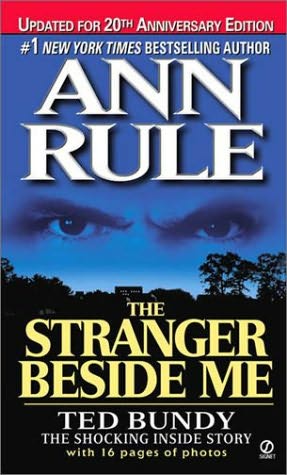
Books read in 2014 – 14. The Stranger Beside Me: Ted Bundy, The Shocking Inside Story – Ann Rule


eclecticchallenge2014_300

Genre: True Crime, Serial Killers
narrative style: first person, largely chronological Rating:3/5

format: Kindle

Published: 1980

Synopsis: Rule describes Bundy’s murders and also her reaction to them. She decribes their friendship and the difficulties she faced in accepting his guilt.

Challenges: Eclectic Reader Challenge 2014 – genre True Crime.

I first came across Ted Bundy when I was writing my MPhil. I was writing a section comparing Bret Easton Ellis’ American Psycho with Helen Zahavi’s Dirty Weekend and my research led me to read a lot about serial killers. Bundy stood out as one of the stranger cases. There was such a disparity between the persona he used to snare his victims (he liked to pretend to be helpless in some way, sometimes having his arm in a sling or using crutches) and the violence and depravity of his attacks. It stuck with me over the years and when I realised that I had to read a true crime book for this years challenge, I knew it would be about Bundy.ann rule

It is this disparity that is at the heart of Rule’s book. She knew Bundy, worked with him in fact, and was already writing a book about the series of violent murders when he became the prime suspect. She knew a charming and polite Ted, a man who worked the phones at a crisis centre, persuading people not to take their own lives. It is little wonder that she did not want to believe that he was the killer the police had searched for. Indeed, it didn’t seem possible that two such different personas could exist in the one person.

It surprised me how long Rule continued to be supportive of Bundy, even when she started to believe in his guilt. Perhaps it is easy to say when you are not emotionally attached to the person involved but I’m not sure I could have kept corresponding with him, sending him cheques and money as well. It maybe that she realised that this would help with her writing career – having the inside line on an infamous killer – and indeed this book did put her on the map. However, I think that the hold that Bundy had on her was a lot simpler. He knew exactly how to manipulate people and bend them to his will. Rule seems taken in by his need for her and at times seems almost awestruck. She claims not to have been in love with him and this may be true but there is something in the way that she writes about him that goes beyond mere friendship.

The details of Bundy’s crimes are horrendous and I had no idea how many women he had killed and how many murders he has been linked to that cannot be proved. Also his escapes from prison and many last minute reprieves from the electric chair made for interesting reading. However, I did get bogged down in what I felt was extraneous detail. Rule, undoubtedly, is very observant and thorough but there was no need to detail the weather or the background of every bit player. Also, I felt that the expression was clumsy at times and felt that who ever edited this work should have had a sharper red pencil. It was a shame because by the time I got to the end and Ted was finally going to be executed, I didn’t really care. I just wanted the book to be over.


Books Read in 2014 – 13. The Sociopath Next Door – Martha Stout

Genre: Academic, Psychology
narrative style: first person, case studies and analysis
Rating:3/5
Format: Paperback
Published: 2005

Synopsis: Stout recounts examples of sociopathy from her practice as a psychologist and analyses what the origins of such behaviours are. 

This book was part research, part pleasure. I have always been fascinated by the psychopath or sociopath in fiction and film. As such, in my next book, I have a character who has some features of sociopathy and I have been reading around the subject for a while.

The book opens with a discussion of conscience and the way most of us react in circumstances when we might have to make a sacrifice in order to help others. This is called the seventh sense and according to Stout 96% of us have it. The other 4% are sociopaths. This seems quite a large amount. And it seems that most of us will have come across at least one in our lives. She then describes exactly what she means by living without conscience. This is by far the most interesting part of the book. Stout uses case studies to illustrate the symptoms of sociopathy and they are quite horrific to read. But also, I must admit, fascinating. Perhaps it is the thought of what it would be like to never feel any obligation towards another person – intriguing but almost impossible to imagine.
She also charts the origins of conscience in a few different ways – religious, evolutionary, psychologically – all of which are also interesting. Personally, I am most drawn to evolutionary theories – what’s good for the group is good for the species. After all, as Stout points out, if we all did exactly as we pleased, the whole species would very soon die out.
However, there are irritating things about this book. There is something deeply spiritual about Stout’s version of conscience which, as an atheist, I found quite hard to stomach. One of the later chapters is devoted to religious leaders who have suggested do into others as you would to yourself as a way of life. This is not really what I would have expected from a psychological all study. It all gets a bit subjective.
Stout seems to want to have her cake and eat it. She obviously feels that she can judge sociopaths lacking as they do not have the emotional connections that we good folk with consciences have. Which maybe true. But she also suggests that sociopathy is a mental illness and may be, at least partly, innate. If this is the case, the it is hardly fair to pass moral judgement.
Finally, there is a sense of either you are a sociopath or you are not. It is black or white. I would suggest that, as with most things to do with the mind, it is a lot more complicated than that.