The Non-Fiction Challenge – We of the Never Never – Jeannie Gunn

2016 Nonfiction Challenge

Genre: Autobiography / memoir

Narrative Style: First person, chronological

Rating: 3/5

Published: 1908Unknown

Format: Kindle

Synopsis: Jeannie Gunn is newly married and has moved out to Elsey Station with her husband. This is an account of the first year. Although published as a novel, the work is recognised as being autobiographical. Jeannie changed the names of the principal characters to keep their identity secret.

I must admit, I thought I might enjoy this more than I did. It does give a strong impression of what life must have been like in the Never Never. The difficulties are described vividly and I know that I would not have been able to cope. Jeannie herself is a strong character who faces all challenges head on including the attitudes of the men already at the station.

The problem is there is no real tension. Events never build to a climax nor is there any sense of real danger. Jeannie is unrelentingly cheerful no matter what is thrown at her and that is a little wearing as well.

I found it hard to keep in my head who was who and I would have preferred it if the others had real names rather than the Dandy, the Quiet Stockman and so on. I found I couldn’t distinguish between them or get a handle on what they were like.

Finally, there is a liberal use of the N-word and that was a little hard to take even when I know that it wasn’t racially charged in the same way it is now. Events such as the ‘nigger-hunt’ are described as if it were merely a picnic and not a potentially lethal clash between white and black.

As a historical document, this is interesting and shows what life was like at that time. As a casual read, it wasn’t a lot of fun.

Constructive Criticism

I guess most writers feel the same but it sometimes seems absurd how protective I feel of my writing. Putting it out there feels like giving away a small part of my soul. (Y’know if I believed in the notion of a soul but I can’t think of an atheist version of this simile.) So waiting for critiques after I posted the opening to Choose Yr Future on Scribophile was an absolute agony.

It’s a strange experience. For one thing, I wouldn’t be doing it if I didn’t think there was some merit in the writing so it takes a level of arrogance I wouldn’t normally display. On the other, it has left me a mess of self doubt over whether or not I was merely imagining that it has merit. These are the two extremes that I swing between.

On the whole, the response was positive and criticism was constructive which is how it should be. I know I would struggle being a member of an actual reading group but the virtual world means that I can be brave. Of course, not everyone will like what I write and I have to remember that this doesn’t necessarily make my writing bad. I don’t love everything I read and sometimes have the arrogance to wonder how the writer in question managed to get themselves published.

So now I have to review more work before I can post anymore of Choose Yr Future. I like the way Scribophile works. You build up points from critiquing others’ work so you can post your own. Remembering how you want your own work to be treated is a good benchmark for reviewing other peoples’. So far, it has definitely been a positive experience.

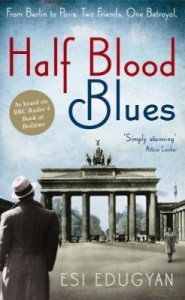
Eclectic Reader Challenge – Half Blood Blues by Esi Edugyan

2016eclecticreader_bookdout

Genre: Historical Fiction, War

Narrative Style: First person moving between present and 2nd world war11076123

Rating: 4/5

Published: 2011

Format: Paperback

Reading Challenges: Eclectic Reader Challenge 2016 – genre – nominated for the Booker Prize (2011)

Synopsis: In 1940, rising jazz star Hiero Falk is picked up by nazi soldiers in Paris. No one is sure what happened to him after that but he is presumed dead. In 1992, a documentary is made about him that brings Hiero’s friends and bandmates Chip and Sid back to Berlin. Sid was the only witness on the day Hiero disappeared and he finds memories coming back to him that he had thought long buried. 

Edugyan’s novel is written from Sid’s point of view and in his voice which gives the prose an almost jazz like rhythm. It was very easy to read and also gave a clear picture of what Sid was like.

At the beginning of the novel, he and Chip are preparing for a trip to Berlin for an airing of a documentary about Falk and the record they made called Half Blood Blues. Sid is clearly reluctant. Even more so when Chip announces that he has been contacted by Falk who is not dead but living in Poland and he intends to go to see him. It is clear what Sid has secrets and memories that he does not want to face. Nevertheless, he goes with Chip to Berlin.

The story shifts easily between the present day (1992) and 1939-40 in first Berlin and then Paris. Sid is a bit of a nervous character and his fear and worries give the reader a good impression of what it must have been like to be black at that point in history. It was an angle I hadn’t really considered and it certainly made me want to find out more it.

Sid and Chip are both scarred by their experiences, as is Hiero when they finally meet up with him. The revelation of what Sid has done is shocking and his final confession to Hiero is touching. I felt that the novel ended a little awkwardly and it could have been taken a little further. As it was, it just stopped suddenly, leaving a lot of questions unanswered.

Overall, this was a very enjoyable story which gave an unusual (to me anyway) perspective on the second world war.


Writer Apathy

I really expected I might be closer to publishing Choose Yr Future then I am by now. The worst thing is there is no one to blame. I have been suffering from apathy. Not writer’s block as such – Choose Yr Future is finished and I’ve been scribbling away at other ideas. It’s the thought of further editing, beta readers, all the next steps. It’s making me exhausted. I’ve even been avoiding writing this blog. (It would be easy to blame lack of time but really that is just an excuse and not a reason.)

I wasn’t very good at promoting myself when I published Shattered Reflections. And while that has had some good ratings and reviews and so I am more confident, I still find it hard to put myself forward. It’s not really in my nature to show off and it seems to me that what social media involves. I’m quite a reserved person and while I know this is not a useful thing to be online, I find it hard to shake off the habits I have formed.

I have a better idea of what I am doing now, of course. And I have joined a couple of writing sites so I can get some reader feedback – Wattpad and Scribophile – and I would be grateful for any advice anyone has about getting beta readers. And then there are all the publishing platforms that have sprung up in the last few years. I’m a little stuck for which direction to take. I used Amazon’s Createspace last time but I’m not sure I want to again. Any advice would again be gratefully received.

The Power of Beauty – Nancy Friday

2016eclecticreader_bookdout2016 Nonfiction Challenge

41M5MWGCWDL._SX296_BO1,204,203,200_

Genre: Psychology, feminism

Narrative Style: Informal, first person

Rating: 2/5

Published: 1997

Format: Hardback

Synopsis: Friday analyses the way beauty effects female lives. She uses psychoanalysis to investigate events early in her own life that she feels have held her – and all women – back. She uses anecdote and fictional examples to support her ideas.

Challenges: Eclectic Reader Challenge and Non Fiction Challenge

This book was a slog. I very nearly didn’t finish it. (It took me a month to read it, I was that irritated with it and it has gone straight on the charity pile.) The main problem is Friday’s tone. She sounds hard done by – especially in the early chapters. She blames a lot of her issues on problems with her early childhood. Her father abandoned their family and she felt her mother loved her sister more as she was prettier. This lack of loving gaze meant that Friday was lacking in confidence about her looks. This seems disingenuous when you look at the author picture and Friday is indeed a beautiful woman. She later says that by the time her looks came in, it was too late for her to believe that she was beautiful. She uses psychoanalysis to help her understand how her formative years were so important in making her the person she is. To a certain extent this is fine. I am happy to agree that psychoanalysis is a useful therapeutic tool but Friday takes this one step further. She then extrapolates from her personal experience to all women lacking the gaze from their mothers. My own experience of childhood was completely different from Friday’s. My father was very much involved in childrearing and my mother worked because she had to. How can Friday assume that my issues will be the same as hers?

Friday does seem to see all women as being the same as her. That is white, privileged, straight and American. She sees gender as the only issue affecting women and men. (And men are masculine and women are feminine in this little world.) All of the examples she gives are from the business world or from friends who are writers and artists. Hardly representative of the whole human race. Which is also fine but if you are going to talk about all women, perhaps you should think about what that really means.

At one point, Friday talks about sexual harassment in the office. Instead of blaming men, she says, we ought to think about how women have changed the atmosphere of the office by coming in to work dressed sexually and making it hard for men to understand the new rules of the office. There may be some truth to this. Undoubtedly more women being in the office has changed the dynamic between men and women but lets not let men completely off the hook. Harassment suggested a sustained campaign. Sexy clothes are no excuse for that sort of behaviour.

Similarly, when Friday talks about the media and its affect on women’s perception of beauty, she seems to let the media off the hook as well. She says that women aren’t so easily brainwashed. Well, true, women can think for themselves but there is also no doubt that the media influences how we feel about and see beauty around us. How Friday can discuss beauty for older women and not challenge the way beauty is seen in the media as a youthful characteristic, I do not know. Again, she puts the blame squarely at the feet of other women without stopping to think about what may make women act in this way.

Rightly, Friday says that we shouldn’t blame men for all of our ills. I remember being thoroughly depressed by some of the authors she mentions – Dworkin and McKinnon, for example. But instead of suggesting that patriarchy affects all of us, she goes on instead to blame other women. This is no more helpful that saying all men are evil. It is finding just another scapegoat instead of actually challenging any of patriarchy’s expectations.

Overall, I was disappointed with how personal this book was. I enjoy reading about others’ experiences, however, this was not an autobiography, this was supposed to be about men, women and beauty. Really it is just about Nancy Friday.


Top Ten Tuesday – Spring TBR

7aabb-toptentuesday2

Top Ten Books on Spring TBR. (Top Ten Tuesdays are hosted by The Broke and the Bookish.) (If I ever manage to finish the two books I am currently reading which I feel like I have been reading forever.)

  1. The Heart Goes Last – Margaret Atwood (2015) The only current book on this list. Really excited to read this as Atwood is my favourite author. Slightly regretting having bought this on my kindle so it won’t have a spot with all the others on my shelves but it was so cheap I couldn’t let it go.
  2. Half Blood Blues – Esi Edugyan (2011) This is for the Eclectic Reader Challenge – genre Booker Prize nominated.
  3. Water for Elephants – Sara Gruen (2006) Don’t really know anything about this one but it sounded interesting and has good reviews.
  4. If This is a Man – Primo Levi (1947) This has been on my list of things to read for a long time. Thanks to the Non Fiction challenge, I am finally going to get it read.
  5. Small Island – Andrea Levy (2004) This is also for the Eclectic Reader Challenge – genre Immigrant experience. I’ve read one other book by Levy and I found it enjoyable and I also watched the TV adaptation so looking forward to this one.
  6. The Night Circus – Erin Morgenstern (2011) I’ve heard a lot of good things about this one. It’s a long time since I’ve read any magic realism.
  7. The Redbreast – Jo Nesbo (2000) Another author I’ve been meaning to read for a while. I love a decent detective story and again, I’ve heard good things about Nesbo.
  8. The Damned United – David Peace (2006) I inherited this book and although I’m not really a massive football fan, Clough was such a fascinating character, I’m going to give this one a go.
  9. Just Kids – Patti Smith (2010) This was a Christmas present and I am keen to read it as Smith is one of my favourite recording artists.
  10. Fingersmith – Sarah Waters (2002) I haven’t read any Waters yet and I can’t help feeling this is a bit remiss of me.

Writing is Fun

I’ve just started to read a collection of short stories by Ray Bradbury. In the introduction, Bradbury talks about his enjoyment of writing – how the ideas come and take you to a brilliant new place and they spring from your pen and you’ve done it, you’ve created a new world. You can taste this joy when you read Bradbury and the stories I’ve read so far certainly suggest someone who loves the job of being a writer.

I’m not writing this as a review of Bradbury’s book. For a start, I’ve only read about 10 stories so far (and according to my kindle, it’s going to take 160 hours to read the rest of it!). It’s a reflection on some of the things Bradbury says about writing and how I agree with them.

First of all, I quite agree that writing is a really fun thing to do. I love it. I don’t often suffer from writer’s block because I don’t work in a particularly linear fashion so there is always something else to work on or look at until while I wait for ideas to work themselves out. Words are exciting and playing with them can be a delight. There is nothing more satisfying then reading back something and knowing it is good. (of course, there are things that make it less enjoyable. Like the fact that somehow when I opened the most recent copy of Choose Yr future, the chapters were in the wrong order!)

The other thing that Bradbury said that rang true to me was  the fact that he wasn’t completely in control of his narratives. Often it feels like this. You don’t know straightaway how things are going to work out. You have to get to know the characters, chat with them, give them things to do before you can really know how they will feel or react. Sometimes they sneak into the narrative and become important without you really pushing them in that direction, other times they tiptoe away without leaving much of a mark. Sometimes its a surprise to find them gone.

Non Fiction Reading Challenge – My Own Story – Emmeline Pankhurst

2016 Nonfiction Challenge

Genre: Autobiography / memoir

Narrative Style: First person

Rating: 4/5

Published: 1914

Format: Kindle

Synopsis: A personal account of the meetings and actions of the W.S.P.U. and also an explanation for these actions. 

Reading Challenge: The Non Fiction Challenge.

When I was a student, I did some modules on the suffragettes and when the film came out last year, it re-sparked my interest in this part of history. So when this came up on Amazon, I didn’t hesitate.

It was a very good read. It showed the power and passion of Pankhurst herself as well as the rest of the W.S.P.U. quite clearly. Pankhurst seems to have been an incredibly charismatic leader as well as being clearly intelligent and determined. She must have been a force to be reckoned with.

In one sense, this is an uplifting read. I’m not sure that I could have kept going in the face of forcible feeding and the cat and mouse act but these women were not going give up, no matter what. It was inspiring to think of them fighting back especially considering they had no real political power. They had to find other means to make their voices heard.

For the most part though, it is a difficult read. Pankhurst writes of thirst and sleep strikes where she was so weak she could barely stand but still she attempted to walk the length of her cell and not rest. The politicians do not come out of this well. Lloyd-George and Asquith particularly prove themselves to be duplicitous and uncaring. They treated the women as if they were hysterical and ignored their demands whereas male rebels (such as those in Ireland who opposed home rule) were taken seriously.

Mrs Pankhurst’s style is conversational and so is easy to read. However, speeches and political discussions are often recorded in full and are sometimes a little dry. There is a lot of talk about motives for action but the actions themselves are not always described. This slows the pace a little. However, as an insight in the workings of such an important political organisation, it is definitely worth the read.

Belated Response to Germaine Greer’s transphobic comments

You’d think that ‘are you a feminist’ would be an easy question to answer. Enthusiastically, you’d say ‘of course, I believe in equality, don’t you?’ In fact, if asked, I do say yes, not least because it is important to acknowledge all the changes that have brought us to the position we are now in. The women who won votes for us, women who were firsts, who fought for whatever reason. And I do believe in equality. Obviously. Not just for women but for everyone.

And therein lies a problems with feminism. It isn’t inclusive. You’d think that being on the wrong side of prejudice might make feminism open its arms to all women who have suffered. This does not seem to be the case.

A recent example of this was Germaine Greer saying in her usual subtle way that trans women can’t be women. (Does this mean you’re only a real women if you have all the correct body parts. What if you have had a mastectomy? What if you are intersex? What if you happen to look rather boyish? Do you have to prove your female parts before you are allowed to have a voice?)  I do not think that the entirety of my personality – or anyone else’s – resides entirely in their genitals. I do not look at someone else and think I wonder if they have the correct genitalia for the clothes you are wearing. Greer goes on to say that transwomen don’t always look or sound like women. The assumption is then what do women sound or look like. Is she suggesting you have to be suitably feminine to be a feminist? Surely not but clearly there are some rules. Whatever it is she thinks about women and what they are like, it is very narrow and confining.

If you are going to live as a woman, you are going to face female problems, regardless of what body parts you may have beneath your clothing. If you are going to face sexism in any form then you are surely allowed a voice within feminism. Of course, I am not the same as a transwoman, just like I am not a black woman and I am not a lesbian but that doesn’t mean that I think that feminism should be open only to those who are like me. Difference is important, probably more important than sameness.

Transfeminism exists, has its own identity and doesn’t need the likes of Greer to offer support or otherwise. But it would be nice if mainstream feminism – the view that the majority of people get of the movement – would be a bit more supportive. Greer is listened to and has an enviable position in the media. It is a shame she uses this position to be a bully. Maybe it is true that once you have some form of power, you can no longer relate to others who don’t, regardless of what sex you are.


The Art of Fiction – David Lodge

2016eclecticreader_bookdout2016 Nonfiction Challenge

Genre: Literary Criticism

Narrative Style: A series of essays originally published as newspaper columns.Unknown-2

Rating: 3/5

Published: 1994

Format: Paperback

Reading Challenges: Non Fiction Reading Challenge, Eclectic Reader Challenge – Genre a book about books.

I have had this book on my shelf for about twenty years so it seemed a good place to start reading some long neglected non fiction. I do enjoy reading literary criticism and it is a long time since I have read any so I was looking forward to reading it.

Lodge has an easy to read style – probably because these were originally written for a non-expert audience. It is easy to grasp the concepts that he discusses even when they were quite complex ideas. Each chapter looks at a different aspect of literary criticism and is illustrated by extracts from texts which illustrate its use. This was good because it meant that you had carefully chosen extracts to ponder over if you found the ideas difficult to understand.

As always with literary criticism, there were times when I thought Lodge stretched things a bit but they were few and far between. It is the nature of reading that some things that seem obvious to one reader will seem far fetched to another so I would have been surprised had this not been the case.

My other criticism is really a matter of taste. Lodge favours writers such as Woolf , Beckett and Joyce which really don’t particularly appeal to my taste. He seems quite in thrall to this sort of writing – in fact, he does talk of the influence on his own fiction of such writers. Lodge mentions his own fiction fairly often and even uses it as an illustrative example for one of the chapters. While it would seem unlikely that he would manage to not mention his own fiction, it does seem rather conceited to put it up there as an example in amongst such writers as Austen, Joyce, Elliot, James and Poe. (I have never read any of his fiction so maybe I am being a bit harsh.)

The main thing I have  come away from this book with is a list of authors that I would now like to read that I might not have considered otherwise so thank you, David Lodge for expanding my already over burdened to read list.