
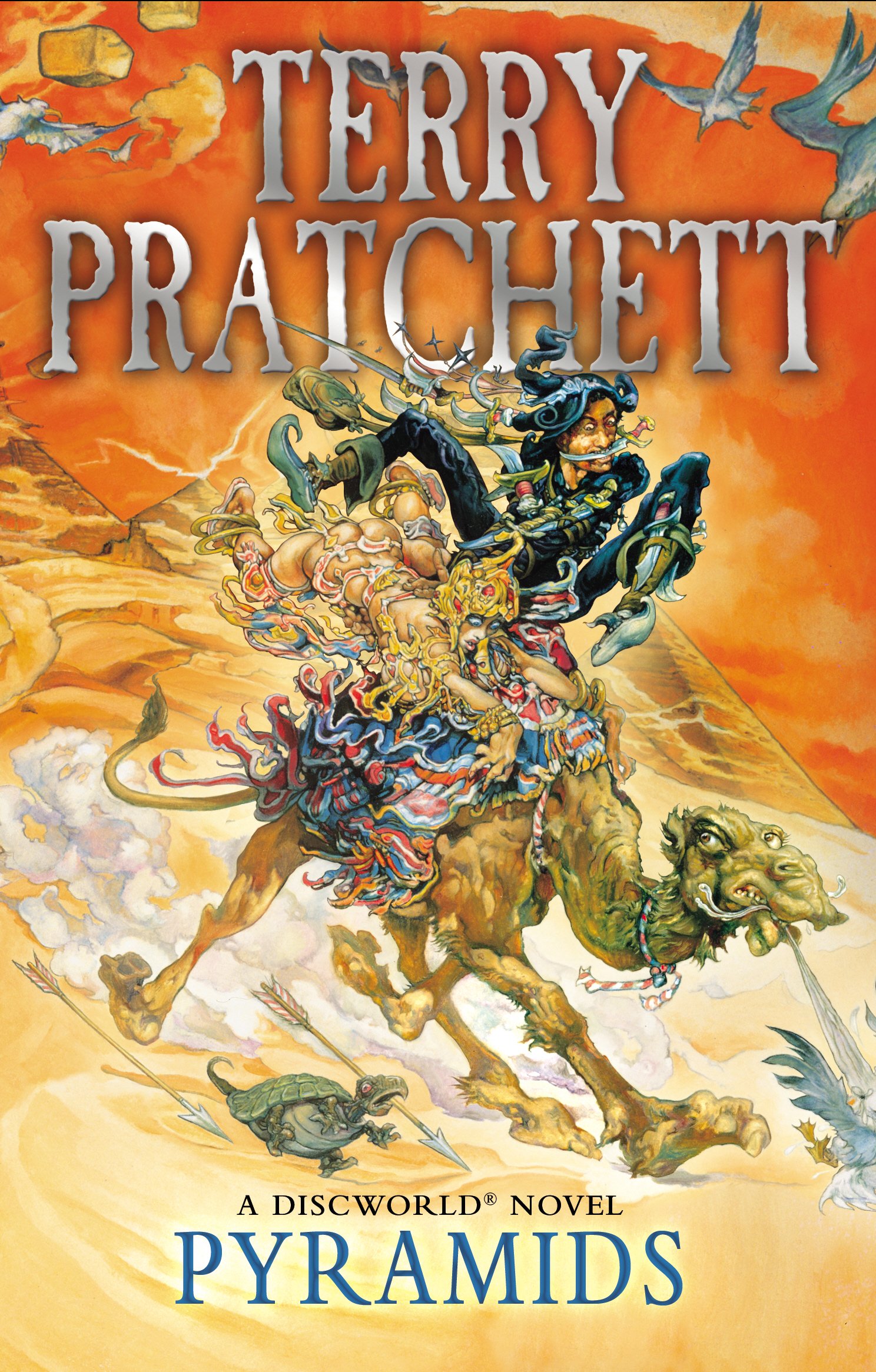
This was my first Pratchett so I must have liked it well enough to keep reading but now, having read so many others, it is quite near the bottom of the list. It is partly I think, that it is a one off and so lacks the familiarity of a lot of the other books but also, the story and characters didn’t particularly grab me.
The story starts in Ankh Morpork with Teppic, an Klatchian prince, completing his assassins’ guild examinations. (Incidently, looking at the books as a whole, the reader now has a lot of information about how society works on the Discworld. In Wyrd Sisters, we learn about the Fools Guild and the Thief’s Guild and in this one about the Assassin’s Guild, along with some information about how the guild system worked. Pratchett’s world building is steady and subtle so it doesn’t intrude into the plot but once you start to think about it, you realise that you have a lot of information.)
After he successfully passes his exams, he learns that his father, the current king / god of Djelibeybi has died and so he has to take his place. Teppic is not pleased by this, going back to the tiny kingdom which now seems woefully old fashioned to him. Even more annoying, he has no actual power, as the high priest, Dios, interprets all of Teppic’s words so that they fit with the traditions of Djelibeybi. This follows the last two novels’ ideas about power quite nicely as we are introduced to Dios, a man so unable to let go of power that he chooses immortality in order to make sure the kingdom carries on the way he wants it to.
The story revolves around the building of pyramids and the mythical properties that pyramids are supposed to have. There is nothing wrong with Pratchett’s satirising of these mysteries and the way that time is disturbed is both clever and amusing but I didn’t feel compelled by the story. Perhaps it was because I didn’t really feel drawn to any of the characters so there was little sense of jeopardy. I wasn’t really concerned about how things turned out.
This being Pratchett, there are some nice touches. Teppic’s father Pteppicymon XXVII, is disgusted to realise that while he is immortal, he will be trapped in his pyramid and so while he has eternal life, it is definitely limited. He realises exactly how pointless the rituals he believes in actually are. Ptraci, the late king’s handmaiden, manages to escape being killed and interred with the king and Teppic falls immediately and hopelessly in love with her but he has no idea how to deal with this. Ptraci and Teppic make their escape on the back of a camel called You Bastard, who happens to be the world’s greatest mathematician as well as having all the stereotypically bad tempered characteristics of a camel. There is some clever playing around with time as Teppic orders the biggest pyramid ever made which also causes the Gods to materialise making it much harder to believe in them.
All in all, though, I felt that it doesn’t add up to much and for me, it is not one of the better stories. It feels a bit flimsy with not quite as much depth to the writing as you would hope for.
 kepagewriter