Pratchett Reread – 4. Mort

For me, this is the first five star read of the series. It made me laugh from start to finish. The characters were fully realised, the plot was more than just a series of jokes strung together and I couldn’t put it down.

It starts with Mort, an awkward teenager who doesn’t fit in in his small village. His father has heard that there is a hiring fair and takes Mort along. Unfortunately no one wants him until – at midnight, of course – Death turns up to take Mort as his apprentice. Mort’s father is happy just to see his son placed somewhere and so Mort’s new life begins.

This takes us to Death’s kingdom and we meet Ysabell, Death’s adopted daughter and Albert, his grumpy manservant, both of which are full of comic potential. Ysabell has been a teenager for a long time (as you do not age in Death’s kingdom) and as you can imagine this has had quite an effect on her mood. Albert seems like just the salt of the earth servant you might expect Death to have but it transpires that he was a secret he’d rather Mort didn’t know.

Death begins to show Mort the ropes, taking him to the more important deaths of the Discworld. Mort begins to learn about fairness – ‘There is no justice’ Death tells Mort, ‘Just me.’ This is a valuable lesson and one which Mort seems reluctant to learn. When he begins to do the duties, things quickly go wrong because Mort is reluctant to kill Princess Keli at her allotted time. This leads to many problems for Keli and for Mort.

Keli discovers that the world carries on as if she has died – history is stronger than individuals. Mort decides that he will try to fix things himself, seemingly oblivious to the fact that history will sort itself out and Death decides that he will go on a holiday know that he has an apprentice. Death decides that there are aspects of human life he would like to investigate – getting drunk, gambling and dancing eventually finding some sort of satisfaction working in a greasy spoon. Mort becomes more like Death while Death becomes more human.

There are interesting philosophical questions raised about life, death and history. There is action. And there are characters that are convincing that you care about. This definitely feels like the real beginning of the Discworld saga.

Pratchett Reread – No. 3 Equal Rites

Well, this was surprising. I enjoyed this much more than I expected. I’m really not sure what I disliked about it so much last time round. It may have been the division between witch (female) magic and wizard (male) magic which was seemingly reinforced by Granny Weatherwax. I was a little disappointed in Granny, I think, as I knew her from later novels before I read this one. She doesn’t seem quite her later self. The division felt entrenched in the first half of the novel although by the end it is less so.

I still thought that this time round but perhaps because I was expecting it I didn’t find it quite as jarring. Certainly, this is still underdeveloped in places. The Librarian is still quite a small character compared to his later appearances. Granny seems even more set in her ways although to be fair, she does end up giving in and taking Esk to Unseen University once she realises that she needs to learn wizard magic.

That aside, it trots along nicely as a story. Esk is a strong female character – headstrong and determined to do what she wants – something that means that Granny has to rescue her regularly. Granny is not quite fully formed but a lot of the things that are good about her are already there. She is one of my favourite Discworld characters but she is definitely better in the comic trio of Nanny Ogg and Magrat.

So overall, this was a fairly solid read – not my favourite but definitely moving in the right direction.

Pratchett Reread – 2. The Light Fantastic

Well, I enjoyed this a lot more than I expected and certainly a lot more than The Colour of Magic. It felt like things had fallen into place a little more. Rincewind and Twoflower felt a bit more well rounded and their relationship was more nuanced than in The Colour of Magic. The plot also trotted along at a good pace and the addition of the red star heading for the discworld made it quite exciting.

Other characters seemed a bit more like themselves as well. There is a scene where Twoflower tries to teach the four horsemen of the apocalypse to play Bridge and Death is utterly confused and fascinated which seems like the start of his attitude to humans in the rest of the series.

I’d forgotten that this was our first meeting with Cohen The Barbarian. At the beginning he is without his diamond teeth which forms a nice comic disparity between Cohen the tough guy and Cohen the old man. Twoflower, of course, is in awe of him. Others often underestimate Cohen although they soon come to regret that. In the course of The Light Fantastic, having travelled through time and space on the back of the luggage, he bursts through the teeth of a just awakened troll. Taking these diamonds and Twoflower’s idea of dentures, he fashions his diamond teeth.

We also meet the Librarian although he is not quite the character that he becomes in the later novels. In fact, he is just a note in the background music of the Unseen University, a passing piece of comedy. But then the other wizards are similarly underdrawn. In the later novels, the wizards are more static, Ridcully is arch-chancellor for a long time. I’d forgotten that he wasn’t always arch-chancellor. There is more comedic value in familiarity, I think, so I’m glad that Pratchett made the decision to keep things more static.

There is more social commentary than in The Colour of Magic. There are the sects of people who spring up with the advances of the star who want to rid the world of magic and are not afraid to use violence to do it. There is Ymper Trymon, a wizard who places organisation above all else. He is a great villain who is convinced that the world should follow a certain order and would like to fit people neatly into that order. He meets a suitably gruesome end which was very satisfying.

Overall, I was pleasantly surprised by how much I enjoyed this but it was still not as good as some of the later novels.

Discworld re-read – The Colour of Money.

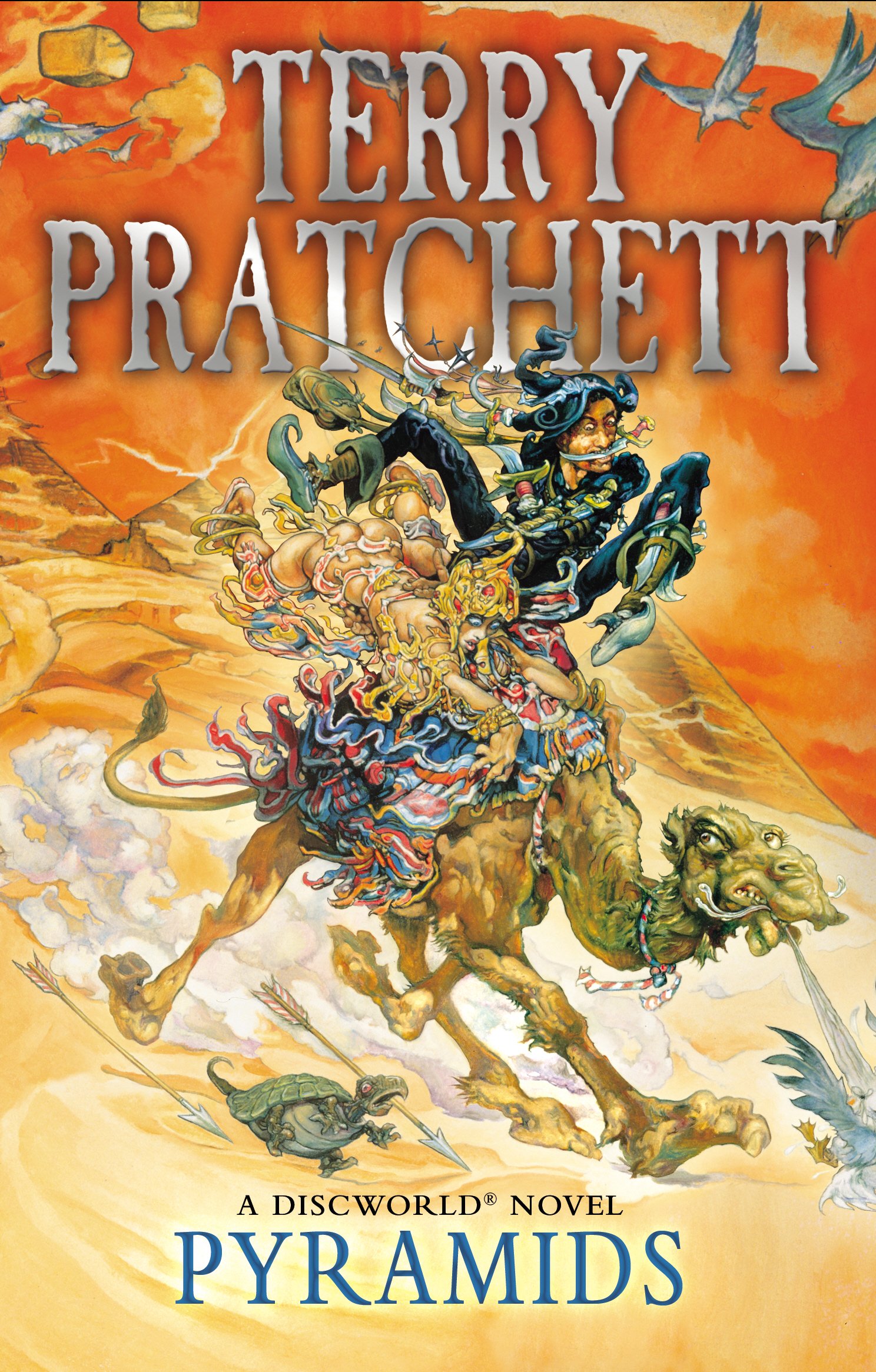
I decided that I would start to re-read the discworld books in order. It was a decision made because I wanted to read something that I knew I would like. I’ve been struggling a little so far this year with deciding what to read and then picking things that I don’t really get on with. I’m not intending to read only Pratchett but maybe every other book will be a Pratchett. I haven’t ever read the whole series in the right order. My first one was Pyramids which I bought in the early 90s. I enjoyed it but I was a bit slow to start reading any others (perhaps because it is a stand alone story). For a while, I picked them up in haphazard fashion, buying new releases while trying to catch up with previous ones although from about 2000 onwards, I was reading them in the right order.

So I started last month with The Colour of Magic. It is strange reading it now, a bit like watching the first episode of a comedy show that you really like but which didn’t quite gel at the beginning. The characters were all there, the setting was the same but things definitely felt a little undeveloped. Death was a different character, colder and less likeable. Of course, as yet, he hasn’t been Bill Door or the Hogfather so his character development is all in the future.

Rincewind and Twoflower make a good pairing though. Twoflower is an excellent comic invention with his naivety only matched by his ability to get into dangerous situations. Combined with Rincewind’s abilty at running away, this makes for some classic Pratchett comedy. Even so, I felt like there was something lacking. I’m not even sure what it was but I definitely didn’t enjoy this as much this time round. I already know that the next two books (The Light Fantastic and Equal Rites) are not ones that I love so it will be interesting to see what I make of them this time round.

Books Read in 2014 – 2. Raising Steam – Terry Pratchett

Genre: Humorous fantasy

Narrative Style: Third person from a variety of points of view. The_front_cover_of_the_book_Raising_Steam_by_Terry_Pratchett

Rating: 4/5

Published: 2013

Format: Paperback

Synopsis: A new invention has arrived in Ankh Morpork and it quickly grabs everyone’s attention. Particularly those with anoraks and notebooks. The steam engine has arrived and is definitely hear to stay despite the efforts of those who wish to stop progress whatever its form. It falls to Moist Von Lipwig to try and keep the railway safe which means pleasing Lord Vetinari, nobody’s idea of an easy life. Moist will need all skills as a scoundrel and a few more besides to survive this adventure. 

This was a Christmas present from my husband. It felt like high time that I got round to reading it, having read all the others. Normally, Pratchett’s are purchased the minute they are released but I’m not a big fan of the other books with Moist Von Lipwig so I didn’t rush this time.

It was so long that I’d forgotten what a pleasure it always is to read a Discworld novel. Especially one with such good subject matter. There is no doubt (in my mind, anyway) that there is something fascinating about the steam engine and something elegant that more modern trains just cannot compete with. Pratchett captures this perfectly in his descriptions of Iron Girder and of her creator’s love for her. Simnel, the engineer with the flat cap and the Northern accent, is one of Pratchett’s better recent creations and was totally believable.

Of course, this isn’t just a novel about steam and the men who tinker with it. This is also a novel about discrimination, extremism and politics. Extreme members of the Dwarfish community have been knocking down the Clacks and are now attacking the train. While the low king is away, they take over and try to place their leader on the Stone of Scone. Pratchett is at his best when he writes of such subjects. There is a strong moral at the heart of this novel but it is never preachy. At the very heart of it is a message of tolerance which is impossible to argue with.

It is less successful, I think, when dealing with the gender issues in the Dwarfish community. Dwarfs do not reveal their sex normally but many were starting to break with the tradition and near the end of the novel, the Low King reveals she is in fact a queen and not only that but about to become a mother. I’m not sure what it is about this that rankled but I just didn’t find it convincing.

As for Moist Von Lipwig, he still remains one of my least favourite Pratchett characters but there was so much other stuff going on that he didn’t annoy me as much as he has  done before. The pace is fast with exciting train rides, battles and action aplenty. I could have happily continued reading.


Day 7 A book that is a guilty pleasure

I’m not sure that I really believe in the concept of a guilty pleasure when it comes to reading. I like what I like and I am not ashamed of any of it. Nobody else should be either. I tend to assume that because I like it, it must be of a quality. I know, that’s a particularly circular argument but I genuinely believe it. And it’s quite an easy thing to say when you don’t read anything that might be considered particularly trashy.

Of course, it is only my opinion. For example, my father in law cannot understand why I read any of the fantasy books I like. In fact, he says he wouldn’t even call them literature. I know that he means Terry Pratchett when he says that. So maybe I should view them as a guilty pleasure but to me, they just are a straightforward pleasure. They make me laugh and they make me think. Surely, you can’t get better than that.

Day 5 – Comfort book – Pratchett and Rankin

When I am feeling a bit low, I tend to look for reading that is either going to make me laugh or that is going to be nicely tied up at the end. There are two things that I periodically turn when I am in this mood – one of the many Discworld books, guaranteed  to lift your spirits or detective fiction of some description which would give me a puzzle to solve and hopefully leave me with the correct answer.


The next task for me was to decide which Discworld book to talk about. This was stupidly difficult. As far as I am concerned, they are all good so it wasn’t even a question of eliminating the ones that were bad. Eventually, it came down to favourite characters – and that came down to Death. Of the

reaper-man-1books which feature Death as a main character, Reaper Man is my favourite. In this, Death goes miss and lives as a human called Bill Door. Appropriately, he becomes a reaper of corn. There is a wonderful scene where he becomes aware of the nature of time, something he has never had to worry about before. He cannot imagine how humans manage to live with clocks in their houses, quietly ticking off the seconds of their all too brief (from the point of view of an immortal) lives. As Death is no longer doing his job, life force starts to build up and Ankh-Morpork becomes home to a number of undead – vampires, zombies and old wizards who fail to die when they are supposed to – all of which add to the humour.

This is a novel that manages to be both comic and profound. It tackles big ideas without them seeming big or pretentious. It makes you think about life and death without being the least bit depressing.


The other type of novel I like when I feel a bit under the weather is detective fiction. Although I have read Rendell, Kellerman, Patterson and others, I find that Ian Rankin’s Rebus just resonates the most with me. My favourite

question of blood

Rebus Novel is A Question of Blood. The murder takes place in a school; a shooting by a loner who then kills himself. I like this because it appears an open and shut case but, of course, it isn’t. As ever, Rebus’ personal life gets him into trouble and is as much a concern as the case he is working on when it seems he may have committed a crime in order to help DS Siobhan Clarke.

I try not to read books that I have read before especially when there are so many books waiting patiently on my to-read list but there are times when it is comforting to know exactly what you are going to get. And both Pratchett and Rankin never let you down.

Day two- Favourite side character – Walser, Spud and Ponder Stibbons

As you will discover as this challenge continues, I am incapable of picking a single book for anything. So each post will probably look at two or three books.
My first choice for favourite side character is Walser from- Nights at the Circus by Angela Carter
Jack Walser is the straight man to the magical, winged woman Fevvers in Angnights-at-the-circusela Carter’s wonderful tale of mystery and intrigue. In a lot of ways, he performs the function of a reader, incredulous and duped by the amazing Fevvers. He gets drawn into her chaotic world almost against his will and is amazed by her along with the reader.
In the course of the novel, Walser is frequently injured and humiliated. He completely loses himself at one point before being reborn a new and wiser man. As a reader, we feel for him and worry for him, in a way that you don’t have to about Fevvers who is strong and confident and although she gets into scrapes, she seems so together that there seems little need to doubt she will survive.
The reason I like him so much is that as a journalist, he should be cynical but in the face of the Fevvers, he cannot remain so. He is described as unfinished and does not reach his true personality until he has been through his series of adventures and falls for Fevvers in every way.
Spud from Trainspotting by Irvine Welsh
Spud is one of my favourite comic characters. He is involved in one of my favourite incidents in Trainspotting – the job interview which he attends with Renton having taken speed and in which he informs the interviewer that htrainspottingas lied on his application form. Welsh perfectly captures his voice, calling everyone ‘cat’ and ‘kitten’ and showing his eternal optimism and friendliness. Unlike Renton, Sickboy and Begbie, Spud is a warm character who maybe a little naive and hopeless but is not as flawed as the others.
Spud has perhaps the most poignant moment in the novel where he begins to feel close to a woman but loses his nerve after remembering a line from There is a light that never goes out by The Smiths. It is heartbreaking.
Ponder Stibbons from the Discworld series by Terry Pratchett
If you have ever worked in an office (or wherever) and felt that you were the only sane person in the place, then you will have a great deal of sympathy for my third choice, Ponder Stibbons. He is the only sensible wizard in Unseen University. Having to deal with Arch-chancellor, Ridcully  on a daily basis would try the patience of a saint and Ponder is often on the very edge of his patience. But what is really great about this character is the strategies he employs in order to ensure that things are actually done his way. The way he plays Ridcully is a joy to behold.