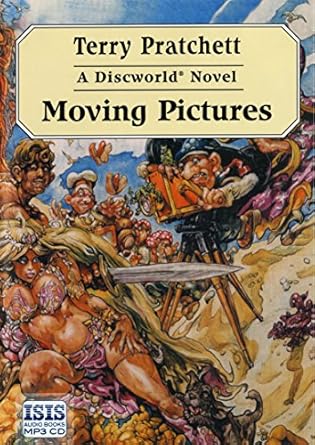
Pratchett Reread – 9 Moving Pictures

This is one of my favourite Discworld stories and it was very enjoyable again this time. There are lots of clever references to films and Hollywood lore. It cleverly sends up our obsession with fame and with the frenzy that comes with the movies and it is incredibly funny. It also introduces some of my favourite charachters who – thankfully – reappear in later books.

The story starts when the last keeper of the gate dies without a successor. That is when the Holy Wood magic starts to seep out into the land. Very soon, many individuals are affected by wild ideas that seem to come from nowhere. Thomas Silverfish, an alchemist, discovers the Discworld equivalent of celluloid, Victor Tugelbend, a student wizard who is careful never to pass his exams, becomes a leading man in the style of Errol Flynn or Clark Gable, Cut-Me-Own Throat Dibbler starts dreaming about grand passions, forbidden romances and, of course, 1000 elephants.

Then there are the animals who have been sleeping in the Holy Wood hills who suddenly discover they can talk and think. Along with a cat, mouse, rabbit and duck, there is Gaspode the Wonder Dog – in my opinion, one of Pratchett’s greatest comic creations. (Apparently Pratchett had originally wanted Gaspode to die at the end. Thank goodness he changed his mind.) Gaspode is wonderfully sarcastic, torn between his wolfish instincts and the need to be loved by a human. Pratchett then presents us with the perfect foil to Gaspode in Laddie who truly is a wonder dog in the eyes of everyone apart from Gaspode who despairs of his stupidity.

Other characters that are introduced in this novel are Ridcully, the arch chancellor of the university who manages to avoid assassination attempts. He is loud and brash and prefers hunting to magic. Quickly, he starts to drive the Bursar crazy, the beginning of a long and tortured relationship. None of the previous arch chancellors really stood out which may be why none of them survived more than one novel. Then there is Ponder Stibbons who is really just comic relief in this novel but has a great Discworld journey ahead of him.

Like the best of the Discworld novels, this is funny, clever, has so many real world references you couldn’t possibly spot them all, it’s exciting and you root for the characters. As if this wasn’t enough, there are moral points to be taken about fame, about specatating and about generally treating people well. It’s astonishing really, that it flows so well and is so easy to read. Excellent from start to finish.

Books Read in 2015 – 16. Breakfast of Champions – Kurt Vonnegut.

Genre: Satire, Metafiction, Science Fiction

Narrative Style: Third person but with interjections by the character of the author. 

Rating: 4/5

Published: 1973

Synopsis: Science Fiction writer, Kilgore Trout, is invited to an arts festival, much to his horror. Little does he realise exactly what events he will cause when he gives the already unbalanced Dwayne Hoover one of his books to read. The book opens with the idea of the catalytic nature of their meeting and then traces their respective journeys to this point. 

This is probably more about science fiction then it is science fiction as the setting is earth in the seventies. However, there are many descriptions of Trout’s books and stories and there is also a commentary on the place of science fiction as a literary genre (e.g. right at the bottom of the cultural heap) and also on the way science fiction should be read. Hoover speed reads one of Trout’s novels and comes to believe that he is the only man on earth with free will and everyone else is a robot. This causes him to go on a violent rampage where he injures Trout, his girlfriend and his son.

The journeys of both Hoover and Trout, up to this point, are exciting and weird in the way that only Vonnegut’s writing is weird. Hoover suffers from echolalia and hallucinates that the ground is melting while Trout cannot remember who he is talking to and is fascinated by the names on the sides of trucks which seem to make no sense to him. They are joined at the Arts festival by the character of Kurt Vonnegut who wears dark glasses and hides in the shadows so as not to unsettle his creations. This allows Vonnegut (the author) to play with the idea of author as the God of his novels. This is meta-fiction as its best with interesting ideas about writing , authorship and characterisation.

The best – and funniest – part of this novel is undoubtedly the tone and style. The novel is a bit like an idiot’s guide to Earth and so things that are obvious are explained as if they are not. Some of the explanations are hilarious and also send up American culture at that time. There is a strong satirical tone throughout. Very enjoyable.

Books Read in 2014 – 31. The Stepford Wives – Ira Levin

Genre: Horror, Dystopia, Satire

Narrative Style: Third Person from the point of view of one characterdownload (8)

Rating 4/5

Format: Paperback

Published: 1972

Synopsis: Joanna moves to Stepford at the insistence of her husband, Walter and, at first, it seems to good to be true. She soon becomes irritated by the passiveness of the women and their housework obsession. Then the two friends she thought were different start to show the same obsessions and she starts to wonder what exactly is going on in Stepford. I can remember seeing the 1975 film version of this book when I was fifteen so I knew what the basic story was. You might think that this would spoil the story, making it less tense but this was not the case. Levin unfolds Joanna’s story masterfully and knowing what might happen to her only made me more anxious for her to escape the clutches of the men of Stepford. Joanna begins the novel an independent, strong woman who works as a photographer. She does housework when she has to and is used to having strong female friendships. She is sexual and attractive without the need for make-up. However, when she comes to Stepford she finds all the women are eerily similar and coldly distant. They are unable to find a place in their housework schedule to even meet for coffee. They are beautifully coiffed and clothed. She is rightly appalled by this and by her husband leaving every evening to go to the men’s association. Joanna does meet two other like-minded women – both of whom have not lived in Stepford for long – and they try desperately to get some sort of female movement going. However, when one of them suddenly becomes docile like the other women, they start to worry that they’ll be next. Eventually there is only Joanna left and she tries desperately to warn the one woman to move to Stepford after her before the men seal her fate. Levin cleverly does not tell the reader exactly what happens to Joanna. She merely loses narrative perspective. Ruthanne takes over the narrative point of view and she runs into Joanna in the supermarket, noting her coldness, her obsession with housework and how good she looks. As Ruthanne is a writer, it can be assumes that she will be the men’s next victim. The men in the novel respond specifically to their wives’ attempts at politicising themselves. Joanna discovers that the women were once activists or very successful professionals that held feminist meetings. The message that Levin is trying to get across is clear. Men will not just stand back and let women gain power from them. As Chuck Palahniuk notes in the introduction, perhaps more heed should have been taken. The whole beauty industry and the obsession with women’s appearance is one very successful way of keeping them in their place regardless of their professional position.

Eclectic Reader Challenge – Humour – I Can Make You Hate – Charlie Brooker

I’m quite an angry person. I don’t mean that I go out and start fights or anything like that but intellectually, it is definitely my default position. The news, the abundance of stupid people on the TV, the growing gap between mainstream and genuinely alternative (rather than the mainstream MCfly version of alternative), all of these things and more are capable of making my blood boil. In this sense, Charlie Brooker’s I Can Make You Hate was the perfect book to read for the humour category of the Eclectic Reader Challenge. This book is very very funny but it is also incredibly angry. And understandably so.

I knew what to expect from this book. I’d read Brooker’s columns before – particularly when he used to write Screen Burn for The Guardian and of course, he is now on TV fairly regularly. He already ranked as one of my favourite angry people (along with Ben Goldacre, Mark Kermode and David Mitchell). You know the sort of people who are passionately and endlessly angry. Like when reading Kermode, there were numerous times when I felt as though Brooker had crawled inside my head and read my thoughts. Although, obviously, he expressed them with a lot more verve and potty humour then I would have managed.

Brooker’s bile is wide-ranging. There is political comment – in my mind, David Cameron will always be a foal swallowing lizard now – cultural comment on TV, video games, music and film, as well as coverage of the Royal Wedding and the Olympic preparations. Nothing escapes Brooker’s gleeful voice of angry destruction. He manages to cut photo-10through the bullshit of modern life with remarkable clarity. And while he can come across as an angry man on a rant and clearly does want to shock people out of their complacency, he manages to avoid saying things that are just offensive and not funny or pertinent; a knack that seems to have escaped Frankie Boyle.

I would recommend this book for anyone who thinks that modern life is a bit rubbish. Believe me, by the end of reading this book, you will know exactly who to blame.