Books Read in 2014 – 16. Translated Accounts by James Kelman

Genre: Experimental, Dystopia

Narrative style: a variety of first person accounts from a number of unnamed people.

Rating 2/52014tbrbutton

Format: Paperback

Published: 2001

Synopsis: A series of nameless narrators tell of their life in what seems to be some sort of police state. There are rules and securty forces and the narrators seem concerned about conforming or otherwise. The accounts are supposed to have been translated from the original language by some Government authority and as a result they are somewhat alienating to read. 

Challenges: TBR Pile Challenge

Time on shelf: I bought this in about 2003, not long after I had finished my MPhil, in which I wrote about A Disaffection and How Late it was How Late both of which I really enjoyed. However, I felt the need to read less challenging books for a while after finishing my thesis so this got stuck on the shelf as I knew it was likely to be difficult. 

This was a real slog and it is a long time since I have felt so pleased to have finished a book. In fact, if not for the fact of reading it for the TBR Pile Challenge I might have abandoned it. I knew it wasn’t likely to be an easy read but I had no idea of the problems I was going to have with it.

There are a number of things that make this difficult to read. The first is download (4)that not only are none of the narrators named but neither are any of the characters. They are referred to as woman, wife, mother and so on. This means that there is no continuity and it is even more difficult to tell which narrator is which. It also means that no character stands out and so there is no one for the reader to attach themselves to or be concerned for.

There is very little detail about the society although you can glean that people are frightened and that they’re ruled by some all powerful higher authority but the rules are never really explained and as there is very little action the plot moves very slowly.

Finally, the language is disjointed and does sound a lot like it has been translated from another language. It is as if the fracturing of society has had a fracturing effect on the language of its people. Again, this makes it difficult to read.

I realise that what I’m viewing as problems might very well have been Kelman’s intentions and I understand the points he is trying to make about the way a police state would strip its members of individuality and make it difficult to discuss anything openly. It was an interesting experiment although ulitmately, I think, a failed one.

Day 8 – Books that are underrated – A Disaffection and The People’s Act of Love.

I have to confess that I don’t really follow fashion or know what is underrated. So the books I am going to mention are ones that I have read but not many people I know have read and I feel that they would enjoy.

The first book I have chosen is A Disaffection by James Kelman. It has one of my favourite opening lines – “Patrick Doyle was a teacher. Gradually he had become sickened by it.” It sums up very neatly exactly what happens in the novel as Patrick becomes more and more disaffected with his life in gen9780330307369 (1)eral and his career choice in particular. Gradually, his behaviour becomes more erratic and the narrative voice- although third person – becomes increasingly rambling along with it. It becomes difficult to tell where the third person narrator ends and Patrick’s thoughts begin. This could show just how removed Patrick is from his own life, unable even to grasp a first person narration of his own life.

This is a very down to earth novel and was one of the first books  I read that used dialect words and to have the rhythm of working class language. This appealed to me and also influences me as a writer as I am from a working class background myself. It was also the first time I had read a book that played around with the rules of grammar and punctuation – for example not using apostrophes in words such as shouldnt or question marks at the end of questions. Sentences break off without warning into new paragraphs. Others are left unfinished. This cleverly shows the fragmented nature of Patrick’s thoughts. After all, few people’s thought processes are as clear cut as they appear in most novels. Inside your own head, you don’t have to make complete sense as you are the only one who needs to understand.

This novel is an examination of the human state reminiscent of Kafka and just as surreal at times even though it is grounded in realism. The end of the novel is one of the most poignant I have read. The reader knows that the future is not looking good for Patrick as his final thoughts in the novel are about suicide. The final words are “Ah fuck off, fuck off.” This shows that Patrick is no closer to being able to deal with the world now then he was at the beginning, in fact things are an awful lot worse and likely to continue in that fashion. There is no need to continue the novel as the rest of Patrick’s life is summed up in those five words.

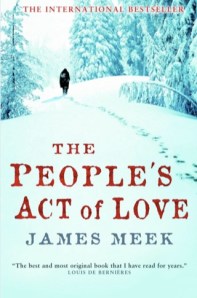
The second book I have picked is The People’s Act of Love by James Meek. It is set in Siberia in 1919, a time and a place I knew nothing about. It begins with the appearance of a mysterious stranger who has escaped from an Arctic prison and who claims he is being chased by a cannibal. This is an exciting narrative that is full of twists and turns and containing some of the

peoples_act_of_love

most interesting characters I have come across.

For me, the main success of the book was making interested in a time in history that I had previously not even considered and the author is clearly knowledgeable about the era, including things such as the Russian sect of Castrates called Skoptsky and also about The Czechoslovak Legion fighting in the Russian Civil War which i don’t think are common knowledge. When I finished this book, I had an urge to find out more, surely the sign of an excellent book.