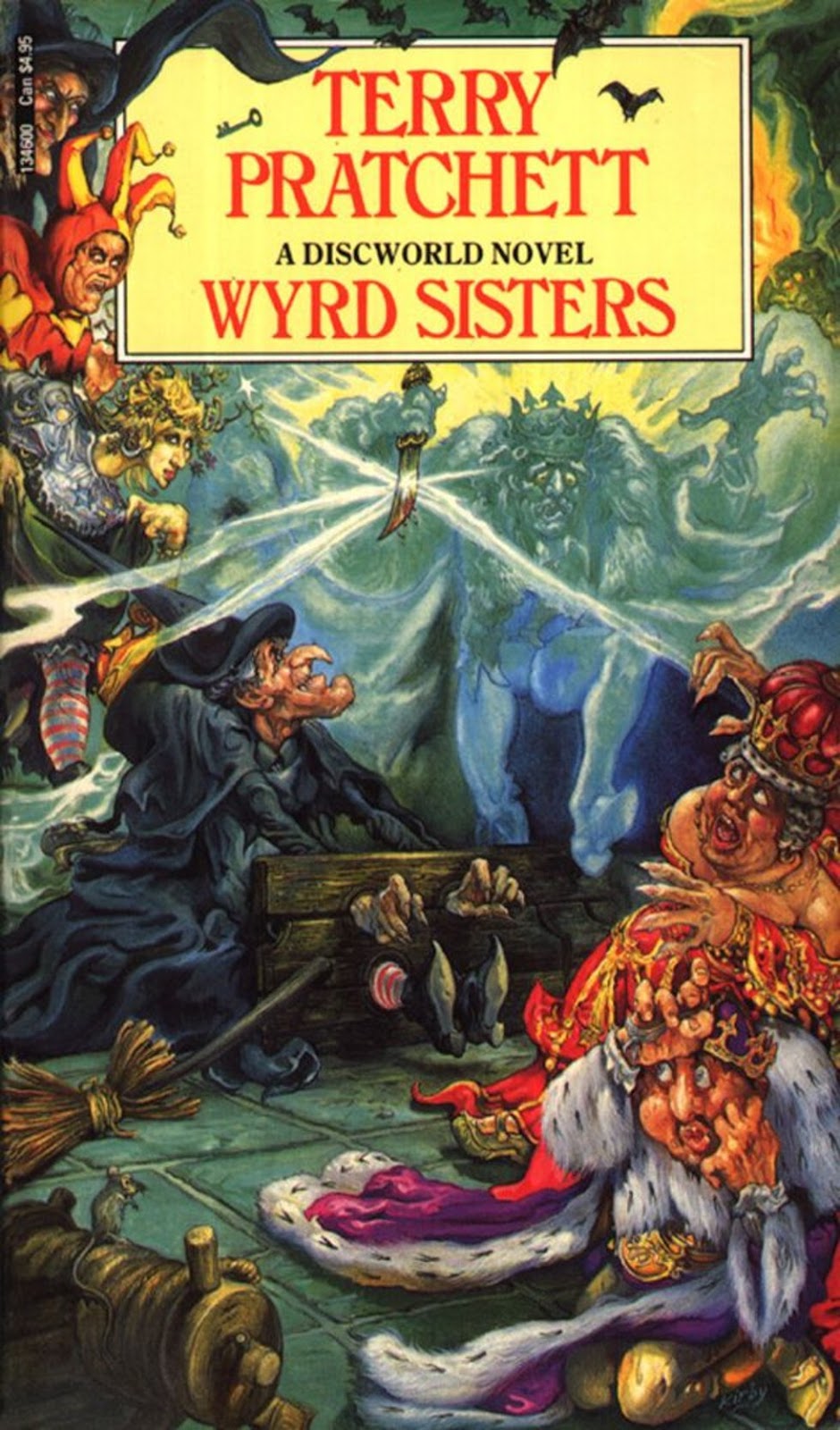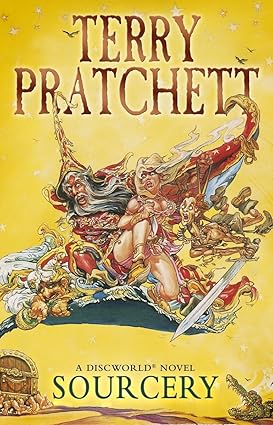
Pratchett Reread 5. Sourcery

I wasn’t sure how much I was going to enjoy this one. My memory was that it was okay but not the best. As such, it’s not one that I have reread very often. however, I was pleasantly surprised. It was much better than I remember. And like Mort, it is so much more than a story about a boy who is the seventh son of a seventh son who becomes a sourcerer.

This is a tale about power – who should wield it and how it should be wielded. Quite an unwieldy subject but Pratchett makes it so you barely notice. There is no heavy handed moralising here. Just a comic tale of what might happen if the power of magic should fall into the wrong hands.

We have Rincewind, reluctant hero whose first thought is to runaway (along with the rats and the gargoyles from Unseen University). As ever, his attempts to get away from the action only pull him in further. His adventures bring him into contact with Conina, the daughter of Cohen the Barbarian, Nijel, a desperately unlikely hero and Creosote, the richest man in the world. There is also a much bigger role for the Librarian who hides all the magical books from Coin, the sourcerer. The Librarian is also responsible for looking after the Patrician – who has been turned into a lizard.

There is plenty of comic business. Nijel is the worst hero ever although he does try very hard. Conina just wants to be a hairdresser although she has a barbarian’s instincts. And of course, Rincewind, despite being the worst wizard, is full of knowledge about what he thinks wizardry should represent and how magic should be used. He is not taken in by Coin, when most of the other wizards see only the possibility for gaining power.

The novel ends with Rincewind saving the day but in the dungeon dimensions. So while the world is saved, Rincewind is missing in action The rest of the world returns to normal with little thought for the reluctant hero. It was mostly a satisfying read and much better than I remember.

Pratchett Reread – 4. Mort

For me, this is the first five star read of the series. It made me laugh from start to finish. The characters were fully realised, the plot was more than just a series of jokes strung together and I couldn’t put it down.

It starts with Mort, an awkward teenager who doesn’t fit in in his small village. His father has heard that there is a hiring fair and takes Mort along. Unfortunately no one wants him until – at midnight, of course – Death turns up to take Mort as his apprentice. Mort’s father is happy just to see his son placed somewhere and so Mort’s new life begins.

This takes us to Death’s kingdom and we meet Ysabell, Death’s adopted daughter and Albert, his grumpy manservant, both of which are full of comic potential. Ysabell has been a teenager for a long time (as you do not age in Death’s kingdom) and as you can imagine this has had quite an effect on her mood. Albert seems like just the salt of the earth servant you might expect Death to have but it transpires that he was a secret he’d rather Mort didn’t know.

Death begins to show Mort the ropes, taking him to the more important deaths of the Discworld. Mort begins to learn about fairness – ‘There is no justice’ Death tells Mort, ‘Just me.’ This is a valuable lesson and one which Mort seems reluctant to learn. When he begins to do the duties, things quickly go wrong because Mort is reluctant to kill Princess Keli at her allotted time. This leads to many problems for Keli and for Mort.

Keli discovers that the world carries on as if she has died – history is stronger than individuals. Mort decides that he will try to fix things himself, seemingly oblivious to the fact that history will sort itself out and Death decides that he will go on a holiday know that he has an apprentice. Death decides that there are aspects of human life he would like to investigate – getting drunk, gambling and dancing eventually finding some sort of satisfaction working in a greasy spoon. Mort becomes more like Death while Death becomes more human.

There are interesting philosophical questions raised about life, death and history. There is action. And there are characters that are convincing that you care about. This definitely feels like the real beginning of the Discworld saga.

Pratchett Reread – 2. The Light Fantastic

Well, I enjoyed this a lot more than I expected and certainly a lot more than The Colour of Magic. It felt like things had fallen into place a little more. Rincewind and Twoflower felt a bit more well rounded and their relationship was more nuanced than in The Colour of Magic. The plot also trotted along at a good pace and the addition of the red star heading for the discworld made it quite exciting.

Other characters seemed a bit more like themselves as well. There is a scene where Twoflower tries to teach the four horsemen of the apocalypse to play Bridge and Death is utterly confused and fascinated which seems like the start of his attitude to humans in the rest of the series.

I’d forgotten that this was our first meeting with Cohen The Barbarian. At the beginning he is without his diamond teeth which forms a nice comic disparity between Cohen the tough guy and Cohen the old man. Twoflower, of course, is in awe of him. Others often underestimate Cohen although they soon come to regret that. In the course of The Light Fantastic, having travelled through time and space on the back of the luggage, he bursts through the teeth of a just awakened troll. Taking these diamonds and Twoflower’s idea of dentures, he fashions his diamond teeth.

We also meet the Librarian although he is not quite the character that he becomes in the later novels. In fact, he is just a note in the background music of the Unseen University, a passing piece of comedy. But then the other wizards are similarly underdrawn. In the later novels, the wizards are more static, Ridcully is arch-chancellor for a long time. I’d forgotten that he wasn’t always arch-chancellor. There is more comedic value in familiarity, I think, so I’m glad that Pratchett made the decision to keep things more static.

There is more social commentary than in The Colour of Magic. There are the sects of people who spring up with the advances of the star who want to rid the world of magic and are not afraid to use violence to do it. There is Ymper Trymon, a wizard who places organisation above all else. He is a great villain who is convinced that the world should follow a certain order and would like to fit people neatly into that order. He meets a suitably gruesome end which was very satisfying.

Overall, I was pleasantly surprised by how much I enjoyed this but it was still not as good as some of the later novels.

Discworld re-read – The Colour of Money.

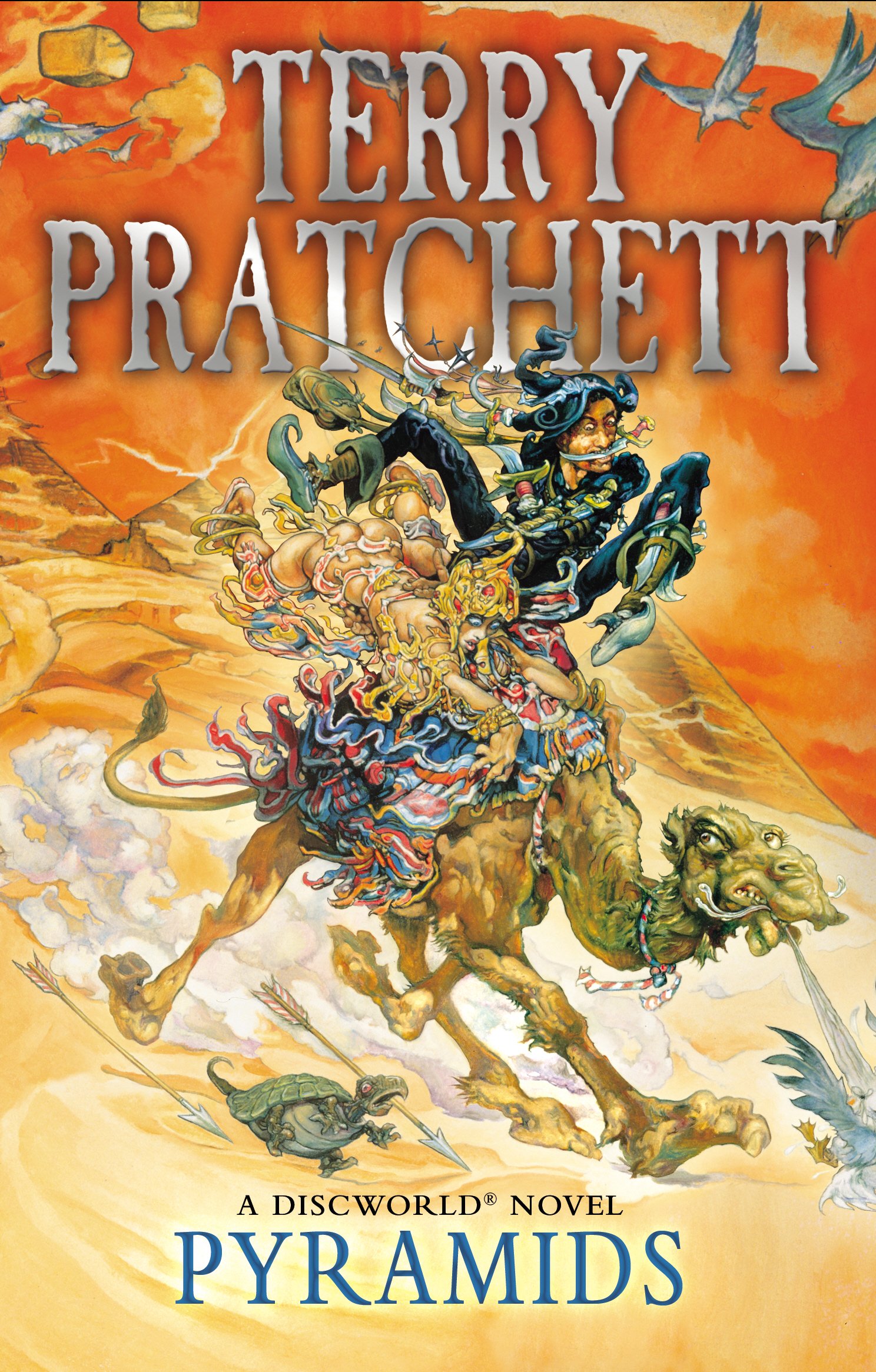
I decided that I would start to re-read the discworld books in order. It was a decision made because I wanted to read something that I knew I would like. I’ve been struggling a little so far this year with deciding what to read and then picking things that I don’t really get on with. I’m not intending to read only Pratchett but maybe every other book will be a Pratchett. I haven’t ever read the whole series in the right order. My first one was Pyramids which I bought in the early 90s. I enjoyed it but I was a bit slow to start reading any others (perhaps because it is a stand alone story). For a while, I picked them up in haphazard fashion, buying new releases while trying to catch up with previous ones although from about 2000 onwards, I was reading them in the right order.

So I started last month with The Colour of Magic. It is strange reading it now, a bit like watching the first episode of a comedy show that you really like but which didn’t quite gel at the beginning. The characters were all there, the setting was the same but things definitely felt a little undeveloped. Death was a different character, colder and less likeable. Of course, as yet, he hasn’t been Bill Door or the Hogfather so his character development is all in the future.

Rincewind and Twoflower make a good pairing though. Twoflower is an excellent comic invention with his naivety only matched by his ability to get into dangerous situations. Combined with Rincewind’s abilty at running away, this makes for some classic Pratchett comedy. Even so, I felt like there was something lacking. I’m not even sure what it was but I definitely didn’t enjoy this as much this time round. I already know that the next two books (The Light Fantastic and Equal Rites) are not ones that I love so it will be interesting to see what I make of them this time round.

Top Ten Tuesday – 10 Books with flowers in the title.

Top Ten Tuesday was created by The Broke and the Bookish in June of 2010 and was moved to That Artsy Reader Girl in January of 2018. It was born of a love of lists, a love of books, and a desire to bring bookish friends together.

This weeks prompt could be anything to do with flowers so I’ve chosen to list books with flowers in the title.

  1. Purple Hibiscus – Chimamanda Ngozi Adichie (2003) – An excellent story about the difficulties of growing up when your country is in turmoil and your family life is equally difficult.
  2. Flowers in the Attic – V. C. Andrews (1979) – A woman hides her children in the attic in order to gain an inheritance. I read this as a teenager (when everyone at school seemed to be reading it). I’m not sure what I’d think of it if I read it now.
  3. The Perks of Being a Wallflower – Stephen Chbosky (1999) – A powerful coming of age story about trying to live your life when you don’t understand your impulses or the world around you.
  4. The Name of the Rose – Umberto Eco (1980) – A convoluted mystery set in a medieval monastery with a cast of strange monks to add to the creepiness.
  5. The Black Dahlia – James Ellroy (1987) – A dark and disturbing story about the murder of a beautiful women in LA. This was my first Ellroy and one of the most enjoyable.
  6. The Virgin’s Lover – Philippa Gregory (2004) – The romance between Elizabeth 1 and Robert Dudley portrayed like a Carry On film. Not one of my favourites.
  7. All the Flowers in Shanghai – Duncan Jepson (2011) – An okay story set in 1930s Shanghai and showing the horrors of arranged marriages and the pressure to produce a male heir.
  8. Flowers for Algernon – Daniel Keyes (1966) – A thought experiment looking at the way we treat others based on how intelligent we perceive them to be. One of my favourite science fiction books.
  9. Odour of Chrysanthemums – D. H. Lawrence – A short stories about a woman waiting for her husband to return from the mine, unaware that he was killed in an accident earlier that day.
  10. The Day of the Triffids – John Wyndham (1951) – Okay more of a tree than a flower probably but nonetheless a well written look at the aftermath of a disaster.

Books Read in 2015 41. The Ocean at the end of the Lane by Neil Gaiman

Genre: Fantasy, bildungsroman 

Narrative Style: First person, flashback framed at both ends by the present day.

Rating: 4/5Unknown

Published: 2013

Format: Kindle

Synopsis: A middle aged man returns to his childhood home after a funeral.  He ventures to the house down the lane and remembers long forgotten and sinister events from his childhood. 

The nameless narrator of this novel returns to the place where his childhood home used to be. Seemingly compelled to investigate, he starts down the lane to see if the farm and the “ocean” that used to be there still exist. Once there, he sits down by the pond and begins to remember Lettie Hempstock, the little girl who used to say that the pond was an ocean.

With memories of Lettie, come memories of a chilling nature. Events start with the suicide of a man who has stolen money from his friends. This awakens a supernatural force which tries to give money to people. One of the most creepy parts of this book is when the nameless narrator wakes from a dream in which he is choking to discover he really has got a coin stuck in his throat. This really touched on one of my deeper fears.

Events quickly take a fantastical turn, with monsters in human form and creatures from a realm beyond our understanding. The governess Ursula Monkton enthrals all except the narrator who sees her as the personification of evil especially as she seems to have a strong hold over his father. The narrator’s perception of her as a monster is like a child’s explanation of adult events that are beyond his understanding and the forgetting of these events as the child ages.

The darkness in this story – personified by Ursula Monkton and the Hunger Birds – is pretty unsettling especially when the Hunger Birds start to eat away at the universe. But the images of friendship and sacrifice – personified by the Hempstock family – are equally powerful. I liked the idea that the universe is being protected from the worse of evil by three generations of strong women.

Perhaps because this was the story of a young boy who didn’t entirely understand events all of the time anyway, there is never any room for disbelief. The story was utterly convincing. It transpires that the man has visited the farm a few times in his adult life although he cannot remember doing so. By the time he leaves the farmhouse, the reader realises that he will not remember this visit either. This made me think of the way that difficult childhood memories can have such a powerful hold even if you cannot remember them fully.

Reading this was a little like reading a modern fairy tale. You could take it at face value, a scary story about death, friendship and sacrifice or you could look at it as an allegory about good and evil, childhood and growing up. Like the pond, that was really an ocean, this is a novel with unexpected depth.

Books Read in 2014 – 6. The Doll’s House – Neil Gaiman

Sandman_Dolls_HouseGenre: Graphic Novel, Fantasy

Narrative Style: Mix of viewpoints. Generally linear.

Rating 4/5

Format: paperback

Published: 1989

Synopsis: Due to the absence of Dream from his realm, some of the dreams and nightmares have escaped. This leads to all sorts of bloody mayhem. Add in the presence of a Vortex that could wreck the dream world forever and you have the makings of an exciting story.

As I mentioned in my last post I was going straight on to read the next Sandman book The Doll’s House. I was glad to have been loaned the second one as well as otherwise I would have felt a little bereft. I’m pleased to say that I was not disappointed.

Having said that, this is much less a story about Dream – obviously he appears in it but he isn’t the centre as much as he was in the first book. Instead, Rose, granddaughter of Unity Kinkaid (a character from the first book) is the focus and her search for her younger brother supplies most of the narrative momentum.

One the way she meets a whole host of wacky and wicked characters. There seems to be no limits to Gaiman’s imagination in this respect. And while they are strange, they are never less than convincing. Such is the level of his talent.

There is plenty of gore, as well and the illustrations are just as impressive and vivid – in fact more so, as the story allows for an unleashing of the artists twisted imagination much more than in the first book.

I felt this book was more compact and self-contained than the first and I don’t feel such a compulsion to read on immediately. Having said that I am much more interested in reading the rest of them now.

Books Read in 2014 5. Preludes and Nocturnes (The Sandman Vol. 1) – Neil Gaiman

eclecticchallenge2014_300Reading Challenges: Eclectic Reader Challenge 2014

Genre: Graphic Novel, Fantasy

Narrative Style: Mix of viewpoints. Generally linear.

Rating 4/5

Format: Paperback

Published: 1988

Synopsis: Crowley like magician, Burgess tries to summon Death, in order to live forever. Instead he gets Dream (or Morpheus or The Sandman). He keeps him prisoner and steals items from him. Eventually, those guarding Dream make the mistake of falling asleep and he escapes, aiming to wreak vengence on those who imprisoned him and to get back the things that belong to them.images

When this genre came up, I knew immediately that I would read one of The Sandman books. I had read a couple of the comic books a long time ago – from the middle of the series but the nature of these stories means they can be read out of sync. I thought it would be nice to see if they stood up to the test of time. I also knew that Gaiman’s subject matter would be pleasing to me and I hoped to enjoy this as much as other things that he has written. So I asked a friend who is a big fan to loan me the first book.

Preludes and Nocturnes was definitely a page turner. I read it quickly and not just because obviously the words per page are less than in a novel. I wanted to know about Dream’s revenge and how he would regain the tools of his trade. The action did not disappoint – from duels with demons in hell to the spectacular nightmares unleashed on the world by John Dee- and I was often surprised at the turn that events took. At the end of the book, I wanted to read on straightaway – which was okay because I have been loaned a copy of the next book as well. I have an awful feeling I’m going to end up buying the rest.

The character of Dream is not really what I would have expected from the character of The Sandman. my impressions of The Sandman before reading any of this series was much more whimsical. I’m sure I’m not alone in having quite a dreamy, sweet picture of the man who brings you dreams at night. Of course, this discounts the idea of nightmares completely. In fact, few dreams are ever straightforwardly lovely – at least in my experience. It makes sense then that Dream should be a harder, more difficult character. And he is one of the Endless along with Death and Desire and that gives him an isolation from the humans whose dreams he crafts. There is something attractive about Dream – perhaps this is as it should be – even though he is not a nice person if that is even an appropriate thing to say about an anthropomorphic personification.

The illustrations are amazing. Vivid and nightmarish, they make the story come alive for the reader. The use of colour is often jarring as if to ensure that this is recognised as being a fantasy world. They are the perfect way to capture the ideas in Gaiman’s imagination.

If there is anything to complain of here, for me, it is the fact that their is less work for my imagination to do. Imagine the prose that would describe some of these drawings. It would be truly amazing to read. That said, there is nothing intellectually lacking about these stories. They stand up to rigourous scrutiny along with the best of fiction. Much recommended.

Day 5 – Comfort book – Pratchett and Rankin

When I am feeling a bit low, I tend to look for reading that is either going to make me laugh or that is going to be nicely tied up at the end. There are two things that I periodically turn when I am in this mood – one of the many Discworld books, guaranteed  to lift your spirits or detective fiction of some description which would give me a puzzle to solve and hopefully leave me with the correct answer.


The next task for me was to decide which Discworld book to talk about. This was stupidly difficult. As far as I am concerned, they are all good so it wasn’t even a question of eliminating the ones that were bad. Eventually, it came down to favourite characters – and that came down to Death. Of the

reaper-man-1books which feature Death as a main character, Reaper Man is my favourite. In this, Death goes miss and lives as a human called Bill Door. Appropriately, he becomes a reaper of corn. There is a wonderful scene where he becomes aware of the nature of time, something he has never had to worry about before. He cannot imagine how humans manage to live with clocks in their houses, quietly ticking off the seconds of their all too brief (from the point of view of an immortal) lives. As Death is no longer doing his job, life force starts to build up and Ankh-Morpork becomes home to a number of undead – vampires, zombies and old wizards who fail to die when they are supposed to – all of which add to the humour.

This is a novel that manages to be both comic and profound. It tackles big ideas without them seeming big or pretentious. It makes you think about life and death without being the least bit depressing.


The other type of novel I like when I feel a bit under the weather is detective fiction. Although I have read Rendell, Kellerman, Patterson and others, I find that Ian Rankin’s Rebus just resonates the most with me. My favourite

question of blood

Rebus Novel is A Question of Blood. The murder takes place in a school; a shooting by a loner who then kills himself. I like this because it appears an open and shut case but, of course, it isn’t. As ever, Rebus’ personal life gets him into trouble and is as much a concern as the case he is working on when it seems he may have committed a crime in order to help DS Siobhan Clarke.

I try not to read books that I have read before especially when there are so many books waiting patiently on my to-read list but there are times when it is comforting to know exactly what you are going to get. And both Pratchett and Rankin never let you down.