Full House Reading Challenge – The Bridges of Madison County – Robert James Waller

Genre: Romance

Narrative Style: A mix of first person, third person, and letters.

Rating: 2/5

Published: 1992
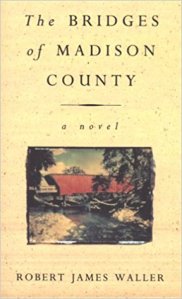
Synopsis: A writer is presented with the diaries of Francesca Johnson by her children. They detail the brief affair that she had with Robert Kincaid who came to photograph the covered bridges of Madison County. It shows the sacrifice she made by staying with her family. The writer promises to tell the story. 

Reading Challenges: Full House Reading Challenge: Made into a movie.

I read this because I really enjoyed the film. Romance is not really my thing but I remembered crying at the film so I thought that maybe the book would be as emotional. Instead, I found it sentimental and slightly irritating.

At the beginning, there is a preface explaining how the writer came by this story when Francesca’s children brought her journals to him. This makes it feel like you are reading a true story and I admit, this made me like the story more. It also explained some of the worst excesses of the text – Kincaid’s pseudo hippy talk, for example – as he was working from real people. However, about halfway through, I decided to investigate whether it was true or not and it isn’t. I admit, my impressions of Waller as a writer went down from this point.

Looking at the Goodreads reviews of this book shows that it completely splits opinion. There were a whole raft of one star and five star reviews. I don’t really understand this book inspiring either extreme love or extreme hatred (and some of the one star reviews are pretty angry). It left me feeling empty. I felt little sympathy for either party.

Of course, in the film you have Clint Eastwood (who easily embodies this sort of masculinity) and Meryl Streep, both capable of making an okay story into something special through their performances. Things that had niggled only a little after the movie became downright irritating after the book. Why was it that Francesca had to sacrifice her happiness and stay with her family and  then spent all her time holding onto the few things that reminded her of Robert. The whole ‘last cowboy’ and Kincaid as the end of an evolutionary line of masculinity was irritating as well. Presumably this is the type of man Waller would have liked to be: no ties or responsibility but with the secret of a lost love in his past to explain his solitariness.

At the end of the day, the best thing I can say about this book is that it didn’t take long to read.
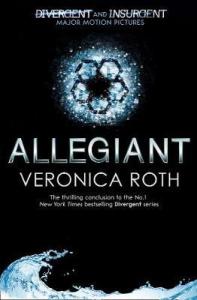

 

Contains Spoilers – Full House Reading Challenge – Allegiant by Veronica Roth

Genre: Young adult, dystopia

Narrative Style: First person from two points of view

Rating: 2/5

Published: 2013

Format: paperback

Synopsis: The faction system is broken. Tris is surrounded by violence and nothing seems to be any better than before. Tobias is caught between his warring parents. Perhaps they can find a better life outside of the city? 

Reading challenges: Full House Reading Challenge – Genre: Favourite series. 

First of all, I should point out that I don’t really have a favourite series but this is a series that I needed to finish. I thought the previous books were ok -certainly enough to decide that I needed to know how it ended.

I really wish I hadn’t bothered.

I’ve had some problems with accepting the idea of the factions in the previous books. It just doesn’t hold water for me. Discovering that it was all a giant experiment to try and return the  world to genetic purity didn’t help me suspend my disbelief any. In fact, it made it all seem a bit more false.

Don’t get me wrong, I appreciate that Roth was trying to make a point about the use of genetics as an excuse to treat some people as second class citizens. Definitely a point worth making. However, Roth spoils any political point she may have been trying to make by the way that Tobias and co. win their freedom.

Instead of a realistic battle with the government, Roth settles instead for allowing all the government’s memories to be reset by a serum so they could be given a new history and would no longer be obsessed with genetic purity. This seems to me to be a slightly more grown up version of ‘and then I woke up’. Had she run out of ideas? It certainly seemed a lazy way out of the problems the city was in.

This wasn’t the worse thing though. No, that was the death of Tris who happily sacrifices herself for the rest of the group even though there is no reason for her to. This annoyed me so much, I nearly didn’t finish the book. (Especially the whole scene with her hallucination of her mother which was needlessly sentimental.) Why bring a character so far through a story, make her battle so much, to not have her survive and enjoy the victory?

Finally, the epilogue made everything just too perfect. It was too easy. Real political battles are much more hard won. I admit, I don’t like uncomplicated happy endings and so I was never going to be pleased with this. However, I know I would have been happier if Tris had been in the final picture.


Full House Reading Challenge: 1977: Red Riding 2 – David Peace

Genre: Historical Fiction, Thriller

Narrative Style: Two alternate first person voices

Rating: 3/5

Published: 2000

Format: Paperback

Synopsis: Bob Fraser is investigating the ripper murders but he has a more personal stake than simply wanting to catch the murderer. Jack Whitehead, reporter, is  jaded and desperate but he too wants to get to the bottom of the ripper murders. This is a dark and violent tale of corrupt police, brutal murders and desperate men.

Reading Challenges: Full House Reading Challenge: Genre – number in title.

I didn’t enjoy this as much as I thought I would and I’m not really sure why. I liked the first one and there wasn’t much difference in style but something didn’t work for me this time.

It does capture the era well. The police corruption, the racism and sexism all are written in vivid detail. I did find this difficult to take. I realise the reason for it – and it isn’t like this is the first book in this sort of style I’ve read – but it was pretty difficult to stomach.

I didn’t really take to Fraser or Whitehead either. Both men have dark secrets and to say they are flawed would be to put it mildly. They have no redeeming features and it was difficult to sympathise with either of them.

The plot should be driven by the hunt for the ripper and I suppose it is but there is a lot of other stuff getting in the way. Fraser’s relationship with a prostitute which eventually implodes, for example or Whitehead’s haunting memories of a former relationship which are incredibly disturbing. And. of course, there is no closure. Far too early in the ripper story for that.

While I knew this would be a dark book but I had no idea how difficult it would be to read about how the women in this book are treated. Not just the murders but Whitehead with his constant erections and Fraser with his jealousy and mistreatment of his prostitute lover. It was unremittingly bleak and while that may be true to the time, it didn’t make for a great read.


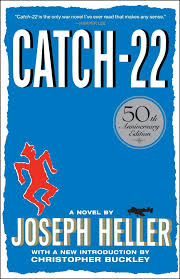
Full House Reading Challenge – Catch 22 – Joseph Heller

Narrative style: Detatched, third person

Rating: 3/5

Published: 1961

Format: paperback

Synopsis: Yossarian doesn’t want to fly any more missions. He has done the required amount but the goalpost keeps moving. He doesn’t see why he should kill himself for the safety of others. However, whatever he tries, he is unable to escape his fate.

Reading Challenges: Full House Reading Challenge – Genre: Published pre 2000 

This has been on my reading list for a long time. I seem to be saying this a lot at the moment but I didn’t enjoy it as much as I thought I would.

First of all, there are bits of this book that are brilliant. The satire is generally spot on and Yossarian was easy to identify with. This was all as I expected. So why only give 3/5?

Well, this isn’t any easy book to read. The language isn’t difficult. In theory, you should be able to trot through it at an easy pace. But I certainly didn’t find this to be a page-turner. This is because there is no plot to speak of. Things happen. There are events. But there is no overarching storyline. I realise that this is likely a ploy on Heller’s part to represent the insanity of the situation but it meant that it wasn’t compelling to read.

Also, I found it hard to keep track of all the characters and spent a lot of  time flicking back through the book, trying to remember who did what. Obviously some characters stood out more than others such as Doc Daneeka and Milo Mindbender but some of others just blurred together.

Overall, I’m glad I read this. It’s another classic ticked off and the ideas behind it were worthwhile and interesting. I just wish they had been delivered in a slightly different way.

Full House Reading Challenge – Swallows and Amazons – Arthur Ransome

Genre: Children’s, Classics

Narrative Style: Third Person

Rating: 3/5

Published: 1930

Format: Paperback

Synopsis: The Walker children are given permission to camp on an island in the middle of a lake (somewhere in the Lake District.) They are looking forward to some adult-free adventure so when they spot another boat flying a pirate flag, they expect there will be war. And who is the grumpy grown up in the houseboat and why does he think the Walkers have broken into his boat? 

Reading Challenges: Full House Reading Challenge: Genre – Middle Grade

I was going to read a more modern book for this genre but my husband was so appalled that I hadn’t read this, that I had to read it in order to shut him up. I don’t remember having heard of it when I was younger and as I was obsessed with horses, my books tended to revolve around them.

This was a very old-fashioned book. That’s not necessarily a bad thing but it had clear differences from modern children’s fiction. Like Little Women, it was less strong on plot and was more a series of events involving the same people. It was a set of adventures rather than one over-arching storyline. As such, it took a long time to get started and I could imagine young readers getting bored waiting for something to happen, being used to diving headlong into the action straightaway.

It is hard to imagine modern parents allowing their children to go off unsupervised onto a deserted island. There is one moment when the Walker mother visits to find Titty alone on the island and despite her worries, leaves her their alone. As a child reading, I know I would have appreciated the idea of an adult-free environment. As an adult, I found it a little harder to deal with.

Overall, I did enjoy it but I must admit, I wished for more to happen. I had thought it would be a little like the famous five, with a mystery to solve but although there was some intrigue involving the houseboat owner, it wasn’t really enough to satisfy me. The children – particularly the Walker family – were fairly well-drawn and I didn’t find them too annoying (unlike a lot of modern novels). I probably wont carry on and read the rest of the series though.


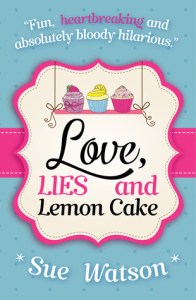
Full House Reading Challenge – Love, Lies and Lemon Cake – Sue Watson

Genre: Romantic comedy

Narrative Style: First person chronological

Rating: 2/5

Published: 2014

Format: Kindle

Synopsis: Faye Dobson’s marriage has grown stale. She no longer has anything in common with her husband and she is bored with her life. She had had dreams once but now they all seem dead. When a new deli opens with a hunky Australian behind the counter, she realises something has to change.

Reading Challenges: Full House Reading Challenge – Genre – Food in title.

Okay, so I knew this might not be for me from the start. I was struggling to find a book with food in the title. All the obvious ones like Chocolat, for example, I’ve already read. There are a lot of rom-com sounding books with food in the title so I thought I’d give one a go. It’s good to read outside of your norm once in a while anyway.

So, the narrator of Watson’s novel is Faye Dobson. She is a bored housewife whose husband is a stereotypical pig who only cares about his plumbing. Her daughter is away at university and no longer needs her. She works in a hairdresser with an assortment of stereotypes and this is not fulfilling her. So far so typical. Everything in Faye’s life is a cliché. Which would be okay if she broke out of the mould and did something exciting.

Unfortunately, the trope of Antipodean hunk rescuing middle-aged frump is just a different sort of cliché. Dan is everything you’d hope he would be. Perfect on the eye, understanding, just longing for an older woman to be his mother substitute.

As you may be able to tell, I found this book rather irritating. It isn’t particularly badly written. In fact, it was one of the more enjoyable of this genre that I have read. It just wasn’t for me. I’m not going to deny my intellectual snobbiness. The main character was a hairdresser and her husband was a plumber. I really don’t think I was the target audience.

I think the thing that I found the most irritating was the fact that this was pure escapism. Faye leaves her husband in the most easy way possible and then we barely hear from him again. She is allowed unlimited time away from work to have her Mediterranean adventure with Dan. And when history repeats itself with her daughter, everything turns out rosy in the way that it didn’t for Faye. Real life has no place here.

It made me think about why I read. I wouldn’t say that escapism is very high on my list. I like to read about other people’s lives to find out about different times and places. This told me nothing that I didn’t already know.

Full House Reading Challenge – So You’ve Been Publicly Shamed – Jon Ronson

full-house-challenge-2017-final

Genre: Non-Fiction, Psychology, Culture

Narrative Style; First person, journalistic

Rating: 4/5

Format: Paperbackunknown

Published: 2015

Synopsis: The story starts with Ronson discovering a Spambot posting as himself on twitter. He uses the righteous indignation of the Internet to get it taken down. He then begins to look at the phenomenon of online shaming. This leads him to talk to some of the people who have suffered badly at the hands of the Internet – Justine Sacco, Adria Richards and Lindsey Stone, for example – and discusses the best ways to survive shame. 

Reading Challenge – Full House Reading Challenge – Genre Non-Fiction

I was interested in this book for two reasons – the first was Ronson himself, an always enjoyable writer who tackles interesting subjects, the second was the subject matter. It has been with increasing distaste and disappointment I have watched such shaming unfold online. Unlike Ronson, I have never taken part. It is particularly disgusting to see the way the comments go when women are the object in question. No one deserves to be told they should be raped and abused. It is horrific.

Ronson first gets involved in the subject of online shaming when he uses the power of the Internet to get some researchers to take down the spambot they had made in his name. The comments turned nasty and Ronson won. They took down the spambot. Ronson cites early examples of the shaming of corporations into treating their customers better or newspapers being slapped on the wrist for printing homophobic or sexist stories. This was a new phenomenon and Ronson decided to investigate.

There is a difference between shaming corporations and shaming individuals although the basic impulse may be the same. (Ronson suggests that people think they are doing good in both situations.) This is what unfolds in the rest of the book as Ronson speaks to Justine Sacco (she of the I can’t get AIDS, I’m white tweet), Jonah Lehrer (who made up quotes in his books), Lindsey Stone (who mocked the sign for silence and respect at Arlington National Cemetry, to name but a few. Most of them were guilty of stupidity at most. Lehrer was more difficult to sympathise with but even then, you couldn’t help feeling that no one should have to read what people posted on the live twitter feed while he was trying to apologise. It is certainly true that a stupid tweet or photo should not still be impacting your life a year later.

Ronson also looks for solutions and ways to survive. He discusses the role of shame in a prison environment, visits a workshop for Radical Honesty and discusses the historical origins of shaming. All of which is very interesting and told in Ronson’s trademark style. However, what he can’t offer is any sort of solution or ways to avoid being shamed. And it certainly seems like this is something that is here to stay. In the Afterword, Ronson describes being accused of being racist for supporting Justine Sacco and of being a misogynist because of a misjudged comment about rape. His final advice is to the reader is to make sure that they don’t stay silent if they think that someone is being shamed, get involved and stand up for them. Empathy is the solution to shame. And it is true that we can’t leave the Internet to the trolls and lowlifes who would say that they would see someone raped or murdered because they made an ill-judged decision.

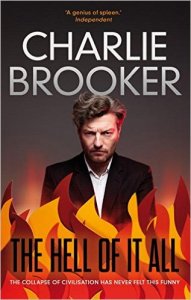
Non-Fiction Challenge – The Hell Of It All – Charlie Brooker

2016 Nonfiction Challenge

Genre: Cultural Comment, Journalism, Humour

Narrative Style: First person opinion pieces

Rating: 5/5

Format: Kindle51i2ihfnmml-_sx315_bo1204203200_

Published: 2009

Synopsis: A collection of Brooker’s columns for The Guardian. Subject matter ranges from Celebrity Big Brother to The State of Gordon Brown to Holidays to The Apprentice. Filled with Brooker’s trademark snarky ire. 

Reading Challenges: Non-fiction Challenge

I probably ought to admit that I bought this book because it was cheap for Kindle and I didn’t investigate any further than that. I’m rather fond of Brooker’s grumpy brand of pessimism so I was quite excited by its cheap price. However, it transpires that it was from 2008-9 so it was a little weird to be reading about things from that long ago. Still, it didn’t stop it from being enjoyable although I did sometimes wonder if I’d been asleep throughout that time as I couldn’t remember everything that he was talking about.

It also felt a little surreal. There are columns here on the vacuity of celebrity culture, on the horribleness of politicians, on the racism of the BNP, the global financial meltdown, and the way people over-react to everything. Reading it from the vantage point of 2016, it felt like these were our halcyon days. If Brooker was this angry then, his head must explode every time he switches on the news these days.

There are many laugh out loud moments such as when he suggests that breathing is the only hobby he is likely to be able to cope with or when he describes the woeful attempts of crisp manufacturers to delight us with new flavours or his opinion on nightclubs (he doesn’t like them much, in case you wondered).Or when he describes his lazy attitude to household tasks which leads him to have to live by the light of his fridge when he fails to buy lightbulbs. As my husband and I are currently down to two out of four lights in the kitchen and are involved in a protracted game of lightbulb chicken, this definitely resonated.

Like reading Owen Jones’ Chavs, it is always good to remember that there are journalists who I can agree with and who give voice to the things that trouble me. Especially at times like these.


Non Fiction Reading Challenge – My Own Story – Emmeline Pankhurst

2016 Nonfiction Challenge

Genre: Autobiography / memoir

Narrative Style: First person

Rating: 4/5

Published: 1914

Format: Kindle

Synopsis: A personal account of the meetings and actions of the W.S.P.U. and also an explanation for these actions. 

Reading Challenge: The Non Fiction Challenge.

When I was a student, I did some modules on the suffragettes and when the film came out last year, it re-sparked my interest in this part of history. So when this came up on Amazon, I didn’t hesitate.

It was a very good read. It showed the power and passion of Pankhurst herself as well as the rest of the W.S.P.U. quite clearly. Pankhurst seems to have been an incredibly charismatic leader as well as being clearly intelligent and determined. She must have been a force to be reckoned with.

In one sense, this is an uplifting read. I’m not sure that I could have kept going in the face of forcible feeding and the cat and mouse act but these women were not going give up, no matter what. It was inspiring to think of them fighting back especially considering they had no real political power. They had to find other means to make their voices heard.

For the most part though, it is a difficult read. Pankhurst writes of thirst and sleep strikes where she was so weak she could barely stand but still she attempted to walk the length of her cell and not rest. The politicians do not come out of this well. Lloyd-George and Asquith particularly prove themselves to be duplicitous and uncaring. They treated the women as if they were hysterical and ignored their demands whereas male rebels (such as those in Ireland who opposed home rule) were taken seriously.

Mrs Pankhurst’s style is conversational and so is easy to read. However, speeches and political discussions are often recorded in full and are sometimes a little dry. There is a lot of talk about motives for action but the actions themselves are not always described. This slows the pace a little. However, as an insight in the workings of such an important political organisation, it is definitely worth the read.

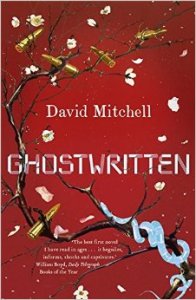
Books Read in 2015 55. Ghostwritten by David Mitchell

Genre: Post-modern, literary fiction

Narrative Style: A range of first person monologues that are linked in subtle ways51MnXKfLFfL._SY344_BO1,204,203,200_

Rating: 4/5

Published: 1999

Format: Kindle

Synopsis: The story starts with a member of a cult who is on the run then moves to a jazz lover in Tokyo and then to a lawyer in Hong Kong who is in over his head and continues moving through seemingly disparate narratives to the end. However, there are links between the characters – some more subtle than others – and slowly an overarching narrative is revealed.

This is an exceptionally clever book. The range of different voices is astonishing and all are carried off with aplomb, all the more remarkable given that this is Mitchell’s debut novel. As the novel progresses and more of the underlying plot is revealed, the more you have to admire Mitchell’s skill.

As you might expect, with such a novel, some of the characters were more appealing than others. Some I could have read a whole novel about and felt bereft when the story moved on, others I found I just wanted to get through their chapter. This is particularly true of the chapter from the point of view of a spirit (if that is the right word) who has floated from person to person until they are eventually reborn in Mongolia.

However, the overarching narrative kept me reading and I was curious as to how the tale would end. The ending was satisfying whilst also offering a scary commentary on the uses of AI in war. The different narratives investigate different ways of being, different ideas about the soul, about intelligence and about free will. It makes sense then that this novel would end with a machine that is virtually sentient.

Overall, this was an enjoyable novel where the reader had to work in order to put the pieces together and make the links that Mitchell requires. I always enjoy having to work in this way and it certainly made me feel that I wanted to read more of Mitchell’s writing.