Pratchett Reread 5. Sourcery

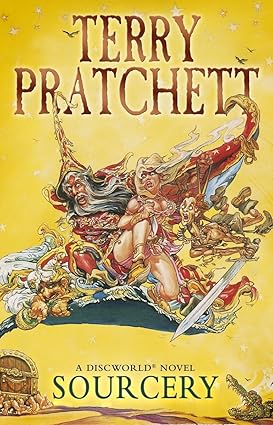
I wasn’t sure how much I was going to enjoy this one. My memory was that it was okay but not the best. As such, it’s not one that I have reread very often. however, I was pleasantly surprised. It was much better than I remember. And like Mort, it is so much more than a story about a boy who is the seventh son of a seventh son who becomes a sourcerer.

This is a tale about power – who should wield it and how it should be wielded. Quite an unwieldy subject but Pratchett makes it so you barely notice. There is no heavy handed moralising here. Just a comic tale of what might happen if the power of magic should fall into the wrong hands.

We have Rincewind, reluctant hero whose first thought is to runaway (along with the rats and the gargoyles from Unseen University). As ever, his attempts to get away from the action only pull him in further. His adventures bring him into contact with Conina, the daughter of Cohen the Barbarian, Nijel, a desperately unlikely hero and Creosote, the richest man in the world. There is also a much bigger role for the Librarian who hides all the magical books from Coin, the sourcerer. The Librarian is also responsible for looking after the Patrician – who has been turned into a lizard.

There is plenty of comic business. Nijel is the worst hero ever although he does try very hard. Conina just wants to be a hairdresser although she has a barbarian’s instincts. And of course, Rincewind, despite being the worst wizard, is full of knowledge about what he thinks wizardry should represent and how magic should be used. He is not taken in by Coin, when most of the other wizards see only the possibility for gaining power.

The novel ends with Rincewind saving the day but in the dungeon dimensions. So while the world is saved, Rincewind is missing in action The rest of the world returns to normal with little thought for the reluctant hero. It was mostly a satisfying read and much better than I remember.

Pratchett Reread – 4. Mort

For me, this is the first five star read of the series. It made me laugh from start to finish. The characters were fully realised, the plot was more than just a series of jokes strung together and I couldn’t put it down.

It starts with Mort, an awkward teenager who doesn’t fit in in his small village. His father has heard that there is a hiring fair and takes Mort along. Unfortunately no one wants him until – at midnight, of course – Death turns up to take Mort as his apprentice. Mort’s father is happy just to see his son placed somewhere and so Mort’s new life begins.

This takes us to Death’s kingdom and we meet Ysabell, Death’s adopted daughter and Albert, his grumpy manservant, both of which are full of comic potential. Ysabell has been a teenager for a long time (as you do not age in Death’s kingdom) and as you can imagine this has had quite an effect on her mood. Albert seems like just the salt of the earth servant you might expect Death to have but it transpires that he was a secret he’d rather Mort didn’t know.

Death begins to show Mort the ropes, taking him to the more important deaths of the Discworld. Mort begins to learn about fairness – ‘There is no justice’ Death tells Mort, ‘Just me.’ This is a valuable lesson and one which Mort seems reluctant to learn. When he begins to do the duties, things quickly go wrong because Mort is reluctant to kill Princess Keli at her allotted time. This leads to many problems for Keli and for Mort.

Keli discovers that the world carries on as if she has died – history is stronger than individuals. Mort decides that he will try to fix things himself, seemingly oblivious to the fact that history will sort itself out and Death decides that he will go on a holiday know that he has an apprentice. Death decides that there are aspects of human life he would like to investigate – getting drunk, gambling and dancing eventually finding some sort of satisfaction working in a greasy spoon. Mort becomes more like Death while Death becomes more human.

There are interesting philosophical questions raised about life, death and history. There is action. And there are characters that are convincing that you care about. This definitely feels like the real beginning of the Discworld saga.

Pratchett Reread – No. 3 Equal Rites

Well, this was surprising. I enjoyed this much more than I expected. I’m really not sure what I disliked about it so much last time round. It may have been the division between witch (female) magic and wizard (male) magic which was seemingly reinforced by Granny Weatherwax. I was a little disappointed in Granny, I think, as I knew her from later novels before I read this one. She doesn’t seem quite her later self. The division felt entrenched in the first half of the novel although by the end it is less so.

I still thought that this time round but perhaps because I was expecting it I didn’t find it quite as jarring. Certainly, this is still underdeveloped in places. The Librarian is still quite a small character compared to his later appearances. Granny seems even more set in her ways although to be fair, she does end up giving in and taking Esk to Unseen University once she realises that she needs to learn wizard magic.

That aside, it trots along nicely as a story. Esk is a strong female character – headstrong and determined to do what she wants – something that means that Granny has to rescue her regularly. Granny is not quite fully formed but a lot of the things that are good about her are already there. She is one of my favourite Discworld characters but she is definitely better in the comic trio of Nanny Ogg and Magrat.

So overall, this was a fairly solid read – not my favourite but definitely moving in the right direction.

Pratchett Reread – 2. The Light Fantastic

Well, I enjoyed this a lot more than I expected and certainly a lot more than The Colour of Magic. It felt like things had fallen into place a little more. Rincewind and Twoflower felt a bit more well rounded and their relationship was more nuanced than in The Colour of Magic. The plot also trotted along at a good pace and the addition of the red star heading for the discworld made it quite exciting.

Other characters seemed a bit more like themselves as well. There is a scene where Twoflower tries to teach the four horsemen of the apocalypse to play Bridge and Death is utterly confused and fascinated which seems like the start of his attitude to humans in the rest of the series.

I’d forgotten that this was our first meeting with Cohen The Barbarian. At the beginning he is without his diamond teeth which forms a nice comic disparity between Cohen the tough guy and Cohen the old man. Twoflower, of course, is in awe of him. Others often underestimate Cohen although they soon come to regret that. In the course of The Light Fantastic, having travelled through time and space on the back of the luggage, he bursts through the teeth of a just awakened troll. Taking these diamonds and Twoflower’s idea of dentures, he fashions his diamond teeth.

We also meet the Librarian although he is not quite the character that he becomes in the later novels. In fact, he is just a note in the background music of the Unseen University, a passing piece of comedy. But then the other wizards are similarly underdrawn. In the later novels, the wizards are more static, Ridcully is arch-chancellor for a long time. I’d forgotten that he wasn’t always arch-chancellor. There is more comedic value in familiarity, I think, so I’m glad that Pratchett made the decision to keep things more static.

There is more social commentary than in The Colour of Magic. There are the sects of people who spring up with the advances of the star who want to rid the world of magic and are not afraid to use violence to do it. There is Ymper Trymon, a wizard who places organisation above all else. He is a great villain who is convinced that the world should follow a certain order and would like to fit people neatly into that order. He meets a suitably gruesome end which was very satisfying.

Overall, I was pleasantly surprised by how much I enjoyed this but it was still not as good as some of the later novels.

Top Ten Tuesday – 10 Books with flowers in the title.

Top Ten Tuesday was created by The Broke and the Bookish in June of 2010 and was moved to That Artsy Reader Girl in January of 2018. It was born of a love of lists, a love of books, and a desire to bring bookish friends together.

This weeks prompt could be anything to do with flowers so I’ve chosen to list books with flowers in the title.

  1. Purple Hibiscus – Chimamanda Ngozi Adichie (2003) – An excellent story about the difficulties of growing up when your country is in turmoil and your family life is equally difficult.
  2. Flowers in the Attic – V. C. Andrews (1979) – A woman hides her children in the attic in order to gain an inheritance. I read this as a teenager (when everyone at school seemed to be reading it). I’m not sure what I’d think of it if I read it now.
  3. The Perks of Being a Wallflower – Stephen Chbosky (1999) – A powerful coming of age story about trying to live your life when you don’t understand your impulses or the world around you.
  4. The Name of the Rose – Umberto Eco (1980) – A convoluted mystery set in a medieval monastery with a cast of strange monks to add to the creepiness.
  5. The Black Dahlia – James Ellroy (1987) – A dark and disturbing story about the murder of a beautiful women in LA. This was my first Ellroy and one of the most enjoyable.
  6. The Virgin’s Lover – Philippa Gregory (2004) – The romance between Elizabeth 1 and Robert Dudley portrayed like a Carry On film. Not one of my favourites.
  7. All the Flowers in Shanghai – Duncan Jepson (2011) – An okay story set in 1930s Shanghai and showing the horrors of arranged marriages and the pressure to produce a male heir.
  8. Flowers for Algernon – Daniel Keyes (1966) – A thought experiment looking at the way we treat others based on how intelligent we perceive them to be. One of my favourite science fiction books.
  9. Odour of Chrysanthemums – D. H. Lawrence – A short stories about a woman waiting for her husband to return from the mine, unaware that he was killed in an accident earlier that day.
  10. The Day of the Triffids – John Wyndham (1951) – Okay more of a tree than a flower probably but nonetheless a well written look at the aftermath of a disaster.

Top Ten Tuesday – Books I DNF

Top Ten Tuesday was created by The Broke and the Bookish in June of 2010 and was moved to That Artsy Reader Girl in January of 2018. It was born of a love of lists, a love of books, and a desire to bring bookish friends together.

This weeks list is top ten books I did not finish. It isn’t often that I DNF a book. I’m not sure what I think will happen if I abandon a book but I tend to struggle on. The ones on this list really annoyed me.

  1. Whatever Love Means – David Baddiel – Tedious exploration of masculinity and sex which is neither exciting or clever.
  2. Lorna Doone – R. D. Blackmore – I had seen an adaptation of this and really enjoyed it but the novel was slow and lacking in tension.
  3. The Unusual Life of Tristan Smith – Peter Carey – This was a very strange book. The style was hard to read, the events made no sense and I didn’t care for the characters.
  4. Crime and Punishment – Fyodor Dostoevsky – I really wanted to enjoy this but I didn’t really get that far. The protagonist was annoying and the narrative was stodgy.
  5. The Virgin’s Lover – Philippa Gregory – This was about Elizabeth I and Robert Dudley and reads a bit like Carry on Tudors. Ridiculously bawdy.
  6. The Scarlet Letter – Nathaniel Hawthorne. The prose style was unreadable.
  7. On the Road – Jack Kerouac – Sexist nonsense. Perhaps he should have taken longer than three weeks to complete the first draft.
  8. Atonement – Ian McEwan – I finished this but I genuinely wished I hadn’t bothered. I won’t spoil it but to me it felt like McEwan had said ‘and then they woke up’ at the end. It felt lazy and annoying.
  9. The Time Traveller’s Wife. – Audrey Niffenegger I did in fact finish this but only because the thing that annoyed me was right at the end. To be fair, I was already a little irritated but when I realised Clare waited to see Henry one more time, it tipped me over the edge. I know it’s supposed to be romantic but if I’d realised that was the end, I’d definitely have stopped earlier.
  10. The Guernsey Literary and Potato Peel Pie Society – Mary Ann Schaffer – Another time the film was a lot better than the book. Very disappointing.