Pratchett Reread – 4. Mort

For me, this is the first five star read of the series. It made me laugh from start to finish. The characters were fully realised, the plot was more than just a series of jokes strung together and I couldn’t put it down.

It starts with Mort, an awkward teenager who doesn’t fit in in his small village. His father has heard that there is a hiring fair and takes Mort along. Unfortunately no one wants him until – at midnight, of course – Death turns up to take Mort as his apprentice. Mort’s father is happy just to see his son placed somewhere and so Mort’s new life begins.

This takes us to Death’s kingdom and we meet Ysabell, Death’s adopted daughter and Albert, his grumpy manservant, both of which are full of comic potential. Ysabell has been a teenager for a long time (as you do not age in Death’s kingdom) and as you can imagine this has had quite an effect on her mood. Albert seems like just the salt of the earth servant you might expect Death to have but it transpires that he was a secret he’d rather Mort didn’t know.

Death begins to show Mort the ropes, taking him to the more important deaths of the Discworld. Mort begins to learn about fairness – ‘There is no justice’ Death tells Mort, ‘Just me.’ This is a valuable lesson and one which Mort seems reluctant to learn. When he begins to do the duties, things quickly go wrong because Mort is reluctant to kill Princess Keli at her allotted time. This leads to many problems for Keli and for Mort.

Keli discovers that the world carries on as if she has died – history is stronger than individuals. Mort decides that he will try to fix things himself, seemingly oblivious to the fact that history will sort itself out and Death decides that he will go on a holiday know that he has an apprentice. Death decides that there are aspects of human life he would like to investigate – getting drunk, gambling and dancing eventually finding some sort of satisfaction working in a greasy spoon. Mort becomes more like Death while Death becomes more human.

There are interesting philosophical questions raised about life, death and history. There is action. And there are characters that are convincing that you care about. This definitely feels like the real beginning of the Discworld saga.

Pratchett Reread – 2. The Light Fantastic

Well, I enjoyed this a lot more than I expected and certainly a lot more than The Colour of Magic. It felt like things had fallen into place a little more. Rincewind and Twoflower felt a bit more well rounded and their relationship was more nuanced than in The Colour of Magic. The plot also trotted along at a good pace and the addition of the red star heading for the discworld made it quite exciting.

Other characters seemed a bit more like themselves as well. There is a scene where Twoflower tries to teach the four horsemen of the apocalypse to play Bridge and Death is utterly confused and fascinated which seems like the start of his attitude to humans in the rest of the series.

I’d forgotten that this was our first meeting with Cohen The Barbarian. At the beginning he is without his diamond teeth which forms a nice comic disparity between Cohen the tough guy and Cohen the old man. Twoflower, of course, is in awe of him. Others often underestimate Cohen although they soon come to regret that. In the course of The Light Fantastic, having travelled through time and space on the back of the luggage, he bursts through the teeth of a just awakened troll. Taking these diamonds and Twoflower’s idea of dentures, he fashions his diamond teeth.

We also meet the Librarian although he is not quite the character that he becomes in the later novels. In fact, he is just a note in the background music of the Unseen University, a passing piece of comedy. But then the other wizards are similarly underdrawn. In the later novels, the wizards are more static, Ridcully is arch-chancellor for a long time. I’d forgotten that he wasn’t always arch-chancellor. There is more comedic value in familiarity, I think, so I’m glad that Pratchett made the decision to keep things more static.

There is more social commentary than in The Colour of Magic. There are the sects of people who spring up with the advances of the star who want to rid the world of magic and are not afraid to use violence to do it. There is Ymper Trymon, a wizard who places organisation above all else. He is a great villain who is convinced that the world should follow a certain order and would like to fit people neatly into that order. He meets a suitably gruesome end which was very satisfying.

Overall, I was pleasantly surprised by how much I enjoyed this but it was still not as good as some of the later novels.

Top Ten Tuesday – Books with a high page count

Top Ten Tuesday was created by The Broke and the Bookish in June of 2010 and was moved to That Artsy Reader Girl in January of 2018. It was born of a love of lists, a love of books, and a desire to bring bookish friends together. This weeks top ten is books with a high page count. I’m sometimes wary of reading long books because I hate not finishing a book so usually make myself carry on reading even if I’m hating it but here are 10 with 500+ pages

  1. Middlemarch – George Elliot – 912 pages – This was a lot better than I expected. Elliot’s prose was enjoyable and the story was fairly interesting. I’m not sure it really needed to be so long though.
  2. A Widow for One Year – John Irving – 576 pages – My second Irving and while not as good as The World According to Garp it was suitably weird and interesting.
  3. Middlesex – Jeffrey Eugenides – 529 pages – Very enjoyable tale of three generations of the same Greek-American family.
  4. Tigana – Guy Gavriel Kay – 676 pages – A second attempt at this one. An excellent fantasy novel. I’m glad I persevered this time.
  5. 11/22/63 – Stephen King – 849 pages – A interesting time travel tale, much better than the TV show with James Franco.
  6. Wolf Hall – Hilary Mantel – 653 pages. I read this last year and it was a bit of a slog. It started well and ended well but I felt a bit bogged down in the middle. Still unsure if I am going to read on.
  7. Moby Dick – Herman Melville – 720 pages – This was a bit of a slog. There are some good moments of adventure but also lots and lots of information about whales.
  8. Labyrinth – Kate Mosse – 515 pages. I really enjoyed this holy grail fantasy. It’s much cleverer than the Da Vinci Code although it’s just as absurd. I probably will read on but I haven’t yet.
  9. Gravity’s Rainbow – Thomas Pynchon – 776 pages – I did not enjoy or understand this one but I slogged my way through it. Not sure it was worth it.
  10. War and Peace – Leo Tolstoy – 1392 pages – This was a bit up and down. Some of it was really enjoyable but I found the war elements less interesting than the personal relationships of the various characters.

Discworld re-read – The Colour of Money.

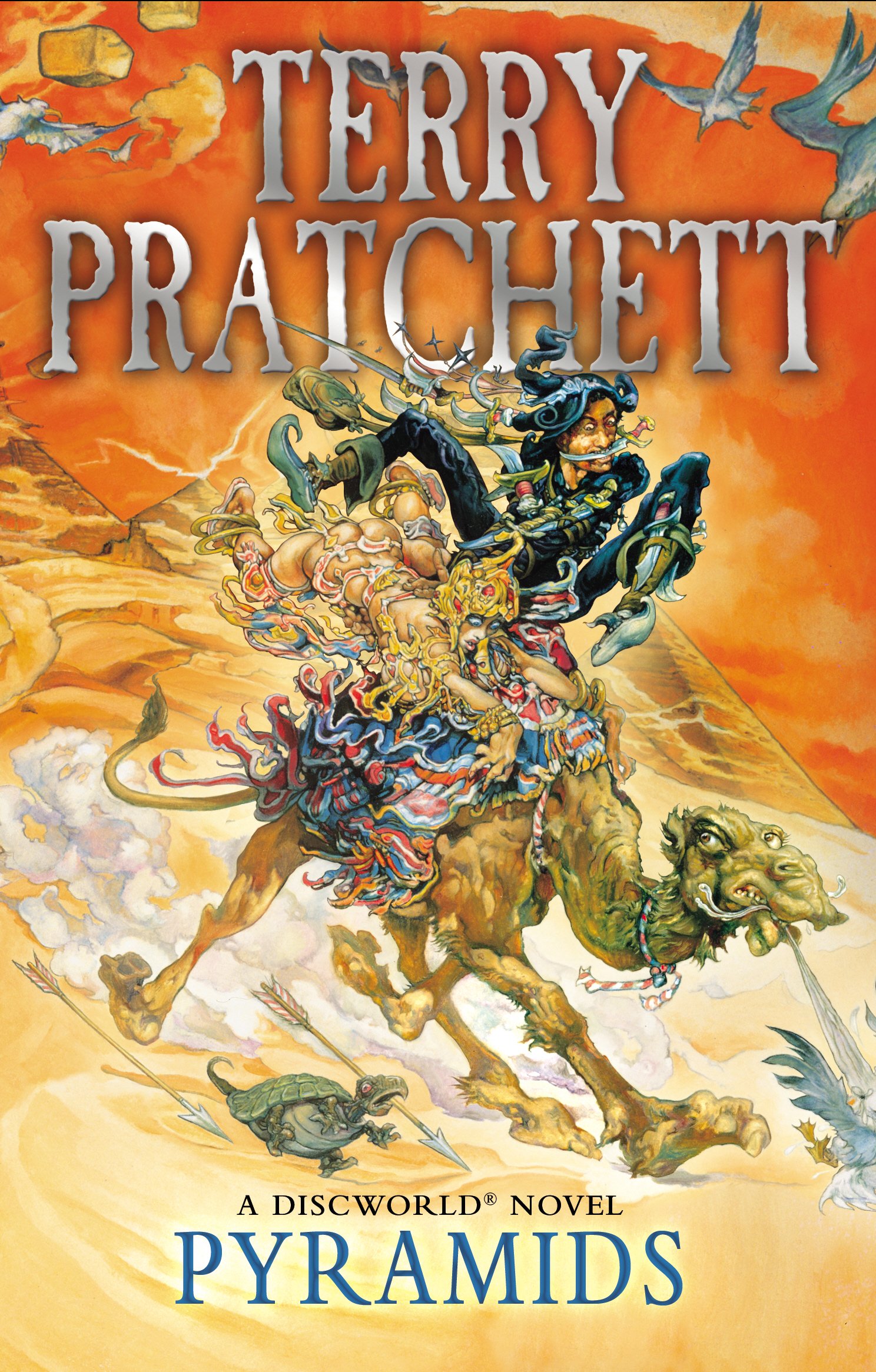
I decided that I would start to re-read the discworld books in order. It was a decision made because I wanted to read something that I knew I would like. I’ve been struggling a little so far this year with deciding what to read and then picking things that I don’t really get on with. I’m not intending to read only Pratchett but maybe every other book will be a Pratchett. I haven’t ever read the whole series in the right order. My first one was Pyramids which I bought in the early 90s. I enjoyed it but I was a bit slow to start reading any others (perhaps because it is a stand alone story). For a while, I picked them up in haphazard fashion, buying new releases while trying to catch up with previous ones although from about 2000 onwards, I was reading them in the right order.

So I started last month with The Colour of Magic. It is strange reading it now, a bit like watching the first episode of a comedy show that you really like but which didn’t quite gel at the beginning. The characters were all there, the setting was the same but things definitely felt a little undeveloped. Death was a different character, colder and less likeable. Of course, as yet, he hasn’t been Bill Door or the Hogfather so his character development is all in the future.

Rincewind and Twoflower make a good pairing though. Twoflower is an excellent comic invention with his naivety only matched by his ability to get into dangerous situations. Combined with Rincewind’s abilty at running away, this makes for some classic Pratchett comedy. Even so, I felt like there was something lacking. I’m not even sure what it was but I definitely didn’t enjoy this as much this time round. I already know that the next two books (The Light Fantastic and Equal Rites) are not ones that I love so it will be interesting to see what I make of them this time round.

Doppelganger: A Trip into the Mirror World – Naomi Klein.

Genre: Academic, politics

Narrative Style: First person academic

Published: 2023

Rating: 5/5

Format: Kindle

Synopsis: Naomi Klein kept finding people confusing her with Naomi Wolf which only worsened as Wolf took a trip into the land of conspiracy theories and misinformation. Klein became obsessed with following Wolf’s Twitter account during Covid 19 and found herself unable to look away. Doppelganger is the result of this obsession, detailing Wolf’s fall from grace and the wider issues of misinformation, conspiracy theories and where it all leaves us as a society.

It was only recently that I discovered that Naomi Wolf had become a darling of the right, promoting conspiracy theories surrounding vaccines and appearing on Steve Bannon’s War Room podcast. She just hadn’t come up on my feed – not even since Musk’s takeover. I was surprised to say the least. I remember reading The Beauty Myth while I was at university and was impressed enough to go to see her talk at Waterstones in Manchester while promoting Fire with Fire: New Female Power and how it will Change the Twenty-First Century. While I didn’t like this book quite so much, I assumed that she would continue to be a respected academic writer. Boy was I wrong!

Klein begins by discussing the fact that people often mistake her for Wolf and the ramifications of that now that Wolf was promoting anti-vaccine conspiracy theories. Klein also does a good job of invoking the strangeness of the Covid 19 lockdowns which contributed to her becoming worryingly obsessed with Wolf and her cronies. At first, I wasn’t sure where Klein was going to go with this – it was interesting to read but seemed to lack Klein’s usual political commentary. However, as the book progressed, Klein widened her argument to include fake news, wellness vloggers, the situation in Palestine and her own Jewishness, bringing each topic back to what she calls the ‘mirror world’ and discussing where that leaves us.

The main topic of this book is disorientation – something that I often feel these days when watching the news or looking at tweets on X (something I can’t seem to stop myself from doing even though it is not a pleasant place these days). I had observed the increase in conspiracy theories during lockdown with a sort of grim humour, sometimes congratulating myself that I wasn’t so stupid. What I hadn’t realised was exactly how apt the term ‘mirror world’ really is. Those who are worried about vaccine shedding are responding to a real worry – the spread of infectious disease. Those who worry about enslavement via the QR codes used to check in to venues are responding to worries about privacy and data usage. Not that I’m suggesting that Wolf is correct when she suggests that vaccine technology can cause time travel and make the vaccinated into robots – these claims are patently absurd – but to dismiss these people as merely stupid is also unhelpful. Klein suggests that it may be that there is something lacking in the way the left has dealt with both these issues that has helped push people towards these theories.

By the end, this seemed more like a typical Naomi Klein book as she suggests that somehow we have to start looking for ways to work together rather than focusing on the things that separate us. As suggested in 2017’s No is Not Enough, Klein ends her book by saying everyone needs to work together if we are going to combat the climate crisis. This means looking beyond surface differences and beyond party politics. We need to stand together despite the fact that our politics and identities might differ. Fighting climate change is more important than all the rest.

Having said that, I find it hard to be especially optimistic about this happening. As I write, Donald Trump is about to be inaugurated for his second term as president with Elon Musk firmly at his side. Both men have used the disorientation that Klein describes to their advantage and I would imagine they will continue to do so. Mark Zuckerberg recently said that there would be no more fact checking on Meta platforms and X already seems like a free for all in this respect. It’s hard to be hopeful for the future.

Top Ten Tuesday – 10 Books with flowers in the title.

Top Ten Tuesday was created by The Broke and the Bookish in June of 2010 and was moved to That Artsy Reader Girl in January of 2018. It was born of a love of lists, a love of books, and a desire to bring bookish friends together.

This weeks prompt could be anything to do with flowers so I’ve chosen to list books with flowers in the title.

  1. Purple Hibiscus – Chimamanda Ngozi Adichie (2003) – An excellent story about the difficulties of growing up when your country is in turmoil and your family life is equally difficult.
  2. Flowers in the Attic – V. C. Andrews (1979) – A woman hides her children in the attic in order to gain an inheritance. I read this as a teenager (when everyone at school seemed to be reading it). I’m not sure what I’d think of it if I read it now.
  3. The Perks of Being a Wallflower – Stephen Chbosky (1999) – A powerful coming of age story about trying to live your life when you don’t understand your impulses or the world around you.
  4. The Name of the Rose – Umberto Eco (1980) – A convoluted mystery set in a medieval monastery with a cast of strange monks to add to the creepiness.
  5. The Black Dahlia – James Ellroy (1987) – A dark and disturbing story about the murder of a beautiful women in LA. This was my first Ellroy and one of the most enjoyable.
  6. The Virgin’s Lover – Philippa Gregory (2004) – The romance between Elizabeth 1 and Robert Dudley portrayed like a Carry On film. Not one of my favourites.
  7. All the Flowers in Shanghai – Duncan Jepson (2011) – An okay story set in 1930s Shanghai and showing the horrors of arranged marriages and the pressure to produce a male heir.
  8. Flowers for Algernon – Daniel Keyes (1966) – A thought experiment looking at the way we treat others based on how intelligent we perceive them to be. One of my favourite science fiction books.
  9. Odour of Chrysanthemums – D. H. Lawrence – A short stories about a woman waiting for her husband to return from the mine, unaware that he was killed in an accident earlier that day.
  10. The Day of the Triffids – John Wyndham (1951) – Okay more of a tree than a flower probably but nonetheless a well written look at the aftermath of a disaster.

Top Ten Tuesday – Books I DNF

Top Ten Tuesday was created by The Broke and the Bookish in June of 2010 and was moved to That Artsy Reader Girl in January of 2018. It was born of a love of lists, a love of books, and a desire to bring bookish friends together.

This weeks list is top ten books I did not finish. It isn’t often that I DNF a book. I’m not sure what I think will happen if I abandon a book but I tend to struggle on. The ones on this list really annoyed me.

  1. Whatever Love Means – David Baddiel – Tedious exploration of masculinity and sex which is neither exciting or clever.
  2. Lorna Doone – R. D. Blackmore – I had seen an adaptation of this and really enjoyed it but the novel was slow and lacking in tension.
  3. The Unusual Life of Tristan Smith – Peter Carey – This was a very strange book. The style was hard to read, the events made no sense and I didn’t care for the characters.
  4. Crime and Punishment – Fyodor Dostoevsky – I really wanted to enjoy this but I didn’t really get that far. The protagonist was annoying and the narrative was stodgy.
  5. The Virgin’s Lover – Philippa Gregory – This was about Elizabeth I and Robert Dudley and reads a bit like Carry on Tudors. Ridiculously bawdy.
  6. The Scarlet Letter – Nathaniel Hawthorne. The prose style was unreadable.
  7. On the Road – Jack Kerouac – Sexist nonsense. Perhaps he should have taken longer than three weeks to complete the first draft.
  8. Atonement – Ian McEwan – I finished this but I genuinely wished I hadn’t bothered. I won’t spoil it but to me it felt like McEwan had said ‘and then they woke up’ at the end. It felt lazy and annoying.
  9. The Time Traveller’s Wife. – Audrey Niffenegger I did in fact finish this but only because the thing that annoyed me was right at the end. To be fair, I was already a little irritated but when I realised Clare waited to see Henry one more time, it tipped me over the edge. I know it’s supposed to be romantic but if I’d realised that was the end, I’d definitely have stopped earlier.
  10. The Guernsey Literary and Potato Peel Pie Society – Mary Ann Schaffer – Another time the film was a lot better than the book. Very disappointing.

It’s been a while…

I decided this year not to do any reading challenges or make any lists of what I was going to read. I finished the TBR challenge last year but I didn’t finish the blogs so I decided no more challenges. My only plan was to read some of the fatter books on my shelf. I didn’t even sign up to the Goodreads challenge as I find that stressful if I get too far behind – which I would if read some long books. I didn’t realise the impact this would have on my blogging but suddenly it is April and I haven’t written a single one. Not good.

It is a little weird not to have a plan. For the last five years, I have always known roughly what books would read and it is weird that everything is now open to me. My only thoughts at the moment are I will probably read Wolf Hall, The Green Mile and A Prayer for Owen Meany as they have been on my shelf for a while but I am currently reading The Origins of Totalitarianism by Hannah Arendt on my kindle and I suspect that is going to take a while so I don’t want to read another long fiction book until I finish that. As such, I am reading The Ten Thousand Doors of January by Alix E Harrow at the minute which is a bit lighter.

So far this year I have read the following:

  1. Between Shades of Grey – Ruta Sepetys (2011) 4/5 I was given this for Christmas and I really enjoyed it. It tells the story of Lina a Lithuanian teenager who is suddenly removed from her home by Russian soldiers and sent ultimately to the Arctic Circle. This was a bleak, difficult story about an area of history I was unaware of and it was definitely worth a read.
  2. Big Little Lies – Lianne Moriarty (2014) 3/5 This had been on my kindle for a while. It was okay chick lit with some heavier themes than I was expecting. I did see the twist coming though.
  3. The Evil Seed – Joanne Harris (1992) 4/5 I bought this not realising that it was Harris’ debut novel and had been out of print for a while. It was quite different from the other of her novels that I’ve read as it is a vampire tale but it was still well written with parallel stories and a good amount of tension.
  4. The Sellout – Paul Beatty (2015) 5/5 This has also been on my kindle for a couple of years. It won the Man Booker Prize in 2016 and I can see why. It is a biting satire on the state of race relations in the US, looking at slavery, segregation, celebrity, sociology and stereotypes. First 5 star read of the year.
  5. Tigana – Guy Gavriel Kay (1990) 4/5 (The first of the tomes at 676 pages) I had been meaning to read this for a while but I admit I found its length a bit off putting. I had made an attempt at it while I was at university in the nineties but didn’t manage to finish it even though I remembered enjoying it. Although it took a long time to get through, I’m glad I read it. It was a beautifully written fantasy with action, romance and interesting characters.
  6. Mother’s Boy – Patrick Gale(2022) 5/5 I picked this up about a month ago in a charity shop (much to the annoyance of my husband as I’m not supposed to be buying books). It is a fictional telling of the life of Charles Causley. Not that I knew anything about Causley but Gale is one of my favourite authors so I wanted to read it quickly. It is written from the points of view of Causley and his mother who had a complicated relationship and describes his life as a signalman in the navy. Thoroughly recommended.

2020 Alphabet Soup Author Edition – No Surrender by Constance Maud

Genre: Feminist, Political

Narrative Style: Third person, chronological

Rating: 2/5

Published: 1911

Format: Kindle

Synopsis: Jenny Clegg is a mill girl in Lancashire when she gets involved with the Suffragette movement. The novel follows her and her friend Mary O’Neill through marches, prison and force feeding during their fight for the vote. 

Reading Challenges: 2020 Alphabet Soup: Author Edition

I first heard of this novel in the BBC Two program, Novels that Shaped Our World in November, last year. It sounded interesting so I downloaded it onto my kindle. I’d never read a novel about the suffragette movement before – indeed, I don’t think there are many – and so I was quite excited to read it. Unfortunately, it did not live up to my expectations.

The main issue with this novel is that it is purely political. So you might expect when dealing with such a subject but there is nothing else in this novel, no subplots, no romance and no other way of separating characters. The players in this novel are good or bad depending on whether or not they are for or against women’s suffrage. In a lot of cases, this is their only personality trait. On both sides of the argument this led to stereotypical and hollow representations. The suffragettes were all good, moral women and those against them often seemed ridiculous. No one ever wavered in their feelings – no suffragette anyway. Some of the disbelievers come across to the suffragette side.

Secondly, the majority of this novel is dialogue. Not only that but a lot of it is written in dialect which is often hard to decipher and did make me wonder if Maud had ever actually had much to do with the working classes. It made the reading experience jarring at times. All the dialogue also made the pace quite slow. There wasn’t much action, more people describing action.

There are good things – important things – in this book. It describes a lot of the reasons that women wanted the vote really clearly and shows the injustices that women – particularly working women – faced at that time. It described the force feeding of Mary O’Neil in detail and showed how badly the suffragettes were treated in prison. All of this is important historical detail but unfortunately it didn’t override the other issues with the novel.

2020 Alphabet Soup Author Edition – The Remains of the Day – Kazuo Ishigoru

Genre: Historical Fiction, Literary Fiction

Narrative Style: First person

Rating: 5/5

Published: 1989

Format: Paperback

Synopsis: Stevens, the butler from Darlington Hall, is allowed some holiday and takes a driving trip to see the former housekeeper, Miss Kenton, who left the house some years earlier to get married. On his journey, he begins to think back over his time as butler and his relationship with Miss Kenton.

Reading Challenges: 2020 Alphabet Soup: Author Edition

I really enjoyed this book. I wasn’t sure whether I would or not as I’ve read two Ishiguro novels previously – When We Were Orphans and Never Let Me Go – and I didn’t particularly enjoy either of them. All three are quite different from each other though and as such, I was unprepared for the emotional effect of this one.

The novel begins as Stevens, a butler for many years at the prestigious Darlington Hall, begins a journey to see the former housekeeper. At first, he is preoccupied with the idea of what makes a good butler and the idea of dignity. He gives the first details of his relationship with Miss Kenton when he describes an exchange after she tried to bring flowers into his office, an act which clearly baffles him. It is clear to the reader – although seemingly not to Stevens – how Miss Kenton feels about him. She is often frustrated by him and seems determined to provoke some emotion in him.

This is a very subtle novel. Stevens does not discuss his own emotions and the reader has to read between the lines to understand how he feels about events. At one stage, Stevens praises his own sense of dignity when he manages to keep working on the evening that his father dies. It is heartbreaking to read. Stevens, also never seems to realise that Miss Kenton is constantly trying to make him step outside of his professional persona. However, it seems like there is no man underneath the persona, Stevens so perfectly personifies the role of butler.

The reader is also made to think about the nature of loyalty and the relationship between master and servant. Lord Darlington, it becomes apparent, is part of a faction that is fascist and anti-semitic and during the war, he holds conferences with the aim of appeasing Hitler. Stevens thinks that he is right to have remained loyal towards his master and refuses to think that Lord Darlington could have been wrong in his ideas. Even when he is instructed to fire two Jewish members of staff, he follows these orders without question. It is one of the times that he disagrees with Miss Kenton as she thoroughly disapproves of these actions and threatens to leave if Stevens carries them out. Miss Kenton presents an emotional counterpart to Stevens’ repressed and proper personality.

The ending of the book, when Stevens finally meets with Miss Kenton, was very sad as they both realise what their lives could have been like if they’d been able to admit their feelings to each other. At the very end, Stevens ends up crying when talking to a man about his employer, his only show of emotion in the whole book. This suggests perhaps, that Stevens will at last be able to acknowledge his emotions and perhaps gain more enjoyment from what remains of his life.