

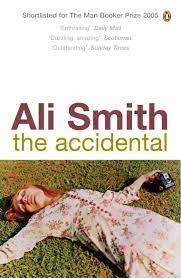
Genre: literary fiction, family, experimental
Narrative style: Stream of consciousness from a number of different viewpoints.
Rating: 3/5
Published: 2005
Format: Paperback
Synopsis: Eve Smart and her family are on holiday in Norfolk when Amber appears at their door. Eve believes she is a student of her womanising husband, Michael. He believes that she has come to interview Eve. Amber is accepted into the family and lies to and manipulates every member of the household.
Time on shelf: Quite a while, I think. I’ve certainly had it as a alternative in earlier versions of this challenge. I have mixed experiences reading Smith and the last one I read – Autumn – left me disappointed so I put off reading this one.
Reading Challenges: TBR Yr 10 Challenge – Hosted by Adam Burgess at Roof Beam Reader.
I enjoyed the start of this book. I liked the different voices. I was interested in the characters and when Amber started to disrupt their lives, I wanted to see what would happen. I thought that there might be some explanation as to Amber’s appearance and was enjoying trying to work out what her relation to the family might be. Somewhere around halfway through, it started to get less enjoyable.
Smith writes in stream of consciousness for each character and it was this that first started to irritate me. The first time we hear Eve’s voice, it is the in the form of questions and answers which mimicked the style of Eve’s fiction which is styled as interviews with characters who died in World War 2. I found it irksome although it was undeniably clever. Later, when Amber has been with the family sometime, Michael, Eve’s husband starts to break down and so does the prose of his section, abandoning the formalities of a novel and becoming poetic, lacking punctuation and showing clearly that Michael is not the creative genius he imagines himself to be. Again, this was a clever way to show Michael’s inner turmoil but I found it irritating and it didn’t do much to further the plot.
In fact, plot seemed a minor consideration here. Amber has no relation to the other characters and no motive for disrupting their lives. She appears and disappears with no explanation. I admit I found this annoying but maybe I’m missing the point. I wanted closure and explanation and it isn’t really Smith’s style to give it. The other characters do change and move forward. Michael is suspended by his university for his behaviour towards his female students and has to take a more fatherly role to his two step children. Eve decides she needs get away from her family and from her writer’s block so she travels to the USA to discover he father’s other family. At the end, she is about to invade a family in the way that Amber invaded hers.
This is a novel about ideas, about boundaries and about the slipperiness of meaning. It’s about how the past affects the present and then the future. She is full of ideas. At the end, the family come home to find their home has been completely stripped of contents even down to the doorknobs. This felt like a step to far, another meaningless event that Smith is not going to explain.
This isn’t a terrible read. It’s better then I’ve made it sound because it is clever and because Smith can definitely turn a phrase but I wasn’t attached to any of the characters and at the end I felt nothing.
 kepagewriter
You must be logged in to post a comment.