Eclectic Reader Challenge – Urban Fantasy – Stardust by Neil Gaiman

A long time ago, I read Neil Gaiman’s series of Sandman graphic novels. I was introduced to them by a friend and it was against my better judgement that I started to read them. Making an early start on my career as an intellectual snob, I reckoned they weren’t going to be up to much. Boy was I wrong! I really enjoyed the stories, the characters and the clear and shining light that is Gaiman’s imagination. As a result, I had been meaning to read one of Gaiman’s novels for quite some time now.

So when looking at the genre of Urban Fantasy for The Eclectic Reader Challenge on Goodreads and I realised that I was able to choose a Gaiman, I was really pleased. I chose the one that I already had on my shelf, Stardust.

This book is quite different from what I would normally read, taking the form, as it does, of an adult fairy tale. It is a simple story but it also has depth and as with all good fairy tales it contains lessons and, of course, a happy ending.

There is a pleasantly old fashioned feel to the book. It is set in Victorian times and the folklore and mythology that is referred to seem apt for this setting. The theme of going on a quest for your heart’s desire, only to discover that it is something different from what you thought is also a tale that has been told for a long time. Yet Gaiman manages to give it a new and interesting twist.

IMG_0004

What I really enjoyed about this novel was Gaiman’s style and the to

ne of the writing which was perfect for the telling of a fairy tale. It is like sitting down around a campfire and being told a tale that you could al

most half believe in, by that friendly fellow traveller who looks like he might have lived out the story he is telling. In fact, you leave this novel longing for a

place such as faerie to exist – how the inhabit

ants of Wall manage to exist knowing that the faerie lands are right next door is beyond me.

Having said all that, this is not a genre I am particularly fond of and while this was a fun read, I’m not sure that I would be interested in reading much more like it. I prefer my fairy tales to be darker, if truth be told and I’m not very good with happy endings either. As this is a fairy tale, the characters are quite simple and while that obviously fits with the genre, I prefer my heroes to be, at the very least, ambiguous. 

Writing Letters Home – a story set in the trenches

I first read poetry from the first world war when I was in sixth form (more than 20 years ago now). I still remember reading some reading some of the poems for the first time and being impressed by how vividly they had captured the atmosphere of the horrific nature of trench warfare. Lines have  stuck with me –  ‘You are too young to fall asleep forever, and when you sleep you remind me of the dead’ from The Dug Out by Siegfried Sassoon, for example, is a poignant reminder of how close the soldiers were to death on a daily basis. My favourite Owen poem was Strange Meeting which has the soldier meeting the enemy he has killed in hell with the famous line ‘I am the enemy you killed, my friend’, although I loved all the Owen poems that we studied.

The era has held its fascination for me and I have read some of the classic literature set in that time, Strange Meeting, Birdsong, The Regeneration trilogy, for example. So when recently my A Level class had to write a story based on a war of their choosing, I decided that I would also try to write a story and I would set it in the first world war. They had to first of all find style models and read as much from their chosen era as possible, in order to gain an idea of context. They had to keep a diary of what they read and what they gained from it.

It was interesting to work so rigorously through the steps of research into writing and producing. I must admit that my normal habits were a lot less organised. I made lists. I made notes. A habit I have tried to keep to although there is still part of me that thinks that I should just be able to keep it all in my head. I read more poetry, more novels. I knew exactly where I was going.

The resulting short story – Letters Home –  owes a lot to the poetry of Owen and I tried to uses some strong imagery to describe the daily horror of life in the trenches. It also owes a debt to Strange Meeting by Susan Hill which is one of my favourite novels. The novel is about the friendship between two contrasting men in the trenches which ends with one of them missing in action. This was the inspiration for the relationship between Mark and James in my story, one of whom is open and friendly, the other more reserved, finding all relationships difficult. I decided to take this a step further than Hill and have one of my characters be unsure about his sexuality. In fact, it isn’t even as conscious as that. He is unable to acknowledge any of the feelings he has for James but also does not wish to return home to the girl who is waiting there for him.

In the end, what this exercise taught me is that influence and inspiration can come from two places – from factual knowledge of a given time and from reading fiction of a similar style or set in the same era as what you are trying to write.

Letters Home is up on my website under short fiction if you would like to read it and give me your opinion.

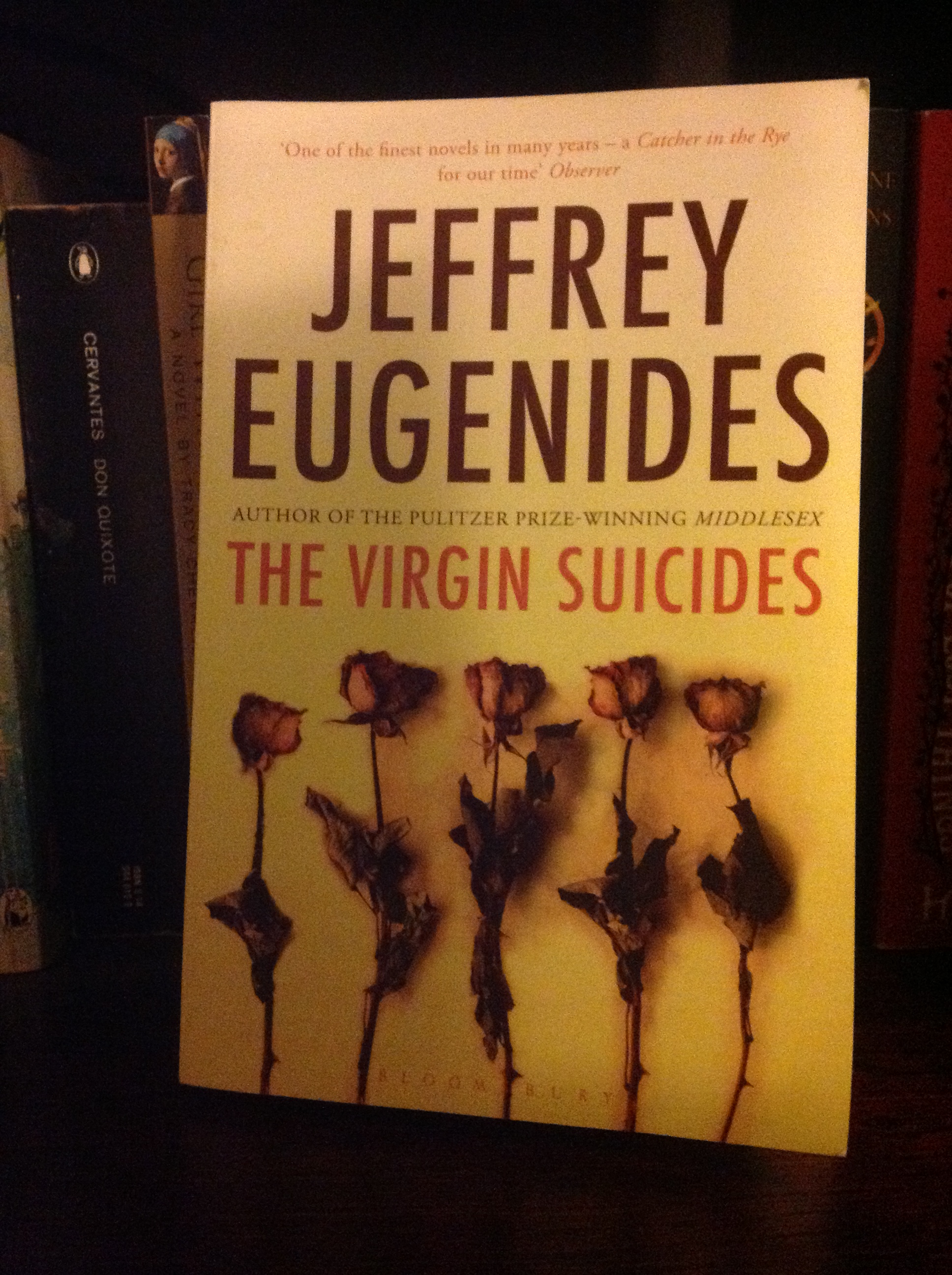
Eclectic Reading Challenge – The Virgin Suicides – Book that was made into a film.

Read as part of the Eclectic Reading Challenge.

I wasn’t sure what to expect from this book. I had an idea of what it was about and I was certainly curious. I haven’t seen the film although I would now like to see how it was done. I expected to find a narrative that was punctuated by the girls’photo-2 suicides, at regular intervals, keeping the reader involved. However, this book is much cleverer than that.

The narrative voice is one of the most interesting I have come across. It is ostensibly first person although ‘I’ is never used. It is written from the perspective of a ‘we’, the group of adolescent boys who are so fascinated by the Lisbon girls. This gives the voice a strange anonymity. Although lots of boys are named, give opinions and interact with the Lisbon girls, the narrator is not named. The voice is collective. This gives the story an universal feel. As if the boys represent all boys who are understandably fascinated by the teenage girls in their social circle. While the suicides are extreme, the lack of understanding between the boys and the Lisbon girls comes to represent the difficulties of communication between the sexes at this awkward time of life.

The first suicide occurs early in the novel and to my mind is the most devastating. The suspense that follows is even greater than if there had been a suicide every few chapters. I will not give away the ending but I could not have predicted how it would go. All the narrative is directed towards understanding the suicides of the Lisbon girls. However, the reader does not yet have the details of the rest of the suicides and so they are trying to understand something ephemeral, not quite real.

To my mind, the novel is about the painful transition from adolescence into adulthood. In this way, the deaths of the girls represent the death of childhood. Many of the boys who are visited twenty years on are past their prime, having had their best moments early in life. The girls have avoided the disappointment of life by taking control early on and killing themselves. They do not have to see the inevitable decay that begins to destroy the archive of their stuff that the boys keep. They escape the ageing process and instead remain forever beautiful and mysterious.

The reader is placed in the voyeuristic position of the boys who watch and note and obsess. The Lisbon girls are the unreadable difficult novel that they cannot understand. The girls are unknowable and the ordinariness of their deaths is baffling. Even with all the clues at their fingertips, understanding is not possible. This is perhaps the real tragedy. Not simply the girls suicides but the fact that whatever message they intended to send was lost in translation.

A gender free environment

Now that I am getting that bit older, quite a few of my friends now have children. Whenever I have to buy presents for the girls, I have my customary moan about how rubbish toys are for girls, compared to those for boys. (Remember if you will that I was always a tomboy. I never played with dolls. I always wanted a gun and a cowboy hat so maybe I’m an extreme judge.) It is not just my personal dislike of pink and cute dolls though, it is the implications of these toys. Boys get to discover science, other worlds, girls get to wait for their prince to come. They get to cook and iron. It all seems a little unfair.

I have now finished reading Delusions of Gender by Cordelia Fine and the final chapters looked at the effect the environment that children grow up in has on them. It also suggested how quickly children learn what is perceived as right and wrong for each gender. And how subtle their senses are. All very disturbing.

Most of my friends thought that they would try to bring their children up in a gender free environment. And they all made some concessions to this. No pink, perhaps. Neutral toys. Similarly, when I bought presents, I made sure to buy science or practical toys for the girls, for example. It wasn’t surprising that many of our efforts resolved around toys and clothes. After all, they are the most obvious signifiers of gender around. Pretty simple stuff, I suppose. And then when their little girls decided they wanted pink anyway (interestingly this does seem to apply more to girls than boys) parents started to question the social basis of gender and look towards genetics and biology.

And I was tempted to agree. Now, after reading Delusions of Gender, I realise exactly how small our efforts were. Fine writes of one family who changed all of the pictures in their childrens picture books so that they were of the opposite gender. That certainly made our efforts seem quite small by comparison.

One parent told a story of buying her daughter tools but seeing her look after them, wrap them in blankets, as if they were dolls. This was taken as biological instinct but Fine asked the question of who was the primary caretaker, who put the child to bed? Could it be that her daughter had simply learned the clues as to what she should do with her toys from what her mother did? Interestingly, Fine’s own sons played like this with their trucks and their father was the primary caregiver.

Children see gender everywhere. Fine talks of the number of pre-school books that still have gendered images, women in aprons and as primary caretakers, for example. And then there is the influence of other children. Children want to fit in with their peers. Children are more likely to make gendered toy choices in the presence of their peers then at home. Finally, there are other families. Even if your family has a stay at home father, your child will very quickly understand that this is unusual.

So we shouldn’t be so quick to assume that biology is the only thing so all encompassing as to be able to override our attempts at non gendered environments. After finishing this book two things were clear to me. One, our attempts at gender neutrality were too small to even matter, two, social factors were easily as large and all-consuming as biological ones. If, in the future, I have a family of my own, I now realise that I would have to go a lot further than a no-pink household in order to create a gender neutral environment.

Eclectic Reader Challenge – LGBT – The City and The Pillar by Gore Vidal

photo-1This book has been on my to read list for a long time, I’ve been meaning to read it for far too long. I’m not sure why it kept getting passed over, I always knew that I would enjoy it. So, I decided to read it as part of the Eclectic Reading Challenge to ensure that this was the year I actually read it.

Straightaway I was drawn in. The opening description of Jim, clearly devastated, in a bar getting drunker, detached from all around him was masterful and intriguing. I wanted to know what had brought him to such a low point. Although it was immediately clear that it related to his school friend, Bob, I had no idea exactly how devastating the ending was going to be.

I can see how this novel would have been so shocking at the time. While it is not explicit, it is unflinching in its description of the life of a gay man in the 1940s. It tells of Hollywood affairs, of the secrecy and sham marriages, of the underground bars, a complete other world. From a modern perspective, it’s effect was twofold. In some ways, it seems like this story should be centuries old, such a lot of things have changed. At the same time, some things haven’t. The question of whether or not a celebrity should come out or not would not be such a loaded one if we truly had left all those old opinions behind.

In the preface to this novel, Gore says that he felt that he was at a crossroads just before he decided to published this book. He’d already published two novels and had a certain amount of acclaim. He knew that once he published The City and the Pillar, this would change. In one direction, a glorious future, Gore describes it as the ‘holy Delphi’. Instead he chose to publish and ‘end up accursed in Thebes’. One can only imagine the level of bravery and honesty that this must have taken.

This is one of the best books I have read in a long time. I was genuinely upset at the end, not only because the ending was so awful but because it was finished and I was not still reading it. An absolute classic.

Cinematic Wish Fulfilment – Django Unchained

At the end of last week, I went to see Django Unchained and I have to say that I  loved it. Well, I love Tarantino, the extreme violence, the superb dialogue and the non-linear chronological structures all appeal. So much so that I was quite excited to go and I was not disappointed.

As with all good westerns, retribution was the main theme of Django Unchained. And retribution of a slave against his masters, was a revenge that the viewer could really get behind. Particularly, I thought, at the end when the toadying slave played by Samuel L Jackson got his comeuppance. That was a particularly satisfying moment.

Also, as with all westerns, even the good guys were really bad guys. Django himself has to go through hell to get his freedom and along the way commit acts of atrocious violence. King Schultz, whilst nominally on the side of good, and who helps Django with his scheme, is a bounty hunter who is willing to shoot a man in front of his son if it means he gets his money. This version of history shows us that no one escaped the depravity of slavery – whether it warped the mind of the slave owners or destroyed the slaves, both physically and mentally, it’s brutality was all encompassing. In this sense, the level of violence seemed apt to show the horror of such a system

Tarantino has been criticised for taking on the subject of slavery. Spike Lee, for example, has suggested that he finds the film – or rather the idea of the film, as he doesn’t feel obliged to see it before he passes judgement on it – offensive. Lee makes a number of assumptions in doing this, one of which

the-help

seems to be that the only people who are allowed to write about slavery are its victims. There is no doubting that this is a white man’s story about racism but that does not immediately mean that it will be racist. Of course, Tarantino is irreverent. Of course, the violence tends  towards the cartoonish. Perhaps these things do not fit with Lee’s views of what a film about slavery should be about but for me it was far less offensive than a film like The Help which was packed with racial stereotypes. Nevermind the idea of the charismatic white woman who saves the day. (see the following link for more re-created movie posters at ww.theshiznit.com.)

Finally, the main reason I like this film is the same reason that I like Inglourious Basterds. Tarantino seems  to be using his films as a sort of cinematic wish fulfilment, a cinematic version of the idea of if you had a time machine, what would you change. At the end of Inglourious Basterds, Hitler is absolutely obliterated. The explosion at the end of Django Unchained performs a similar function on history. It blows up the house and all in it and as Django and Broomhilda ride away from it, it is the very idea of slavery that is blown sky high. All the horrors of the system, Jackson’s house slave, the man who nearly cut off Django’s gentals, all of Candie’s warped acolytes, they all go up in flames. Apart from Django and Broomhilda, only two seemingly innocent female slaves are allowed to escape. The final explosion is cathartic, releasing Django from his past and allowing him to finally, actually be free.

Eclectic Reader Challenge – Historical Mystery – The Moonstone

IMG_0034

Read as a part of the Eclectic Reader Challenge

As I have mentioned in this blog before, I enjoy a mystery and while it pleases me when I work out the answer before the end and I can give myself an intellectual pat on the back, it pleases  me more to be ultimately puzzled. I am happy to admit that The Moonstone kept me puzzled for the most part. By the time that the thief is revealed, I had worked it out but Collins had given me all of the clues by this point so it really wasn’t a great feat. Up until that point, I had been fumbling in the dark in the same way that the characters were.

I particularly liked the structure of this book and the way each character adds their own details to the story as well as their own personal view of events. Each character was memorable from Betteredge, with his Robinson Crusoe obsession, to Ezra Jennings with his hidden past; all were interesting, all were distinctive. As the story unfolds, the reader occupies a similar position to Sergeant Cuff, fooled by events as they stand, unable to see the whole picture until much later on. This is a masterful novel that keeps the reader’s interest at all times.

The Moonstone and the trouble it causes in respectable England seem to me to represent the punishment for colonial crimes that the theft of The Moonstone represents. That the precious stone is restored to its proper place is a satisfying ending even though the lengths the Indians go to get the diamond may be unethical. Their sacrifice for the diamond is greater than anything that the other characters go through in the course of the novel.

This theme of past crimes catching up is present throughout the novel – in the form of Ezra Jennings and his mysterious past, Rosanna Spearman and may be the ultimate reason for Franklin Blake to ask for all to give their version of events – so that his past cannot catch up with him and to ensure his good name in the future.

I expected this novel to be good as it had been recommended to me many times but I did not expect it to be so clever, so enjoyable and so satisfying a read. A must read for all fans of detective fiction.

Keeping it small

I’ve never been very good at writing short stories. The smallness of the idea never seems to last. Choose your future started life as a fairly simple idea about a woman having a melt down in a supermarket because she couldn’t cope with the perfection of the genetically modified tomatoes. Once I started to write it though, it very quickly grew to the current 60000 words of a novel. The universe very quickly expanded outwards – like universes tend to do, I suppose. Because it is set in the future, I suppose there are details and ideas that I wouldn’t have to deal with if this was set in the normal reality of everyday life and this is pushing up the word count.

Now I am concerned that I have too many ideas. I’m already thinking that my first edit will be a drastic one, hacking away all the ideas and characters that do not work or are unnecessary. At the minute though, I am willing to let it expand. It might sound ridiculous  that I would let it grow to untold size in order to crop it at some point in the future. All I can say is I cannot tell at the minute which branches it will be that are culled and which will be allowed to stay. I have to let it sprout with absolute freedom. Only when I have seen the whole will I know about the various parts.


Eclectic Reader Challenge 2013 – Action Adventure – The Zombie Room – R D Donald

51zwoI7vcmL._AA160_This is a genre I am not really familiar with, I must admit and I didn’t really know what to pick when I decided to do The Eclectic Reader Challenge. The Zombie Room sounded interesting – it was about human trafficking and I expected it to be a traumatic read. I expected it to be difficult. That would have made it more interesting.

There was certainly a lot of action. The events never really stopped happening. However, somehow this didn’t make it into a page turner. There was no tension and I didn’t feel compelled to read this at all. In fact, if I hadn’t been reading it as part of this challenge. I doubt I would have made it to the end.

There are traumatic events in this book. But they are described in such a flat way that I did not feel effected by them at all. That was the main problem. I felt no connection to the characters, to the events. In short, I did not care. And it seemed that most of the characters did not care either. Nothing seemed to really effect them either.

Ultimately, I think this was the problem for me. I write psychological stories and I like to read them as well. This story was the very antithesis of a psychological story. There was no knowing the inside of the character’s heads. They didn’t seem to have emotions or even points of view.

It may be that this is typical of the genre. After all, action adventure does suggest events rather than anything else. If so, I’m not sure that I will want to read any further into it.

Typical Girls Don’t Rebel*

(From The Slits song Typical Girl)

I think it is probably because I have always been quite tomboyish that I have always been suspicious of the idea that gender might be hardwired in some way. I’ve always been more into the idea of gender as something that you do, something that you acquire or learn, rather than something that you have or are born with. As Judith Butler suggests ‘Gender is a kind of persistent imitation that passes as the real.’ It’s a role we all play. And, of course, it always seems that this hardwiring just happens to support traditional gender roles. How very handy.

As part of my research for Choose Your Future I have been looking into this idea. Are men really incapable of reading emotions or do we just not encourage them to learn? Are women really no good at reading maps or does the social belief that they are stop them from even thinking that they are. After all, if you are that person who doesn’t fit the stereotype, do you admit it or do you downplay your own ability in order to fit in.

It is surely far too difficult to separate nature and nurture. One of the first things that children pick up is what is expected from their gender. Parents are also so very concerned with their child fitting in. Even now, my mother expresses dismay at my fashion choices and tries to encourage me into things that she thinks are more feminine. As well as pointing out babies to me in the hope that I’ll find them so cute I won’t be able to resist my urge to get pregnant.

At the minute, I’m reading Delusions of Gender by Cordelia Fine. It could not be a more apt title. The relationship between the social and biological is extremely complicated and who can say which came first. Does our brain effect how we behave socially or does society effect the way our brain functions? What does the fact that some male brains process emotions in a different place to some female brains really mean? Can we really make judgements about behaviour from looking at which parts of the brain light up? It is not as obvious as you might think.

It certainly does seem true that social factors can effect our perceptions of our own and others’ genders. For example, women given a talk about women who achieve well in maths and science did better on the maths test that followed than women told the opposite. (It goes without saying that the ability of all women was, in actual fact, about the same.) Similarly, women tend to rate their ability at socially unacceptable traits such as being good at maths as being worse than it actually is.

What I think when I hear about research that suggests gender differences are hardwired is what’s in it for them. Why would it be good if these differences were hardwired. And of course, the answer to that is in the title of the blog. Typical girls don’t rebel; they are polite, demure, do the housework, stay in their place. And typical boys keep all the power for themselves.