GLBT – Eclectic Reader Challenge 2013 – Rent Boy – Gary Indiana

I read Resentment by Gary Indiana when I finished my MPhil in 2001. I really enjoyed it and I vowed to read more of his stuff. So here I am, 12 years later, finally getting round to it by reading Rent Boy for the Eclectic Reader Challenge.

The narrator, Danny, is a rent boy, as you might expect but also a waiter and an architecture student. He also goes under a number of different names. Danny is the name he goes by in the series of letters that make up the novel. The narrative voice is very entertaining – Danny is intelligent and funny, both about his clients, the other rent boys he knows and the social situations he finds himself in .

As you might expect, there is a lot of sex in this book and a lot of it is quite explicit. It isn’t, however, all that sexy. Danny’s world is not a glamorous one and he does not spare the reader some of the seedier details.

When Danny gets involved with a scheme to rob rich people of the kidneys they are not using, you just know that things are not going to go well for him and fairly soon he is up to his neck in trouble and having to leave New York at an urgent pace.298753

In the end, he gives two possible endings to this scenario, both of which involve him on the run. It is difficult to say which is true. We also discover that Danny isn’t his real name either. The final lines of the novel are devastating and poignant. Danny says “I have no real name. I live where nothing has a name, and the rest is silence.” The person he is writing to is never revealed but it seems they are no wiser than the reader as to who Danny actually is.

I really enjoyed this. It was funny, full of biting social comment and gritty descriptions of the underbelly of New York. I’ll try and make it less than twelve years before I read another Gary Indiana novel.

Venus in Furs – Leopold von Sacher-Masoch – Translated Literature – Eclectic Reader Challenge

I wanted to read something a bit different for translated literature for the Eclectic Reader Challenge and this had been on my to read list for a while. I’ve read De Sade before (although a long time ago) and I thought it would be interesting to read the author who had given his name to the opposite end of the spectrum to De Sade. I can’t help wondering how you would feel having such a thing named after you (in case you don’t know, the term masochism comes from Masoch’s name). Do you suppose he knew, did it happen in his lifetime? How would friends and family react to that?

The book itself was not really what I was expecting. It is not particularly explicit and the protagonist’s Severin’s beatings are not particularly graphic. That said, this was published in 1870 and was considered shocking at the time, particularly, I think due to the idea of female dominance and cruelty and Severin’s willingness to submit to it. venus

There are some parallel’s with Fifty Shades of Grey (although this is considerably better written). Severin is in love with his venus, Wanda and adores her so much that he is willing to submit to her every whim and become a slave. They sign a contract outlining the exact nature of their relationship. Interestingly, it is Wanda who seems to have the most misgivings – at least at the beginning. Severin is more than willing to be her slave.

Unfortunately for Severin, Wanda becomes infatuated with another stronger man (in a particular stroke of cruelty, she allows him to beat Severin, marking the very end of their relationship).  It seems that being allowed to be so cruel has killed any love she had at the beginning of the novel.  She finds that she wishes to submit to her new lover whom she loves with a greater passion.

Is this suggesting that this willingness to submit is a part of love, something that is present in all of us but which shouldn’t be acted on? Certainly, I like the way that roles seem more fluid in this book than in Fifty Shades of Grey and also unlike between Christian and Anastasia, it is Severin who wishes to submit who asks for Wanda to fulfil his dreams and Wanda, the dominant one, who has to be persuaded. This certainly made me less uncomfortable than the sexual politics in Fifty Shades.

This wasn’t a great read – it wasn’t terrible either – but in terms of historical interest and cultural significance, I’m glad to have read it at last.

Eclectic Reader Challenge – Memoir – It’s Only A Movie – Mark Kermode.

There were a couple of reasons for picking up this book. First of all, it fulfilled the memoir category for the Eclectic Reader Challenge but, as the last couple of books I have read have been a bit rubbish (Yes, Tell No One by Harlan Coben, I do mean you”) I knew I wouldn’t be disappointed.

And of course, I wasn’t. In this book, Kermode imagines his life as a made for TV movie – a very funny idea which sees him detailing who would play him – Jason Isaacs – and his family members. It does seem as if spending so much time in front of a cinema screen has left Kermode with an odd view of reality and a lot of the episodes he recounts wouldn’t be out of place in a (slightly dubious) biopic. Maybe that is the point.

photo (14)

The story starts with Kermode’s early cinematic experiences, moves through his love of horror, particularly The Exorcist, through his early experiences as a critic to the celebrity status he has today. The early experiences were the most interesting, I thought. Recalling as they do, a different era when going to the cinema was a more intimate experience. Y’know when cinemas had two screens and ran two features. It made me think about going to the cinema in the early eighties and I began to recall my own experiences. Although unlike Kermode, who seems to be able remember which cinema and when for every film he has ever seen, I can’t remember what I went to see first although it was undoubtedly a Disney rerun, this being back in the days before Pixar and Dreamworks and a whole business aiming to sell cinema to small kids.

There is no doubt that Kermode is a geek – and I say this as a compliment – and a particularly grumpy geek, at that. (Amusingly a review of this, or possibly The Good, The Bad and the Multiplex, on Goodreads complained about this grumpiness as though it was a surprise. As if he had happened upon the book by sheer chance, knowing nothing about Kermode. It reminded me of when a friend went to see Billy Bragg and afterwards complained that he was too political. Well, duh.) He gamely outlines the number of people he was annoyed and irritated over the years including being put on the spot by Dame Helen Mirren after saying The Queen wasn’t a  proper film and, my own personal favourite, getting punched in the arm by Benedict Cumberbatch on behalf of Kiera Knightley who resented being called Ikea Knightley on account of her plank-like acting style. A very apt description, if you ask me.

Ultimately, this is a book about obsession and I think this is why Kermode can get away with his rants and raves. He loves cinema with his whole heart and hates the fact that some people do not give it the respect it deserves. It is only possible to remain calm about things that do not matter. Cinema matters an awful lot to Mark Kermode and thank goodness for that.

The Fear of God and Rebellion

The Exorcist is not a film that scares me. It may be that as I am not religious I have no real fear of the devil or possession. That is not to suggest that it is a bad film. It is shocking, disturbing, difficult, even powerful, just, for me anyway, not scary.

Part of the problem was the lack of ambiguity. I thought there was no suggestion that Regan’s problem was anything other than possession. It was written on her face and on her body. Again, I think my lack of religious belief lets me down. This was just something I am not capable of believing in.  Last week, I saw the film again. As part of Sheffield’s DocFest, there was a showing of The Fear of God, a documentary about The Exorcist, a Q&A with Mark Kermode and then a showing of The Exorcist. I have to admit that the main draw was Kermode who is always incredibly intelligent about film and who I admire greatly. I have to admit that I’ve always been a little unconvinced by his championing of The Exorcist when I so often agree with his opinions about films.

The documentary was brilliant, not least because it showed how difficult special effects were before CGI and how borderline insane William Friedkin was. It is always fun to open up a film and find out exactly how it was put together. Well worth a watch if you are at all interested in horror.

Kermode was his usual charming and knowledgeable self. He dismissed notions that we are desensitized to violence these days, pointing out that this is a debate that has been running almost as long as the film industry itself. Most interestingly, he explained exactly what parts of the film impressed him even after more than 200 views. (Can you imagine seeing a film that many times? I’ve seen my favourite film, It’s a Wonderful Life 5 times.) I found myself excited by watching The Exorcist and spotting these things myself.

One of the things that Kermode said about the film was that when you watched it for the first time, it was unrelenting but watching it for a second time, you would be able to spot the more subtle effects. I found that hard to believe.

It was 1998 when I first saw The Exorcist and it was a completely jarring experience. It felt like one terrible moment after the other. I read once that one of the reasons The Exorcist was such a difficult watch was that it showed no sympathy for its teenage heroine. I could only agree. It was completely without mercy. Every image was shocking, sickening, utterly painful. I could completely understand people vomiting in the aisles or running into the nearest church.

So I found it hard to imagine that it would be different the second time around. And some scenes where just as difficult even when you knew what to expect. The sight of a teenage girl, plunging a crucifix between her bloody legs will always remain one of the most disturbing scenes I have ever seen. But Kermode was right, I was able to notice other things. For a start, one thing that disturbed me, that I barely remembered from the first time, was the horror of all the invasive processes that the medical profession force on to Regan. It is interesting to note that the problems really seem to come to a head after her father forgets her birthday. No wonder she was so very angry.

It became apparent that you could read this as something other than a religious parable. Regan’s bodily transformation could represent the changes at adolescence. It could be a manifestation of her very real anger. It could also represent the fears that adults have about the younger generation. So it became a much better, more interesting film on second watching. Still not frightening as such but certainly more interesting and more powerful.


Eclectic Reading Challenge – Made into a Movie – Election – Tom Perotta

election-tom-perrotta-paperback-cover-artI loved the movie of this book. That is why I chose it for The Eclectic Reader Challenge. So I had expectations. Perhaps that was the problem. In my head, Matthew Broderick, Reese Witherspoon and a vivid portrait of high school life in America. Whichever way round it is – a beloved book or movie – it is often problematic when you approach the other version. (That’s why I still haven’t been to see The Great Gatsby and why I didn’t love The Life of Pi.)

The main problem for me was the switching between narrators. There were two problems with this. First of all, as they were all telling the same tale and it was linear, jumping between narrators was irritating and didn’t add much in the way of viewpoint, especially when sometimes the narrator might only have one or two paragraphs before someone else took up the tale again. The other problem was that none of them seemed that distinct from each other. They were lacking in personality.

The plot did drive me on though. And the theme of corruption in high school mirroring the corruption in American politics was clever and interesting but when it came done to it, the rigged election was a bit of a damp squib. I wasn’t attached enough to any of the characters to really care. Who was ruined by it and who wasn’t didn’t have an impact. The whole thing left me cold.

Maybe I would have liked this better if I hadn’t seen the movie. It’s hard to say. Without expectations, we are less disappointed. At the end, I just thought, well, there you go, that it finished. Nothing more or less than that.

The Road – Cormac McCarthy – Dystopia – Eclectic Reader Challenge 2013

I first read Cormac McCarthy years ago. I read Blood Meridian and really enjoyed it. It was gritty, violent, nihilistic and it really appealed to me. It is a little shameful that it has taken more than 10 years to follow up on that enjoyment and read another McCarthy book. To read The Road to fulfill the dystopia category for the Eclectic Reader Challenge 2013the_road.large seemed the perfect way to rectify this.

I had no expectations. I haven’t seen the film so I was aware only vaguely as to what this was about. McCarthy doesn’t give many details. There has been an unspecified happening and now there are (at first) unspecified dangers. This had the effect of unsettling the reader as there was no way of knowing exactly where the danger would come from. Details start to emerge but not enough to ever offer security to the reader. Not enough to allow knowledge of the future.

The crux of this novel is the relationship between The Man and his son, The Boy. The fact that they are not named gives the novel an universal feel. While specific events will have lead to this particular situation, there is a sense that it is a timeless situation. Acts of war, violence, atrocity have always existed and will always exist. The Man and The Boy are just the current version of the victims of this violence. Not the first, nor the last.

The Man tells The Boy to watch out for bad guys and that they are the good guys. And while the bad guys are cannibalistic and the signs we are given of their presence are horrific, The Man also acts in a way that The Boy perceives to be bad – he doesn’t help people when he could and when they are robbed, The Man retaliates in a way that is extremely brutal. This suggests that the ‘bad’ guys may also merely be responding to circumstances, in whatever way they can. In these extreme circumstances, the difference between good and bad gets smaller and smaller. After all, what would you do in order to survive?

The prose and the plot are not complicated but that does not stop this from being one of the most devastating books that I have ever read. The details that McCarthy does give build an atmosphere of tension and fear that is both compelling and horrendous. I wanted to read on and not to read on, both at the same time. I worried for The Man and for The Boy because it seems inevitable that it will not end well for them. There is no note of hope here. As such, the ending is open to interpretation. It could be seen as a rescue, as a hopeful moment but if we have learned anything in this novel, it is that human nature finds it difficult to retain its goodness under extreme circumstances and that it is difficult to tell who are the good guys and who are the bad guys. I want to hope for the best for The Boy because he, more than the man, does seem to represent the good of humanity. He often berates The Man over what he perceives to be bad behaviour but which we can can see is to do with self-preservation. Because of this, I do not feel that the ending can be straightforwardly positive but it can hope for the best. Perhaps that is all any of us can do.

A Change in Reading Habits or How I learned to Love my Kindle

Those who read this blog regularly will know that I have been ambivalent – to say the least – about the rise in reading on kindles and the like. And I still prefer reading an actual paper book. Especially a second hand book where you can romantically imagine all the other eyes that have feasted on the very same words. There is no better place, in my mind, than a second hand bookshop. And there is nothing romantic about the kindle.

I’ve had my kindle for about eight months now and it has taken that long to get used to. One of the first things I did was buy a cover for it so that it was a little bit more like holding a book in my hands. Even so, it is different looking at a screen for a length of time rather than a page. Not particularly better or worse, just different.

The kindle has changed my reading habits for the better. Because so many books are so cheap, I have experimented much more and as a result, I have read a lot of new authors – Josh Lanyon, Michael Faber, Charles Todd, Brandon Shire, for example – which I might not have discovered in a book shop.

Also I have read more classics than I would normally. I always say I’m not really a classics fan – and I think the majority of my reading will always be contemporary fiction – but as they are often free, I’m much more willing to take a chance and have read Dickens’ A Christmas Carol, Conan Doyle’s The Lost World and Forster’s Where Angels Fear To Tread so far this year, all of which were very enjoyable.

(Actually, the kindle can’t take all the credit. I’ve started to use the recommendations on Goodreades when I’m choosing the next book I read on the kindle and this has proved very useful.)

There are still things that I find annoying about the kindle. This nonsense about the percentage that you have read. To me, that is meaningless. I like to know how many pages I have left to read but being up to 79% through a book, that could mean anything depending how long the book actually is. Of course, you can make some judgements by how quickly the percentage changes but it is not the same as moving physically through a book or as being able to work it out with page numbers.

Also, if you want to check something back in the book, that is more difficult as you have to turn past every page you have read so I don’t bother which sometimes leaves me a little confused.

Minor quibbles though. In fact, I’d definitely miss the kindle if I didn’t have it now and it is my constant companion on the journey to and from work on the tram. It might never replace reading actual books – for me anyway – but it is an alternative that I have definitely come to terms with.

The Real World Keeps Getting in the Way

It has been a month of getting very little done. After a very productive April, I have had a really annoying May. The real world keeps intruding into the world of writing which is just rude, if you ask me.

First of all, I was in Newcastle, helping my mam after a knee operation. This meant ten days without the Internet and without really getting any writing done. This last was due to the fact that I like to write on my own and I never really was. So I maybe achieved an hour at night when I was tired, most of which was rubbish which I immediately changed. Although I did manage to finish reading The Female Malady by Elaine Showalter which is part of my research for Choose Yr Future so that was productive. (It isn’t all just about words on the page, I have to remind myself.)

Then, back at school, we got the call from Ofsted which meant that all spare time was spent preparing for that. An Ofsted inspection is incredibly stressful even if you aren’t seen – which I wasn’t this time – and I spent the weekend after in a haze of tiredness and so again got very little done.

Last week was half term, a time when I usually catch up a little and rest a little. Foolishly, I agreed to do some one to one tutoring over the holidays as extra cash is always welcome.  However, it soon became clear that I would get nothing else but lesson planning done and I regretted my decision. I’ll just have to hope that all the notes I’ve made when I have an idea will still make sense when I eventually get around to writing them in full.

Unfortunately, it will probably be the summer before that happens. From next weekend I will be marking exam papers for the next three weeks and that is incredibly time consuming. Its hard balancing the need to make money with having the time to write and sometimes it feels like the scales are tipped the wrong way constantly. At least I can see a time on the horizon when I can write and when I can catch up with myself a little.

A Test of Wills – Charles Todd – Eclectic Reader Challenge 2013 – Historical Mystery

Historical mystery – Eclectic Reader Challenge 2013

There are a lot of good things about this book. The setting is convincing – just after the first world war – and many of the characters are still recovering from it. The main character, Inspector Ian Rutledge, is himself suffering from the ongoing effects of shell shock and has the voice of a Scottish soldier, Hamish, forever criticising him inside his head. There were interesting moral dilemmas as well as an early suspect was a decorated war hero and the evidence against him came from another soldier who was in the process of drinking himself to death and the townsfolk considered him a coward due believing he was only pretending tp suffer from shell shock to avoid fighting. The attitude towards him seems appalling now but was certainly the prevalent view at the time. Indeed, Rutledge is very careful to keep the extent of his own problems a secret or else risk losing his position in Scotland Yard.

So far, so interesting and I started reading full of anticipation, expecting complications – because every reader of detective fiction knows that there is no such thing as an open and shut case – and there were plenty. And then somewhere, about halfway through, I started to get a little weary. First of all, Rutledge’s character began to seem a little unchanging. He gave nothing away and even Hamish’s comments started to lose their startling effect. Some of his conversations with witnesses or potential suspects seemed repetitive as he tried to get to the bottom of the story and no one would open up to him. Secondly, the other characters were all a little wearing. Perhaps, it was to do with the setting – the prim English village just after the first world war – but everybody was just a little careful and that got on my nerves.

a test of wills

In terms of the plot, there were some very interesting twists and turns along the way, some I saw coming, some not. The idea of shell shock and its effect is played out in a number of different ways – all of which are interesting and some particularly disturbing. Indeed, the moment the reader finds out exactly who Hamish was and why he died, is one of genuine emotional power and a highpoint in the novel.

However, the ending seemed a little rushed and after all the painstaking work seemed more like luck than good judgement on Rutledge’s part. It was an interesting ending but not, from my point of view, a completely satisfying one.

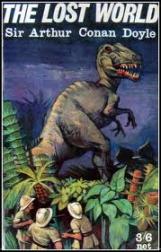
The Lost World – Arthur Conan Doyle – Eclectic Reader Challenge – Action Adventure

Since I discovered that classics are free on the kindle, I have been reading more of them. I’m not sure I would have ever got round to buying this – there would always have been something more pressing to spend my money on- but when I was looking for my next kindle buy, it jumped out at me. I’ve read quite a few of the Sherlock Holmes stories and I was curious to know whether Conan Doyle could do anything else.

When I started to read this, I had just finished the Eclectic Reader Challenge and I didn’t really know if I was going to do it twice as someone suggested. However, I realised that it would fit with the category Action Adventure so this is now the second blog I have written in my second round of reviews.

I really enjoyed this book. Certainly, Conan Doyle proves here that he is capable of writing in more than one style as this is really nothing like the Sherlock stories. The main character Edward Malone is a news reporter who, at the start of the story, proposes marriage only to be turned down by the object of his affections and told that she could only love a man who has had a great adventure. So, obediently, Malone finds himself an adventure to go on – off to the amazing lost world of the dinosaurs. (Interestingly, by the time he returns, she has married some one else – a clerk, no less. At the end of the novel, Malone is planning another adventure – presumably so he doesn’t get hurt again by one of those fickle women.)

The characters are all very well-drawn. Professor Challenger is superbly arrogant and annoying in his condescension. His intellectual rival, who is initially sceptical of the dinosaurs, Professor Summerlee is equally argumentative and arrogant and the pair have some superb arguments. The descriptions also give a wonderful sense of place and the platea

u is made to feel creepy and otherworldly before any of the dinosaurs are even s

ighted. In fact, it is a good third into the book before they even arrive at the plateau. Not that this was a problem for me – the events beforehand were all important  – but I could imagine it trying the patience of someone more used to modern literature.

lost worldIt has to be mentioned that some of the attitudes in this book are a little hard to stomach now. For example, it is taken as a given that the white men are superior, being further along the scale of evolution than any of the native characters. The one black character is loyal to the point of stupidity and talked about as if he were a pet rather than a human being. There is also a sense of imperialism, with the discussion of what to call the lakes and forests they discover as well as the assumption that the land was now theirs. This book is a hundred years old and in these attitudes it really shows. However, the sense of adventure and the action in this book are just as appealing as they ever were.