2020 Alphabet Soup Author Edition – Faggots – Larry Kramer

Genre: LGBT,  Modern Classic

Narrative Style: Third person from multiple points of view

Rating: 4/5

Published: 1978

Format: Paperback

Synopsis: Fred Lemish is about to be forty. He is growing tired of the constant round of parties, clubs, dancing and fucking that occupies his life when he is not working. He is in love with Dinky Adams – as is most of New York, it transpires – and is desperate for his return so that he can cement their relationship. The novel describes the gay scene in New York and on Fire Island with no holds barred. 

Reading Challenges: 2020 Alphabet Soup – Author Edition.

On the front of my copy of Faggots by Larry Kramer, it proclaims that the book will be “disturbing, enlightening, compassionate, explicit, uninhibited, outrageous…” It then goes not to say that no one can be neutral about it. I admit, I thought this sounded a bit over the top. However, as I read I realised all these things were true. Especially that last bit. Faggots, it seems, is a book you either love or you hate.

The novel captures a moment in gay history when sodomy laws in the USA had been revoked in a lot of states and gay men were tasting more freedom than previous generations but before AIDS devastated the gay community. Sex is everywhere, male bodies are on display and I lost count of the different types of drugs that were mentioned. It describes unbridled hedonism. There is a lot of sex in this novel. Some of it is very funny and some of it is very kinky. Certainly, it is easy to appreciate the sense of freedom  – what else was there to do but have sex. There was no need to settle down or have a relationship. Why do that, when there are all these beautiful bodies?

Fred Lemish wants more. He is in love with Dinky Adams. At the beginning of the novel, he is out of town and Fred is waiting for his return as he hopes it will be the start of a proper relationship. However, the reader soon realises that Dinky is much in demand- every other character seems to be also waiting for his return. We quickly realise Fred is heading for a fall. Fred is definitely ready to settle down. He wants more than just sex and bodies. In some ways, he is like Gatsby – in love with love as much as the completely inappropriate object of his affections. Dinky does not want to settle down and Fred is left alone again at the end.

The novel this most reminds me of is Andrew Holleran’s Dancer from the Dance – another novel from 1978 with Gatsby overtones. Both novels critique the narrowness of the perceptions of what gay life could be within this scene. They also both show the interchangeability of bodies and the hollowness of relating only to the physical. Winnie Heinz – also known as The Winston Man, model for Winston Cigarettes takes a fall from a parapet while in a drug addled state and dies when he hits the dancefloor; his place is quickly taken by a younger, fitter version.

It may be for this reason that Kramer has so many characters in this novel. There are dozens and dozens of men, some given little more than a paragraph, some mentioned but not fleshed out and some returned to again and again. It was difficult to keep track of who was who, who’d had who and what everyone’s particular fetish was. Even Fred has trouble keeping track of who he has slept with. Even when he has noted that a man was hot and he would like to see them again, he can’t remember his name. He had spent a year with “a faceless group of sex objects.”

It is this endless list of characters and the overly convoluted state of Kramer’s sentences that stopped this from getting 5 out of 5. Nevertheless, an enjoyable, completely uninhibited read. Not for the faint hearted.

 

2020 Alphabet Soup Author Edition – Contact – Carl Sagan

Genre: Science Fiction

Narrative Structure: Third person, chronological

Rating: 4/5

Published: 1985

Format: Kindle

Synopsis: Ellie Arroway is a radio astronomer who has dedicated her life to the discovery of alien life. When radio-telescopes at the Project Argus pick up an unusual signal, she realises that this may be the message everyone has been waiting for.

Well, this was certainly an interesting read. Being written by an actual scientist made it quite different from any other science fiction I’ve read. (I’ve never been so glad to be reading something on my kindle. I had to keep looking up scientific terms.) It was also much less figurative than most novels. It was very focused and very unemotional. I don’t mean this in a bad way. It was very enjoyable but although there was some love interest for Ellie and somethings outside of the science were mentioned but they were not focused on and sometimes it felt like Sagan had forgotten about these elements. It was a little like reading a documentary about something that hadn’t happened yet. It was probably the most level headed novel I’ve ever read.

The story starts in Ellie’s childhood. She is an exceptionally gifted child, already curious about all things science. Sagan takes us through her school and university career as she becomes more and more interested in the possibility of a message from outer space. This leads her to the Argus Project and the unusual signal.

It becomes clear that the signal is the instructions for the building of a machine. Sagan takes the reader through the various arguments against building it – it could be a Trojan horse or it could be a doomsday machine. We get various religious arguments which are all given a respect I would have found it hard to give.

Indeed, this is not a novel about the divide between science and religion but is one in which the two are brought closely together. When the machine is built, the five top scientists from around the world are sent away in it and they are presented with a vision of the person they loved most in the world who explain to them about a universal message that is written in the physics of the universe. Ellie is told to look in pi but other scientists receive slightly different information. This final message brings together science and religion rather than driving them apart. God is given a scientific explanation.

I really enjoyed this novel. It was exciting. It showed what might happen if we received a message from intelligent aliens. (Although given the current governments in charge, I very much doubt such a calm response might occur these days.) Ellie was an engaging main character who neglected her family and lover due to her dedication to science. Sometimes it felt that Sagan neglected elements of the narrative for the same reasons but overall I would definitely recommend.


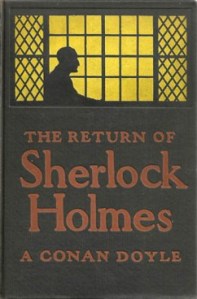
2020 Alphabet Soup – Author Challenge – The Return of Sherlock Holmes – Arthur Conan Doyle

Genre: British Detective, Classics, Short Stories

Narrative Style: First person, 

Rating: 4/5

Published:1904

Format: Paperback

Synopsis: Sherlock Holmes has been missing, presumed dead, after his encounter with Moriaty on the Reichenbach Falls. In the first story of this collection, he reappears, much to the surprise of Watson, his trusty sidekick. Together, they solve five more mysteries of varying degrees of complication. 

Reading Challenges: 2020 Alphabet Soup – Author Edition

Overall, I did enjoy this book but as always, whenever I read a Sherlock Holmes story, I have to overcome my irritation with the main character. Holmes is infuriatingly intelligent, able to spot things that most normal people don’t and always about three leaps ahead of everyone else. Unlike Watson, I don’t find these attractive attributes. I much prefer my detectives to be fallible – to be more human, in fact. But once you get over that – and Watson’s adoration which is also a little annoying – there is much to enjoy here.

The first story – which heralded Holmes reappearance – was perhaps the least satisfying. Holmes has information that Watson, Lestrade and the reader could not know. All that is left if for the reader is to admire Holmes’ abilities. Not much fun, to be honest.

The other four stories in this collection are all much more interesting and allow the reader to stretch their own powers of deduction a bit more. Indeed, I even worked out what one of the mysteries was. (Incidentally, I’m never sure if this pleases me or not. It shouldn’t be too easy to work out, nor too difficult. It’s a fine line or maybe I’m just difficult to please.)

The most enjoyable story was probably Black Peter. It was suitably twisty, it involved a policeman who jumped in the wrong direction, murder by harpoon and lots of cleverness from Sherlock including running through a pig with a harpoon to see how much strength it took.

Overall, I’m not a huge fan of short stories but they work nicely with detective stories. Obviously, if you have a full on police inquiry, you need a full novel but the quirky, interesting mysteries presented here are just complicated enough to sustain about 25 pages of text.

Alphabet Soup Challenge – Author Edition – G – Lanark by Alasdair Gray

Genre: Scottish Fiction, Allegory, Metafiction

Narrative Style: Non chronological, Third Person

Published: 1981

Rating: 3/5

Format: Paperback

Synopsis: Lanark can’t remember who he is or anything about his past. His most recent memory is a train journey which has brought him to Unthank, a place where the sun barely rises. He longs for the sunshine. He meets a group of people but is unable to connect with them. He longs for love but is unable to find it. Is there any way he can escape from Unthank?

Reading Challenges: 2020 Alphabet Soup – Author Challenge

I thought I’d enjoy this more than I did. In fact, for quite a bit, I thought this would be a five star read. I really enjoyed the first three books but then it felt as though it was never going to end. Maybe that was Gray’s problem – he couldn’t figure out how to finish things off.

The novel starts with Book Three and Lanark’s arrival in Unthank on a train. Anything before that is a mystery to him. Unthank is a land of darkness – the hours of sunshine are getting less and less. There is an entertaining episode where Lanark goes to register so he can get money which is Kafkaesque in its pillorying of bureaucracy. There are swipes at the authorial process when Lanark is encouraged to write by Sludden, one of a group of people who lounge around in a cafe all day, and then, after a painstaking description of the writing process, is told that what he has written is no good.

It is clear that Unthank is some sort of punishment – hell, maybe – for an incident in Lanark’s life before. This is supported by the fact that Lanark keeps asking women if he killed them. This becomes even more apparent when Lanark starts to develop dragonhide. (Other characters have equally weird ailments such as eyes or mouths all over their bodies.) He then finds himself in the Institute where once cured, he is made to become a doctor and cure others of the same ailment. When he manages to save a woman, he is given the chance to speak to an oracle and find out about his life before.

Now we are given Books One and Two – the life of Lanark before Unthank when he was Duncan Thaw. The style changes here. We are now given a – mostly – realistic portrait of a Scottish childhood and young adulthood. Thaw has always wanted to draw but finds he is thwarted in many ways. His parents want him to get a more sensible job. The focus is on money and living the same life that everybody else does which Thaw does not want. Even when he eventually gets to art college, he finds it provincial and depressing, pushing him towards a teaching career he does not want.

Thaw is prone to fits of depression, illness and hallucination. During one of these times, he may have killed a woman. As a result, he kills himself and this is how he has ended up in Unthank. Now, he is given the opportunity to leave the Institute and find a better future for himself and the woman he saved. But before any of that, he must return to Unthank.

This is where it started to go wrong for me. The allegory became increasingly complicated as did the satirising of bureaucracy. There were unending obstacles for Lanark. It ceased to be funny and clever, becoming annoying and increasingly post-modern. There is a section where Lanark meets the author of the novel and they argue over what the end of the novel should be. Included in this section are a series of footnotes giving all the other writers that have influenced the story, seemingly trying to head off any potential critics who pointed out allusions. All very clever, but not much fun to read.

By the end of this novel, I didn’t mind how it ended, just that it did. I was quite sympathetic towards Lanark in the beginning; by the end I was just hoping for his death and for it to be over.