2020 Alphabet Soup Author Edition – No Surrender by Constance Maud

Genre: Feminist, Political

Narrative Style: Third person, chronological

Rating: 2/5

Published: 1911

Format: Kindle

Synopsis: Jenny Clegg is a mill girl in Lancashire when she gets involved with the Suffragette movement. The novel follows her and her friend Mary O’Neill through marches, prison and force feeding during their fight for the vote. 

Reading Challenges: 2020 Alphabet Soup: Author Edition

I first heard of this novel in the BBC Two program, Novels that Shaped Our World in November, last year. It sounded interesting so I downloaded it onto my kindle. I’d never read a novel about the suffragette movement before – indeed, I don’t think there are many – and so I was quite excited to read it. Unfortunately, it did not live up to my expectations.

The main issue with this novel is that it is purely political. So you might expect when dealing with such a subject but there is nothing else in this novel, no subplots, no romance and no other way of separating characters. The players in this novel are good or bad depending on whether or not they are for or against women’s suffrage. In a lot of cases, this is their only personality trait. On both sides of the argument this led to stereotypical and hollow representations. The suffragettes were all good, moral women and those against them often seemed ridiculous. No one ever wavered in their feelings – no suffragette anyway. Some of the disbelievers come across to the suffragette side.

Secondly, the majority of this novel is dialogue. Not only that but a lot of it is written in dialect which is often hard to decipher and did make me wonder if Maud had ever actually had much to do with the working classes. It made the reading experience jarring at times. All the dialogue also made the pace quite slow. There wasn’t much action, more people describing action.

There are good things – important things – in this book. It describes a lot of the reasons that women wanted the vote really clearly and shows the injustices that women – particularly working women – faced at that time. It described the force feeding of Mary O’Neil in detail and showed how badly the suffragettes were treated in prison. All of this is important historical detail but unfortunately it didn’t override the other issues with the novel.
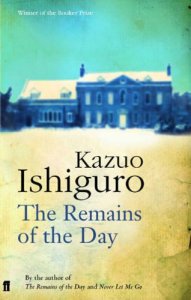
2020 Alphabet Soup Author Edition – The Remains of the Day – Kazuo Ishigoru

Genre: Historical Fiction, Literary Fiction

Narrative Style: First person

Rating: 5/5

Published: 1989

Format: Paperback

Synopsis: Stevens, the butler from Darlington Hall, is allowed some holiday and takes a driving trip to see the former housekeeper, Miss Kenton, who left the house some years earlier to get married. On his journey, he begins to think back over his time as butler and his relationship with Miss Kenton.

Reading Challenges: 2020 Alphabet Soup: Author Edition

I really enjoyed this book. I wasn’t sure whether I would or not as I’ve read two Ishiguro novels previously – When We Were Orphans and Never Let Me Go – and I didn’t particularly enjoy either of them. All three are quite different from each other though and as such, I was unprepared for the emotional effect of this one.

The novel begins as Stevens, a butler for many years at the prestigious Darlington Hall, begins a journey to see the former housekeeper. At first, he is preoccupied with the idea of what makes a good butler and the idea of dignity. He gives the first details of his relationship with Miss Kenton when he describes an exchange after she tried to bring flowers into his office, an act which clearly baffles him. It is clear to the reader – although seemingly not to Stevens – how Miss Kenton feels about him. She is often frustrated by him and seems determined to provoke some emotion in him.

This is a very subtle novel. Stevens does not discuss his own emotions and the reader has to read between the lines to understand how he feels about events. At one stage, Stevens praises his own sense of dignity when he manages to keep working on the evening that his father dies. It is heartbreaking to read. Stevens, also never seems to realise that Miss Kenton is constantly trying to make him step outside of his professional persona. However, it seems like there is no man underneath the persona, Stevens so perfectly personifies the role of butler.

The reader is also made to think about the nature of loyalty and the relationship between master and servant. Lord Darlington, it becomes apparent, is part of a faction that is fascist and anti-semitic and during the war, he holds conferences with the aim of appeasing Hitler. Stevens thinks that he is right to have remained loyal towards his master and refuses to think that Lord Darlington could have been wrong in his ideas. Even when he is instructed to fire two Jewish members of staff, he follows these orders without question. It is one of the times that he disagrees with Miss Kenton as she thoroughly disapproves of these actions and threatens to leave if Stevens carries them out. Miss Kenton presents an emotional counterpart to Stevens’ repressed and proper personality.

The ending of the book, when Stevens finally meets with Miss Kenton, was very sad as they both realise what their lives could have been like if they’d been able to admit their feelings to each other. At the very end, Stevens ends up crying when talking to a man about his employer, his only show of emotion in the whole book. This suggests perhaps, that Stevens will at last be able to acknowledge his emotions and perhaps gain more enjoyment from what remains of his life.