Books Read in 2015 – 18. Saints of the Shadow Bible – Ian Rankin

Genrre: Detective, Police procedural

Narrative Style: Third Person from various points of view21283302

Rating 5/5

Published: 2013

Format: Paperback

Synopsis: Due to a change in the double jeopardy law, an old case is being re-opened. An old case that involves Rebus’ old colleagues. There is suspicion of wrong-doing and they all swore an oath that they wouldn’t tell. Rebus finds himself caught between his old workmates and Malcolm Fox from the Complaints who is determined to get to the truth. 

I must admit, I didn’t love the first of the Rebus in retirement books, Standing in another man’s grave. It wasn’t terrible but it didn’t inspire me to read this one as soon as it came out. Finally, I gave in and bought it with my birthday Amazon voucher in November. It was so much better, I was sorry I hadn’t read it sooner.

I haven’t read any of The Complaints books but Fox has featured – albeit on the periphery – in the Rebus novels before so I was aware of him. He was an excellent foil for Rebus – a rule follower and a reformed alcoholic, he showed up Rebus’ faults in all their glory. Neither man really trusts the other but they manage to create a successful working relationship all the same. Giving a little of Fox’s past, Rankin shows how similar the men really are and how they have attempted to solve the similar problems that life has thrown at them in different ways. I would certainly be tempted to read some of the Fox novels although I’m not sure how well he would work as a lead character without the alternative of Rebus as relief from his uptightness.

The past and the future well and truly crash in this novel as Rankin shows the difference between policing then and policing now. It goes some way to show how Rebus has developed his own moral code and although he doesn’t always follow the rules, the reader is generally on his side because he isn’t just wantonly corrupt. There is a line drawn between him and the other Saints being investigated although it isn’t always clear exactly where it is. Rankin shows how easy it is for power to corrupt and how dangerous it is when anyone takes the law into their own hands but he does not make simple moral statements. He shows the complexity of any moral decision.

As ever, the twists and turns of the plot and main plot are not easy to unravel and keep you turning the pages. Rankin is a master at giving just enough to keep you curious but not quite enough to work it out fully. A real pager turner, I couldn’t put it down.

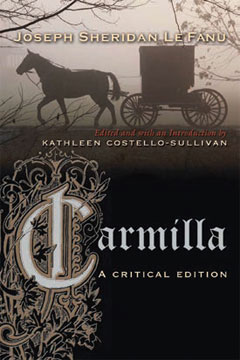
 

Books Read in 2015 – 17. Carmilla by Joseph Sheridan Le Fanu

eclecticreader15 Genre: Horror, Classics, Vampires Narrative Style: First person. Introduced as if part of a doctor’s case-notes Rating 3/5carmilla-240 Published: 1871 Format: Kindle Reading challenges: Eclectic reader challenge 2015 – genre: A story written before I was born. Synopsis: Laura and her father live in a solitary castle in Austria. One night, they witness a terrible coach crash and are persuaded to look after the victims daughter as she is considered too ill to carry on. Strange night time occurrences and appearances begin to bother Laura although she doesn’t immediately associate them with their new guest.  This early vampire story – which pre-dates Dracula by some 26 years – seems quite old-fashioned now. It is a story that has seeped into popular culture. Unfortunately when you then read the original version, it is hard not to feel it is a little predictable. This only shows the extent of the influence of Le Fanu’s story. I particularly enjoyed the opening with its creepy descriptions of the surrounding area and the hints of empty villages and deserted castles. The scene was very effectively set for what was to come. When a friend of the family’s daughter dies in mysterious circumstances just as she was about to visit Laura and the equally mysterious Carmilla appears just days later, the reader knows that something is not quite right. Equally, I found the build up of tension between Laura and Carmilla convincing and interesting. Laura is both attracted and repulsed by her guest and cannot put her finger on why. Carmilla is prone to strange romantic longings with Laura as their focus. These episodes are unsettling to Laura and probably would have been to readers at the time. However, momentum does not quite hold up and the revealing of Carmilla’s vampire status is a bit of an anticlimax. The General – the friend whose daughter died – recounts his own experience with Carmilla in a nearby ruined village. When Carmilla appears, he attempts to attack her but she is too strong for him, thus proving that she is indeed a vampire. At just the right moment, a vampire expert and hunter appears who just happened to know where the hidden tomb of Carmilla is. This ending seems a little rushed and underdeveloped. It’s a shame because I had enjoyed it up until that point.

Books Read in 2015 – 16. Breakfast of Champions – Kurt Vonnegut.

Genre: Satire, Metafiction, Science Fiction

Narrative Style: Third person but with interjections by the character of the author. 

Rating: 4/5

Published: 1973

Synopsis: Science Fiction writer, Kilgore Trout, is invited to an arts festival, much to his horror. Little does he realise exactly what events he will cause when he gives the already unbalanced Dwayne Hoover one of his books to read. The book opens with the idea of the catalytic nature of their meeting and then traces their respective journeys to this point. 

This is probably more about science fiction then it is science fiction as the setting is earth in the seventies. However, there are many descriptions of Trout’s books and stories and there is also a commentary on the place of science fiction as a literary genre (e.g. right at the bottom of the cultural heap) and also on the way science fiction should be read. Hoover speed reads one of Trout’s novels and comes to believe that he is the only man on earth with free will and everyone else is a robot. This causes him to go on a violent rampage where he injures Trout, his girlfriend and his son.

The journeys of both Hoover and Trout, up to this point, are exciting and weird in the way that only Vonnegut’s writing is weird. Hoover suffers from echolalia and hallucinates that the ground is melting while Trout cannot remember who he is talking to and is fascinated by the names on the sides of trucks which seem to make no sense to him. They are joined at the Arts festival by the character of Kurt Vonnegut who wears dark glasses and hides in the shadows so as not to unsettle his creations. This allows Vonnegut (the author) to play with the idea of author as the God of his novels. This is meta-fiction as its best with interesting ideas about writing , authorship and characterisation.

The best – and funniest – part of this novel is undoubtedly the tone and style. The novel is a bit like an idiot’s guide to Earth and so things that are obvious are explained as if they are not. Some of the explanations are hilarious and also send up American culture at that time. There is a strong satirical tone throughout. Very enjoyable.

Books Read in 2015 – 15. My Brilliant Career – Miles Franklin

2015tbrbutton

Genre: Australian Fiction, Classics, Bildungsroman

Narrative Style: First person

Rating: 3/5

Published: 1901miles-franklin-my-brilliant-career

Format: Paperback

Reading Challenges: TBR Challenge

Time on Shelf: About ten years. A relative was selling off some books and she thought I would like it so I bought it but then forgot about it. 

Synopsis: Sybylla Melvyn is headstrong and stubborn. She feels that she doesn’t belong in her community, knowing as she does about music and literature. She hates the monotony of the life in the farming community. She much prefers life at her grandmother’s where she stays for a while. It is here that she meets Harold Beecham who is quickly beguiled by her. Sybylla is not so sure that marriage is what she wants. 

Like many coming of age novels, this may have been more enjoyable to me at a younger age. I did find Sybylla a hard heroine to like. Despite what anyone said to her, she was determined to believe that she was ugly and unloveable and that started to grate after a while. Her behaviour was often odd and I couldn’t really figure her out.

When she meets Harold Beecham, it is immediately obvious that there will be some romance between the two. However, as the blurb on the back declares that Sybylla does not accept his proposal, any tension there might have been was destroyed. Strangely, I found myself wanting Sybylla to accept. Harold was lovely and would have supported her dreams of being a writer. While it is suggested that she refused in order to keep her independence, it seemed to me that she actually refused because of her own perceived unworthiness. Also, the blurb also mentioned that in the film, Harold was played by Sam Neill , one of my early crushes. I know this influenced me, after all, who could say no to Sam Neill?

What I did enjoy were the descriptions of the hardness of life in 1880s Australia. Sybil’s sojourn at her grandmothers is interrupted by the news that due to her father’s drinking, she has to go to work for a man that has loaned him money. When she gets there, she is faced with the horrors of life in poverty. The family are happy but filthy. They cannot afford to eat very much or very well. The children lead Sybylla such a merry dance and the circumstances are so horrible that she becomes ill and has to return to her parents’ home.

Still, it is a testament to Sybylla’s strength of character that she does not accept Harold’s proposal even though it would take her from the monotony of life on the farm. At the end of the novel, she is no further towards her ‘brilliant career’ as a writer and there seems little likelihood that she will escape from her life on the farm. It is a sad ending which did leave me feeling pity for Sybylla.


Books Read in 2015 – 14. The Miniaturist – Jessie Burton (contains spoilers)

Genre: Historical Fiction

Narrative Style: third person, chronologicalUnknown

Rating: 2.5/5

Published: 2014

Format: Kindle

Synopsis: Nella Oortman arrives in Amsterdam to begin her new life as wife to wealthy merchant, Johannes Brandt. Immediately, she notices that things are not what they should be. Johannes is distant and does not come to her bed. His sister is difficult and she and Nella are locked in battle almost immediately. But it is when Johannes buys his wife a cabinet version of their house, to be filled with miniature furniture and figures that things start to fall apart. 

The story at the heart of The Miniaturist is an interesting one and the atmosphere of Amsterdam in the late 1600s is convincingly suffocating, however, I found that I had little interest in reading on and it was a real struggle at times to get it finished.

The story focuses on Nella and her attempts to understand the secrets of those around her. She is young and a country girl and she often misinterprets events. As such, the reader has to try and work out the actual truth, separating it from Nella and her servant, Cornelia’s imaginings. This was quite an easy task and was one of the reasons I felt the novel lacked tension. There were no real surprises.

When the miniaturist starts to send unasked for models that seem to predict events, Nella becomes unsettled. This was interesting and suitably creepy. It was hard to tell whether it was all just in Nella’s head or if the miniaturist really was some sort of witch. This wasn’t resolved which I found a little disappointing.

Finally, the characters were stereotypical and unconvincing. I was intrigued by the story of Johannes and Jack but as the details unfolded it seemed just a bit too familiar. Johannes, the rich merchant with his unholy (at the time) passion for other men and Jack, the whore who would sell out anybody for money were two-dimensional and I felt little for either of them. When Nella first sees Johannes and Jack together, she faints and then wants to report him. But in no time at all, she is supportive of him and so very understanding. There is little sense of why she might have had such a profound change of heart and again it felt a little unconvincing. Similarly, the relationship between Marin, Johannes sister and the negro servant seems too much like a cliche to really involve the reader.

So, for me, the whole thing fell a little flat. Maybe it would have been more interesting if there was more of the other character’s perspectives. Perhaps then they would have been fleshed out a bit more. It left me feeling more than a little empty.

Books Read in 2015 – 13. A Kiss Before Dying – Ira Levin

Genre: American Crime

Narrative Style: 3rd person narration from multiple viewpointsUnknown-1

Rating: 5/5

Published: 1953

Format: Paperback

Synopsis: The future had looked so rosy but then Dorothy announced she was pregnant and all his plans came crashing down. He knows he has to something – indeed he will do anything – to ensure his plans come to fruition. He is a man of ambition and his goal is the millions of wealthy copper ore family, the Kingships. He will stop at nothing, not even murder, to get what he feels he deserves. 

I was familiar with the plot of this story, having seen the film with Matt Dillon in the early 90s so I was eager to see what the book was like. As with other books by Levin, I was impressed to see that the book was even better than the film versions. Levin really was a master of suspense and he certainly kept me reading on.

The novel starts with an unnamed male narrator discovering that his girlfriend, Dorothy Kingship is pregnant. This does not please him but it soon comes clear he feels there is more at stake than merely the loss of his freedom. He has been courting Dorothy with the hope of marrying her and gaining access to her family’s money. If her father discovers the pregnancy, she will be cut off. At first, he tries to make her take pills that will make her miscarry and then, when that doesn’t work, his thoughts take an even darker turn. He cons Dorothy into thinking he will marry her and then lures her on to the roof of the building before pushing her off, making it look like suicide. I must admit, I felt little sympathy for Dorothy and I was more concerned with how he might overcome the obstacles that fate presented for him. It was fascinating to watch the thought processes of a psychopath unfurl. Especially one who thinks he may be getting away with the perfect crime.

In the second part, we are presented with Dorothy’s sister, Ellen who is unconvinced by her sister’s supposed suicide. She has some information about a boy who was seeing Dorothy and she is determined that he had something to do with her death. She meets two men, both of which fit the bill. As the man from the first part is never named, the reader is also in the dark about his identity. I was genuinely surprised when his identity was revealed.

The final part concerns the final sister, recovering slowly from one sister’s suicide and the next one’s murder. She seems to have found the perfect man. He likes all the things she likes. He is a gentleman although he is poor. Now the reader is fully aware that this is the same man from the start and the tension is now whether he will indeed get away with it. The ending was intense and immensely satisfying. It was also a relief. The tension before the end is almost unbearable. An excellent read.

Time, there’s just not enough of it

Well, it seems a long time since I wrote a post that wasn’t a book review. I’m even finding it a bit hard to keep up that end of things. Not from lack of reading. Or from lack of writing. But time is really not working for me at the minute.

My workload at school seems to have exploded. There barely seems to be a spare minute. I decided to work as a supply teacher for exactly this reason but now I am working three days in the same school, I find I am having to do more than I would like. So any spare minutes are spent editing or writing. The blog, unfortunately, is way down the list.

To make matters worse, the school was inspected last week. It is horrible to see the stress this causes teachers. Pressure pushes down from the management team and everyone suffers. It annoys me that most things are now directed towards what is needed for these inspections, not what is best for the pupils. Of course, I understand that these two things are supposed to be the same thing but I really don’t think they are.

Well, it’s over now until the next time, but the tiredness and stress still linger. It makes it hard to concentrate on anything else. Thoughts and ideas are starting to creep back in though and today, I have been writing already and once I have done my school work, then I will do more.

Books Read in 2015 – 12. The Penelopiad by Margaret Atwood

eclecticreader15

Genre: Myth, Feminist

Narrative style: first person with Greek chorus

Rating: 4/5

Published: 2005Unknown

Format: Paperback

Reading Challenges: Eclectic Reader Challenge 2015 – genre rewriting myth

Synopsis: Penelope is left behind when Odysseus goes off to fight in the Trojan Wars. He is then gone for ten years. Penelope has to deal with the rumours about his behaviour and all the suitors who try to convince her he is dead. She cleverly keeps them at bay by sewing and then undoing the shroud she is making. On his return, Odysseus slaughters the suitors and hangs Penelope’s maids, an act which haunts Penelope yet.

I have a fair understanding of The Illiad and know the story of Penelope fairly well. (I researched it when teaching the Carol Ann Duffy poem about Penelope in The World’s Wife, another fab rewriting of the story.) So I was quite excited to see what Atwood would make of it. I was not disappointed.

Atwood’s retelling starts in the fields of Asphodel with Penelope dead and haunted by the death of her maids. She still sees Odysseus (who is still able to trick her into thinking he will stay with her forever) and Helen who she hates. She then begins to tell her story.

Atwood’s Penelope is strong and clever but loses out to the stunning good looks of her cousin Helen. Intelligence in a woman is not appreciated. She has to deal with her mother-in-law who does not approve of her and Odysseus’s nurse, Eurycleia who thinks no one knows Odysseus like her. But she survives through her wit and with the support of her maids.

She sets them to work, like a spy network, to discover what the suitors are really planning. This leads to them being raped by the suitors and Penelope tends them kindly although she does not stop them spying for her. Some of them, she feels, are like her own children. She is closer to them then her son, Telemachus who is little more than a bundle of testosterone and muscle. Ultimately, this is their undoing. As when Odysseus returns he deals with them, second only to the suitors.

The Greek chorus is used to give a different side of the story. Often the chorus is made up of the maids who feel they know the truth of the situation. At one stage, the chorus becomes a modern day court room and Odysseus is put on trial for the crimes of killing the suitors. The maids then appear and demand justice for themselves as well. The scene quickly descends into chaos as the ancient legends mix with a modern court scene.

Finally, it is suggested that Penelope may have been part of a matriarchal goddess cult and so may actually be a lot more powerful than The Iliad gives her credit. Atwood addresses the double standards of the original story – Odysseus is adulterous but expects Penelope to remain pure, for example but the narrative is never merely preachy. Atwood’s women are always complicated and Penelope is not completely innocent, being herself complicit in the deaths of her maids. This is made apparent by her inability to lose them even in death. They follow her around, making forgetting impossible.

Overall, this was funny and clever, typical Atwood in a lot of ways. But really, I wouldn’t have chosen to read this if it was’t Atwood and while it was interesting, Greek myth isn’t really on my list of areas to read about.